Justice and flourishing begin from different questions
The Republic asks whether justice benefits the person who is just, even without reputation or reward. Plato enlarges the problem into a model city, then maps its ordered classes back onto a soul governed by reason rather than appetite or spirit. Nicomachean Ethics asks what human flourishing, or eudaimonia, consists in. Aristotle answers through rational activity over a complete life, virtues trained by habit, practical wisdom, friendship, pleasure, and circumstances partly beyond individual control.
- Justice as order in city and soul: The Republic.
- Flourishing as excellent activity across a life: Nicomachean Ethics.
- Shared insight: character and community cannot be understood in isolation.
Their methods create different kinds of difficulty
Plato’s dialogue moves through objections, analogies, myths, and an ideal construction. Its drama makes the questions memorable, but Socrates’ proposals about education, rule, family, art, and hierarchy demand scrutiny rather than automatic endorsement. Aristotle proceeds by distinctions and revisions: virtue usually aims at a mean relative to a situation, yet practical wisdom must perceive what a general rule cannot settle. The argument can feel slower because terms acquire precision across books.
- In Plato, ask what each analogy illuminates and what it leaves unproved.
- In Aristotle, track definitions across examples before isolating a quotation.
- In both, distinguish a diagnosis of human action from a political recommendation.
Where should a beginner start?
Begin with Nicomachean Ethics if you want concepts for evaluating habits, decisions, friendship, pleasure, and the shape of a life. Begin with The Republic if you want a more dramatic inquiry into justice, education, knowledge, power, and political decline. A productive pairing is to compare Plato’s harmony of the soul with Aristotle’s practical wisdom: one stresses proper rule among parts, while the other stresses judgment formed through practice in particular circumstances.
- Write each book’s question before summarizing its answer.
- Restate one difficult claim in ordinary language and test a counterexample.
- Use introductions and notes for context without letting commentary replace the text.
Sources and scope
Book ideas are attributed to their authors. External evidence is linked directly when a claim needs more than the source book.
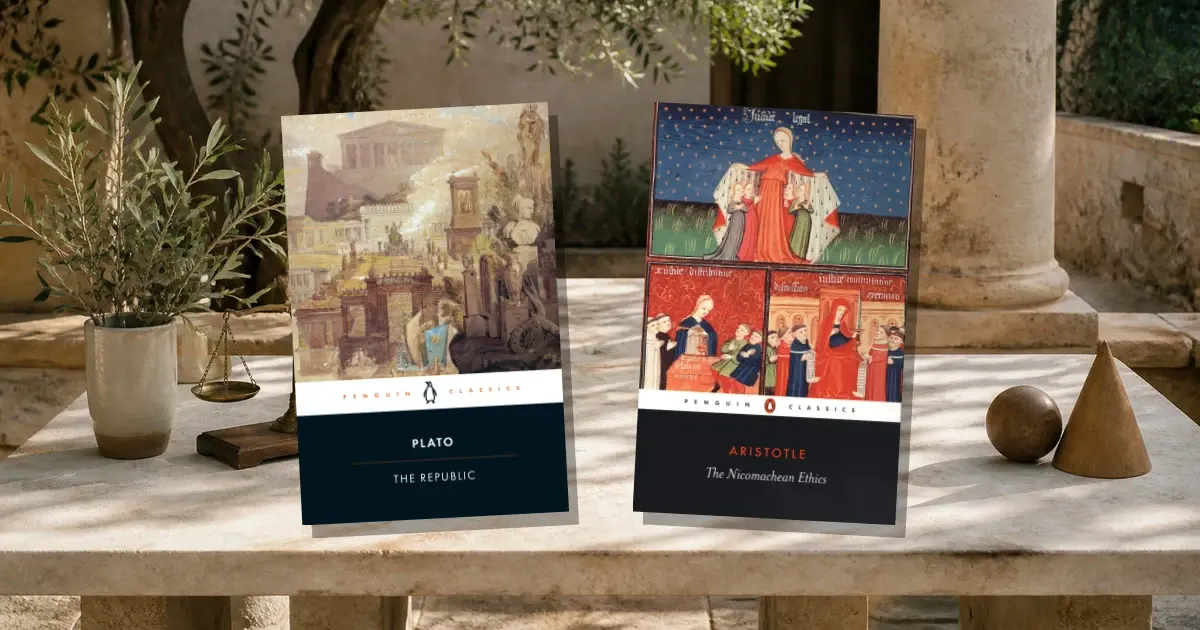
- The Republic: Primary source for Plato’s treatment of justice, the city-soul analogy, education, regimes, and philosopher-rule.
- Nicomachean Ethics: Primary source for Aristotle’s account of flourishing, virtue, practical wisdom, friendship, and pleasure.
To report a factual, attribution, rights, or accessibility concern, email hello@wiseley.app.
Questions readers ask
Is The Republic mainly a political book?
Politics is inseparable from its argument, but the model city also helps Plato investigate the individual soul, education, knowledge, pleasure, and whether justice is intrinsically valuable.
Does Aristotle reject Plato’s approach?
Aristotle shifts toward observation, distinctions, habituation, and context, but the comparison is not a simple rejection. Both connect personal character to communal life and treat reason as central to living well.