What you'll learn
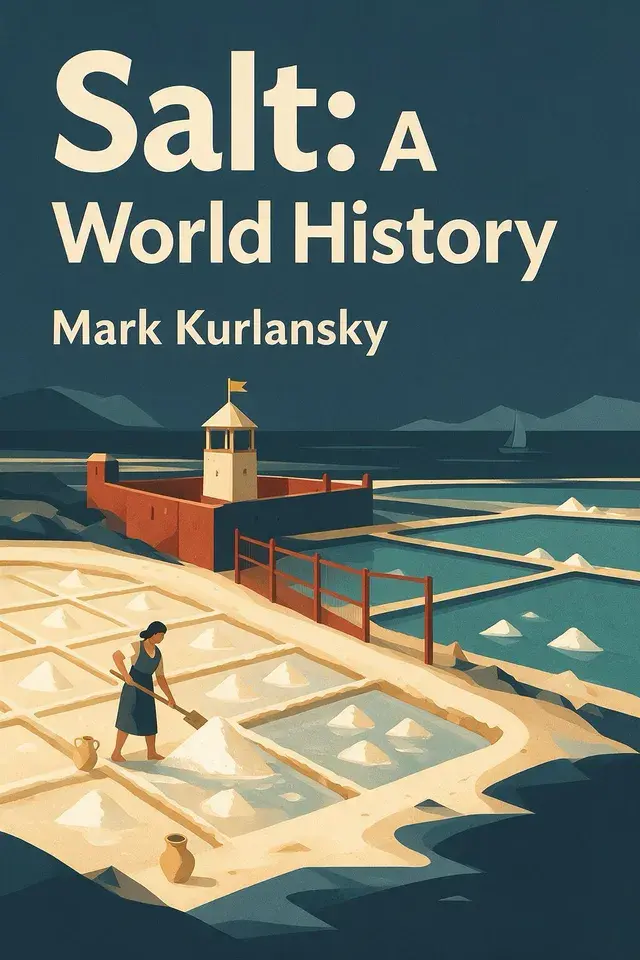
Key ideas from Salt: A World History
These ideas compress the book's argument without treating the author's view as settled fact. Use them as an orientation before reading the full work or listening in Wiseley.
Salt’s biological necessity and resistance to decay made it both a life-supporting substance and a preservation technology.
Venice turned regulated salt movement, subsidies, supplier control, and naval enforcement into commercial and territorial power.
Salt turned Atlantic fish into a movable food supply, linking distant fisheries, ports, and consumers through preservation.
Salt's price and quality shaped class diets, wages, state finance, and access to specialized markets.
Revolutionary blockades turned salt shortage into a test of military survival and governmental self-reliance.
Gandhi made salt a simple national act of nonviolent disobedience, while the wider campaign included state violence and contested negotiations.
Dead Sea water diversion and mineral extraction turn a natural salt landscape into a shrinking, contested system of industry, tourism, and uncertain ecological futures.
Refrigeration reduces salt’s preservative necessity, but cured foods retain value as flavor, memory, and cultural identity.
How Salt: A World History builds its case
Follow how the book develops its argument. Each note is a brief orientation, not a replacement for the chapter.
Why Salt Built Civilizations
Salt looks ordinary only because it is familiar. The book begins with its stranger side: a salt rock at Cardona absorbed moisture, released brine, recrystallized in sunlight, corroded steel, and polished copper.
Empire, Trade, and Regional Foods
Salt becomes a durable institution when administration reaches beyond the saltworks and coordinates prices, routes, labor, and food. Rome, Venice, and the Po Valley reveal three connected forms of that process: imperial supply, commercial regulation, and regional specialization.
The Atlantic Preservation Economy
Salt changed the Atlantic economy by giving marine abundance a future. Fish could be caught in one place, cured there, and eaten far away, but only when salt arrived in time and in a usable form.
Monopoly, Transport, and Class
Once salt's role in preservation had connected distant regions, control of it became a question of sovereignty and price. A ruler could own a mine, but revenue depended on brine, fuel, workers, roads, rivers, and merchants.
Salt, Tax, and Independence
Once salt had become a foundation of food, settlement, and trade, control over it became a political question. Who could reach a spring, lick, marsh, or shore?
War, Industry, and Improvisation
After the Revolution, American salt security began with a simple lesson: shortage could reorganize a community. When trade restrictions cut supplies, Cape Cod salt rose from fifty cents to eight dollars a bushel.
Chemistry, Geology, and Empire
Salt's modern industrial history begins with a change in what the word meant. Earlier writers could call almost any white crystal or flavor-giving substance a salt.
Ecological Limits and Industrial Memory
Modern salt landscapes are more than mineral deposits. They are ecological systems, industrial facilities, tourist spaces, and repositories of practical memory.
Taste After Necessity
Salt’s modern story does not end when refrigeration and factories make heavy salting less necessary. It changes the question.