What you'll learn
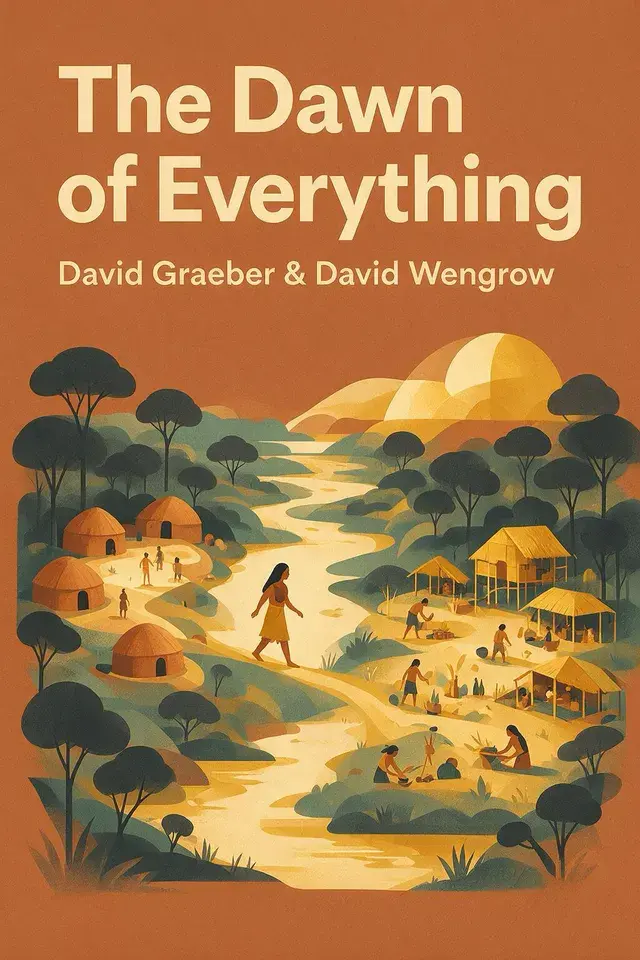
Key ideas from The Dawn of Everything
These ideas compress the book's argument without treating the author's view as settled fact. Use them as an orientation before reading the full work or listening in Wiseley.
Hobbesian and Rousseauian origin stories turn hypothetical arguments into a false evolutionary binary that narrows both evidence and political imagination.
Seasonal movement let communities alternate among dispersed, egalitarian, hierarchical, and coercive forms without making any one arrangement permanent.
The Neolithic transition unfolded through overlapping, reversible experiments rather than one Agricultural Revolution.
Urban scale did not determine monarchy: cities could coordinate through civic institutions without a single sovereign center.
Chavín, Olmec, Aztec, Inca, and Maya combined power differently, challenging one path from complexity to empire.
Osage and Haudenosaunee traditions present councils, female authority, distributed knowledge, and limits on war-making as deliberate constitutional inventions.
Recovering abolished institutions and rejected paths widens political possibility without yielding a final law of history.
How The Dawn of Everything builds its case
Follow how the book develops its argument. Each note is a brief orientation, not a replacement for the chapter.
Against the Single Human Story
Most of human history is inaccessible. Homo sapiens has existed for at least two hundred thousand years, yet evidence reveals only fragments.
Freedom Before the Fall
To ask when inequality began sounds precise, but it assumes humanity began in one condition and then crossed into hierarchy. The deep-time record offers no such baseline.
Foragers and the Politics of Difference
Chapter three rejects the idea that foragers belong to one political category. Some lived in small, mobile communities; others built monuments, permanent settlements, industries, and kingdoms.
Farming Without a Revolution
The Neolithic is often presented as a single turning point: people stop foraging, begin farming, settle permanently, acquire private property, and move toward hierarchy. Graeber and Wengrow treat Agricultural Revolution as a misleading label.
Cities Beyond Kingship
One familiar story of civilization runs like an escalator: farming creates surplus, surplus creates cities, cities require administrators, and administrators become kings. Graeber and Wengrow ask us to stop treating that sequence as natural.
Power Without One State
Rather than locate a single beginning of the state, the authors first question the category itself. Definitions based on a territorial monopoly of legitimate coercion fit modern governments better than many ancient rulers, whose authority could be nominal or geographically narrow.
Roads Not Taken
To rethink civilization, separate it from cities, states, and monuments. Familiar examples—Egypt, Rome, China, and the Inca—were large and accomplished, but also stratified, violent, authoritarian, and often hostile to women’s independence.
Freedom, Not a Lost Beginning
Why did humans become stuck in one social reality? The authors argue that this is more revealing than asking where inequality began.