What you'll learn
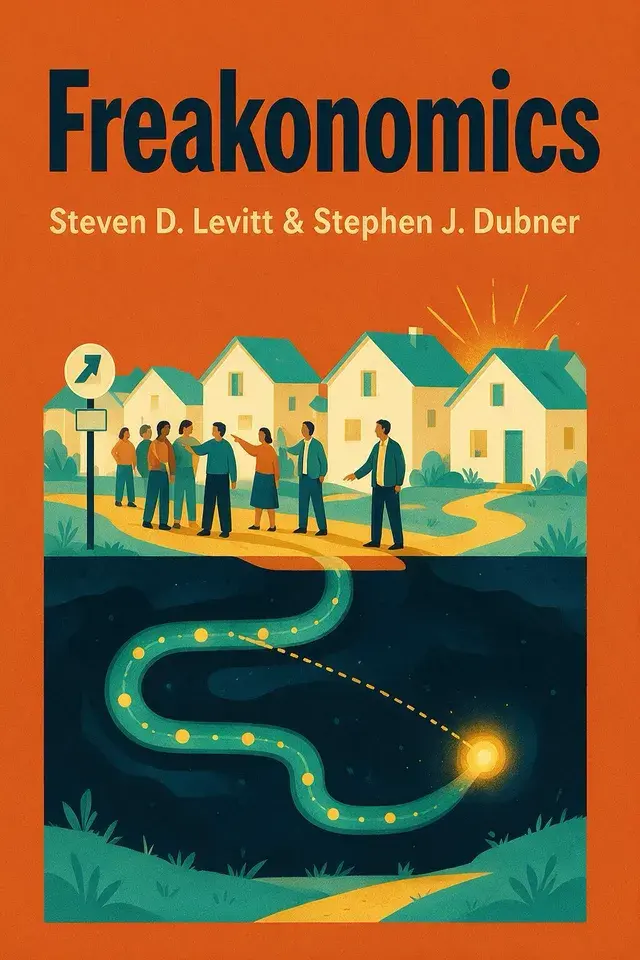
Key ideas from Freakonomics
These ideas compress the book's argument without treating the author's view as settled fact. Use them as an orientation before reading the full work or listening in Wiseley.
The Israeli day-care fine increased lateness after replacing parental guilt with a small price for arriving late.
High-stakes testing created statistical patterns that exposed some teachers’ systematic answer-changing.
Real-estate agents’ longer, more profitable personal sales expose incentives that can favor speed over a client’s highest price.
Crack dealing was a tournament: scarce legitimate opportunities made a dangerous, low-paid route to status appear worth entering.
Expanded imprisonment reduced crime through deterrence and incapacitation, but brought substantial financial and social costs.
Earlier legalization, higher state abortion rates, cohort timing, and evidence from Australia and Canada align with the delayed-causation hypothesis, though they do not settle it.
Chicago’s school lottery showed that better student outcomes can reflect who chooses a school rather than what the school does.
Résumé audits suggest that names affect first impressions, but callbacks cannot explain motives or predict complete careers.
How Freakonomics builds its case
Follow how the book develops its argument. Each note is a brief orientation, not a replacement for the chapter.
Questions Beneath the Obvious
Freakonomics begins with a question about what economics is for. Here, economics is not a narrow catalogue of markets, prices, or national statistics.
When Incentives Change Meaning
An incentive is a reason to act, but it is not always a lever that moves behavior as expected. The chapter separates three kinds.
Cheating, Collusion, and Trust
Once test scores affect promotion, funding, jobs, or bonuses, testing becomes a pressure system as well as a measurement. That pressure can make misconduct invisible to anyone outside the classroom.
Secrecy, Threat, and Disclosure
An organization can be powerful even when it does not use violence constantly. The Ku Klux Klan shows how secrecy, ritual, and a credible threat can make information itself a weapon.
Markets Behind Information Gaps
Markets can preserve unequal power even when facts are public. Information may be scattered, technical, or difficult to use under pressure.
What People Reveal
People do not always say what they believe, and they do not always do what they say. This chapter asks what can be learned from that gap.
The Crack Dealer’s Tournament
Popular images of crack dealing suggested that street dealers were becoming rich. Sudhir Venkatesh’s fieldwork offered a harsher picture.
Why Crime Fell
The crime decline of the 1990s looked like a single reversal, but it resists a single cause. Crime was near a U.S. peak in 1989, after violent crime had risen eighty percent over the previous fifteen years.
A Crime Delayed by Decades
One of the book’s most unsettling arguments begins with timing. A policy may change crime not by altering people already alive, but by changing which children are born.
Risk, Schools, and Selection
Parenting advice often arrives with the confidence of a verdict, even when experts contradict one another and change their minds. The chapter points to reversals over feeding, sleep position, infant stimulation, discipline, and co-sleeping.
What Parents Can Change
The question here is narrower than broad parenting advice: which parental choices change measured performance, and which parental characteristics merely travel with it? The Early Childhood Longitudinal Study, or ECLS, followed more than twenty thousand children from kindergarten through fifth grade.
Names as Social Signals
A name can feel like a parent's first attempt to influence a child's destiny. The Lane brothers turn that intuition into a joke with a serious point.
Clever Comparisons, Open to Revision
Levitt’s method starts with a question that seems too odd or messy for conventional economics. His distinctive contribution is less grand theory than a comparison clever enough to make an unconventional question testable.
Experiments, Enforcement, and Belonging
The book’s empirical habit faces a revealing test when it moves from a person’s kitchen to a city sidewalk and a voting booth. Seth Roberts turns his own body into a long-term laboratory.
Noncash Prices, Visible Choices
Price is more than a number on a receipt. It can include waiting, health consequences, lost time, and social or moral costs.
Chance, Sources, and Adaptation
The selected appendix cases test whether the book’s evidence-first habit survives outside its main investigations. They move from an extreme sports pattern to a disputed historical detail, then to energy, transplantation, and strategic reasoning.
A Method Without One Theme
Freakonomics ends by refusing to give itself a single subject. Its common thread is a method: ask unconventional questions, look closely at what people actually do, and use observation, measurement, and data to test the stories that feel obvious.