What you'll learn
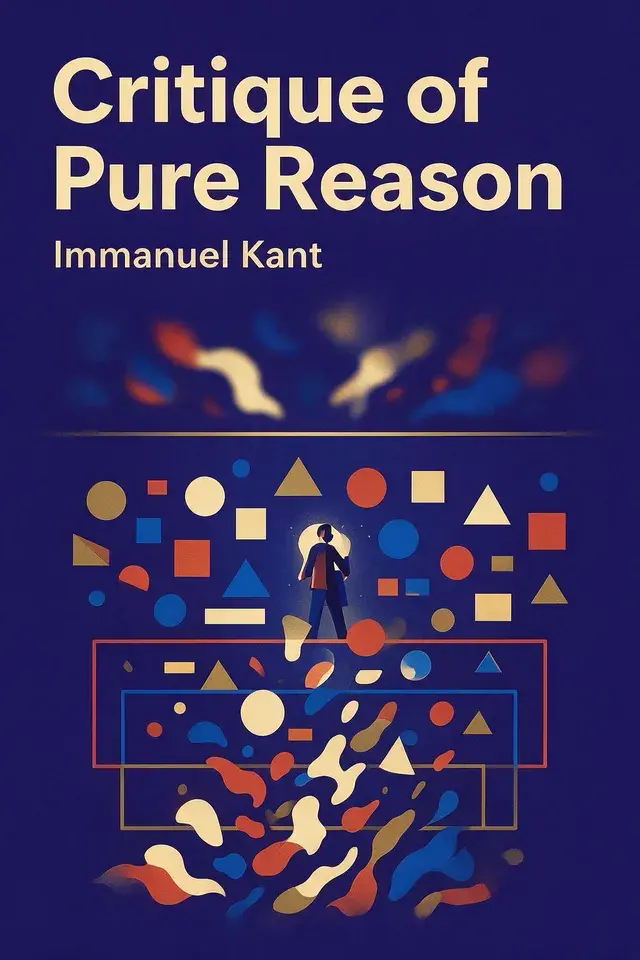
Key ideas from Critique of Pure Reason
These ideas compress the book's argument without treating the author's view as settled fact. Use them as an orientation before reading the full work or listening in Wiseley.
Synthetic a priori judgments add necessary and universal knowledge, making their possibility the central problem of critique.
The Copernican turn explains a priori knowledge by asking how experienced objects conform to cognition’s conditions.
Transcendental idealism preserves empirical objects as appearances without claiming that their spatial and temporal form belongs to things in themselves.
Categories are valid for possible experience, but without sensible intuition they remain empty forms.
The Analogies order experience through persistence, causality, and reciprocal interaction, making objective duration, succession, simultaneity, and natural lawfulness possible.
Reason's search for the unconditioned systematically yields ideas of subject, world, and supreme condition, regulative rather than constitutive.
The dynamical antinomies allow natural law and an intelligible freedom, or possible necessary ground, under different relations.
Moral law supports practical belief in freedom, God, future life, and the highest good without becoming knowledge.
How Critique of Pure Reason builds its case
Follow how the book develops its argument. Each note is a brief orientation, not a replacement for the chapter.
Why Pure Reason Needs Critique
Human reason has a peculiar fate. It is troubled by questions it cannot dismiss, yet cannot answer with the help of experience.
Space, Time, and Appearance
Kant’s Transcendental Aesthetic begins with the receptive side of cognition. Objects are given through sensibility, the capacity to be affected, and intuition is cognition’s immediate relation to what is given.
Categories Make Experience Objective
Kant now turns from what is given in intuition to what the understanding does with it. Sensibility supplies a manifold, while understanding is spontaneous and thinks through concepts.
Rules That Govern Experience
Once the categories have been established as necessary forms of understanding, Kant asks how they can function in actual judgment. A category such as quantity, substance, or causality is pure; no sensory image presents it directly.
From the Limits of Knowledge to the Ideas of Reason
The Analytic has established a secure but bounded territory. The understanding's a priori concepts and principles are made for experience, not for an unrestricted inventory of reality.
The Soul as a False Object
Once reason directs its demand for unconditioned unity toward the subject, it generates rational psychology, the proposed science of the soul. Kant examines a specific mistake: treating the formal conditions of thinking as knowledge of a hidden object.
Antinomies and the World
After the critique has shown why the thinking self cannot be known as a soul, Kant turns to reason’s ideas about the world. Reason takes any conditioned state and asks for the complete series of conditions that makes it possible.
God, Method, and Moral Hope
At the close of the Critique, pure reason has not reached a storehouse of supersensible facts. It has reached a clearer sense of what its ideas can do.