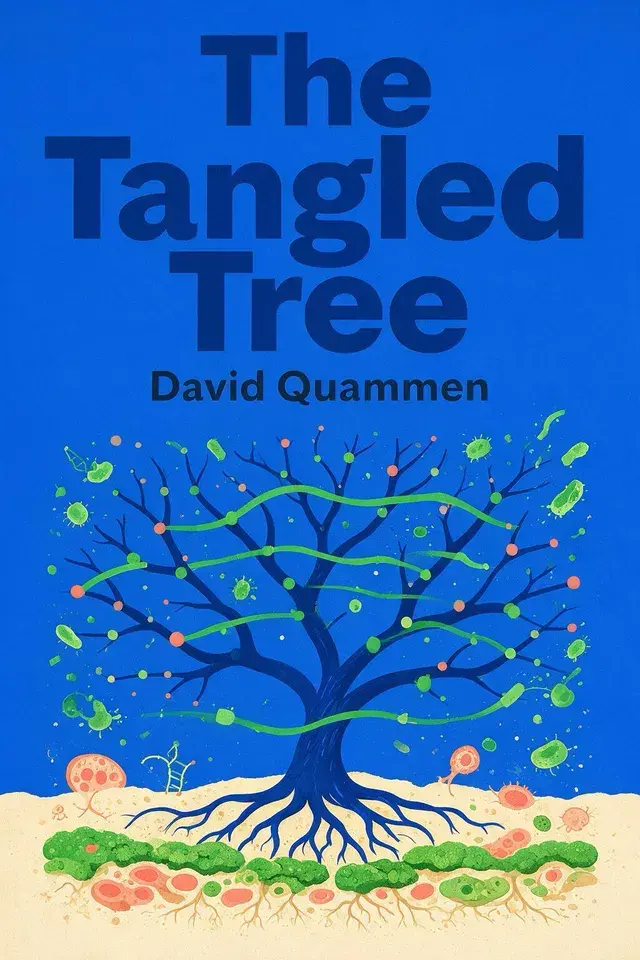
What you'll learn
Key ideas from The Tangled Tree
These ideas compress the book's argument without treating the author's view as settled fact. Use them as an orientation before reading the full work or listening in Wiseley.
Molecular phylogenetics shifted evidence for deep relatedness from visible form toward comparisons among biological sequences.
Methanogen fingerprints differed radically from bacteria and eukaryotes, revealing a third major lineage later called Archaea.
Endosymbiosis explains mitochondria and chloroplasts as captured bacteria that became inherited organelles inside complex cells.
Molecular evidence can expose mergers and conflicting histories, so no single branching diagram is a complete literal history of life.
Transformation uses naked DNA, conjugation uses cell contact, and transduction uses viruses to move bacterial genes.
Complete-genome comparisons show that a gene can carry a different history from the organism that contains it.
Inherited retroviruses are not only genomic fossils: domesticated envelope genes can help construct mammalian placentas.
Hybridization, viral sequences, mitochondria, and symbionts make human species identity composite rather than isolated.
How The Tangled Tree builds its case
Follow how the book develops its argument. Each note is a brief orientation, not a replacement for the chapter.
Darwin’s Tree Meets Molecules
To understand why The Tangled Tree eventually questions the tree of life, begin with Darwin’s encounters with variation. During the Beagle voyage, Galápagos mockingbirds differed from island to island yet remained recognizably similar.
The Third Domain Appears
To reconstruct life’s deepest history, evolutionary biologists needed evidence that reached below fossils, anatomy, and visible form. In 1958, Francis Crick suggested that amino-acid sequences could reveal relationships.
Complex Cells as Ancient Mergers
The molecular reclassification of life also changed how scientists could imagine the complex cell. A eukaryotic cell might not be the product of one lineage gradually adding parts.
Trees, Networks, and Uncertainty
An evolutionary tree looks like a map, but it is closer to a carefully chosen argument. It turns morphology, fossils, embryology, or molecular sequences into a picture of relatedness.
Heredity Moves Sideways
Trees become difficult to read when heredity can move sideways. Besides parent-to-offspring inheritance, a bacterium can receive DNA from outside, acquire a useful trait, and pass it to descendants.
Genome Histories Collide
Chapter 5 showed how resistance genes can move between bacteria. The larger question is what happens when the object of comparison is a complete genome.
Mosaic Bodies and Mobile DNA
Once horizontal gene transfer is understood as a recurring force, the question moves inward. It is not only how genes pass between lineages, but how much of an organism’s working machinery came from elsewhere.
Life Beyond the Simple Tree
The book’s final turn brings its biological argument to a practical threshold. CRISPR began as microbial defense but can now be repurposed to alter mammalian genomes.