What you'll learn
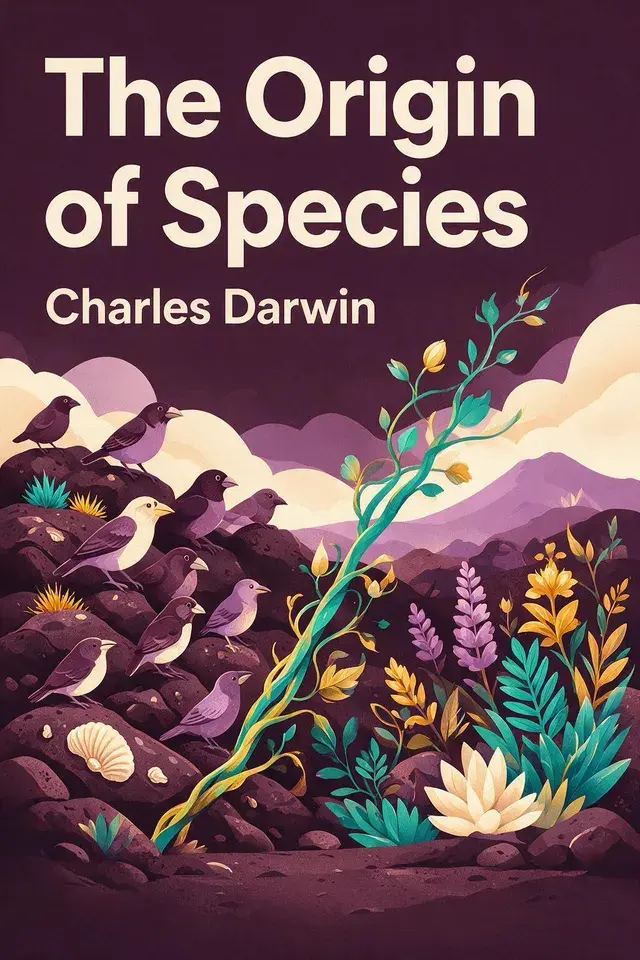
Key ideas from The Origin of Species
These ideas compress the book's argument without treating the author's view as settled fact. Use them as an orientation before reading the full work or listening in Wiseley.
Domestication shows that inherited differences can accumulate through repeated selection into strikingly different breeds.
Geometric reproduction creates more organisms than resources can sustain, making struggle for existence unavoidable.
Natural selection accumulates inherited differences when they alter survival or reproductive success within changing ecological relations.
Finite ecological places make divergence a branching process in which favored forms replace competitors and extinction prunes ancestral connections.
Useful intermediate roles and co-option allow complex organs and habits to develop through small functional changes.
Slow deposition, erosion, uplift, subsidence, migration, and selective fossilization make gradual change appear discontinuous.
Geographical relationships follow historical proximity and barriers more closely than climate alone.
Distribution, fossils, classification, homology, embryology, and rudiments converge as historical evidence for common ancestry.
How The Origin of Species builds its case
Follow how the book develops its argument. Each note is a brief orientation, not a replacement for the chapter.
The Species Problem Begins
Darwin begins with a question about what a species is. Naturalists could recognize many species, yet their affinities, embryological relations, geographical distribution, and geological succession suggested that species were related.
Variation Becomes a Continuum
Having moved from domesticated variation to the natural world, Darwin asks whether nature supplies the same kind of raw material. He argues that it does.
Selection in the Ecological Web
Once inherited differences enter a population’s struggle, reproduction becomes a sorting process. More individuals are born than can survive, so even a slight advantage in survival or reproduction can alter the next generation’s proportions.
What Variation Can Explain
Natural selection can filter only heritable variation, but Darwin is far more confident about this filtering than about its origins. Calling a deviation “chance” means only that its cause is unknown.
Difficulties of Gradual Change
Darwin now turns from presenting natural selection to testing it against its hardest apparent exceptions. If change proceeds through slight inherited differences, why do living species often look sharply separated?
Instincts and Social Inheritance
Darwin narrows instinct to actions that would require human experience but are performed by young animals without instruction, often repeatedly and without knowing their purpose. He declines a strict definition because instinct overlaps with judgment, reason, and habit.
Sterility Without Design
Darwin’s discussion of hybridism asks whether species are separate kinds or diverging lineages. The sterility here differs from sterile social forms: it concerns distinct forms, or their offspring, failing to reproduce together.
Reading a Broken Fossil Record
Fossils are both evidence for descent with modification and the theory’s hardest test. If species arose gradually, rocks should contain countless transitional forms.
Migration Makes a Living Map
The distribution of life gives Darwin an independent test of descent with modification. If climate alone shaped organisms, similar environments should tend to produce similar inhabitants.
Life as a Genealogical Tree
Darwin’s earlier geographical evidence leads to a question about life’s internal order. Organisms resemble one another in descending degrees and can be arranged in groups within groups.
What Descent with Modification Explains
Darwin ends the book by asking what one explanation can make of its many separate observations. His answer is descent with modification: organisms inherit from common ancestors, vary through generations, and diverge as natural selection preserves differences that help them survive and reproduce.