What you'll learn
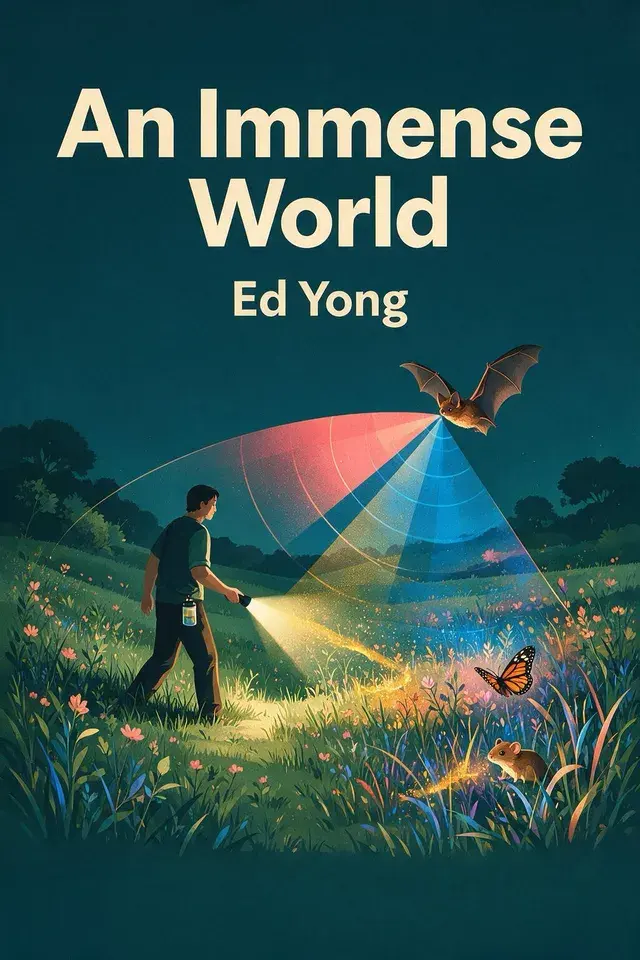
Key ideas from An Immense World
These ideas compress the book's argument without treating the author's view as settled fact. Use them as an orientation before reading the full work or listening in Wiseley.
An Umwelt is an animal’s selective perceptual world, shaped by its body, needs, and evolutionary history.
Smell turns chemical traces into information about identity, history, danger, food, and direction.
Visual systems trade acuity, sensitivity, field, speed, and energy according to ecological demands rather than progressing toward one ideal eye.
Whiskers, lateral lines, and flow-sensitive hairs detect objects and wakes remotely through water and air.
Echolocation turns self-produced sound into active spatial information, with bats and dolphins tuning pulses, echoes, and attention to different environments.
Magnetic compasses provide direction, while magnetic maps link local field combinations to routes, home waters, and natal sites.
An Umwelt emerges from coordinated external senses, bodily feedback, movement, prediction, and neural organization.
Artificial light and noise can shrink perceptual worlds, mask ecological signals, and flatten communities.
How An Immense World builds its case
Follow how the book develops its argument. Each note is a brief orientation, not a replacement for the chapter.
One World, Many Umwelten
Imagine a room containing a human, a mouse, an elephant, a robin, a bat, a spider, and a mosquito. It sounds like one room, but it is not one shared perceptual world.
Chemical Senses Map Life
If every animal inhabits a species-shaped sensory world, chemical senses make that principle vivid. A dog crossing a city samples pavement cracks, hydrants, doorways, and traces left by other animals.
Light, Color, and Meaning
Seeing is not one shared faculty. Light is physical, but vision begins only when an animal’s body turns it into information.
Pain, Heat, and Bodily Limits
Pain can feel like the body's most direct truth: something is wrong, and escape is necessary. Yet the chapter separates two processes often fused.
Touch, Flow, and Vibrations
Touch seems to begin at contact. Yong shows it can be an active way of sampling space.
Sound Builds Invisible Worlds
Sound is movement before it is meaning. A pressure wave compresses and spreads air or water; frequency shapes pitch and amplitude shapes loudness.
Electric Fields, Magnetic Maps
Some animals navigate through fields that humans do not feel. Weakly electric fish make electricity a close-range sensory and social medium, while many animals use Earth’s magnetic field for direction and long-distance travel.
Integration and Threatened Sensescapes
The book’s separate sensory journeys now converge on a larger point: an animal does not experience isolated inputs. Its Umwelt is made as outside signals meet bodily feedback, movement, prediction, and neural organization.