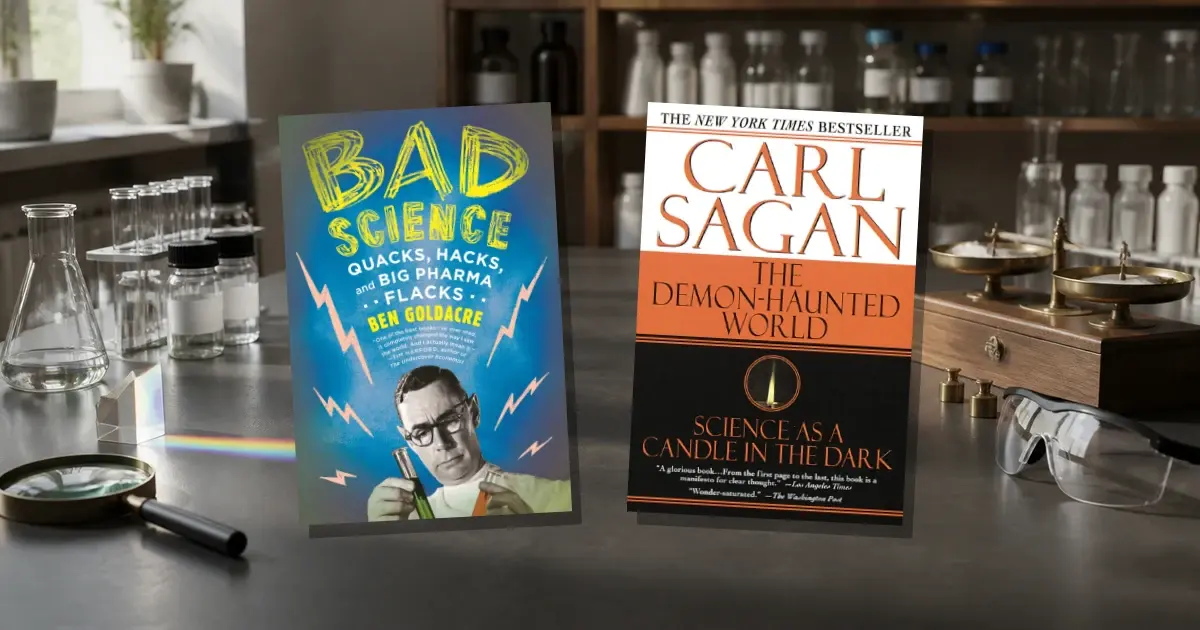
They test claims in different laboratories
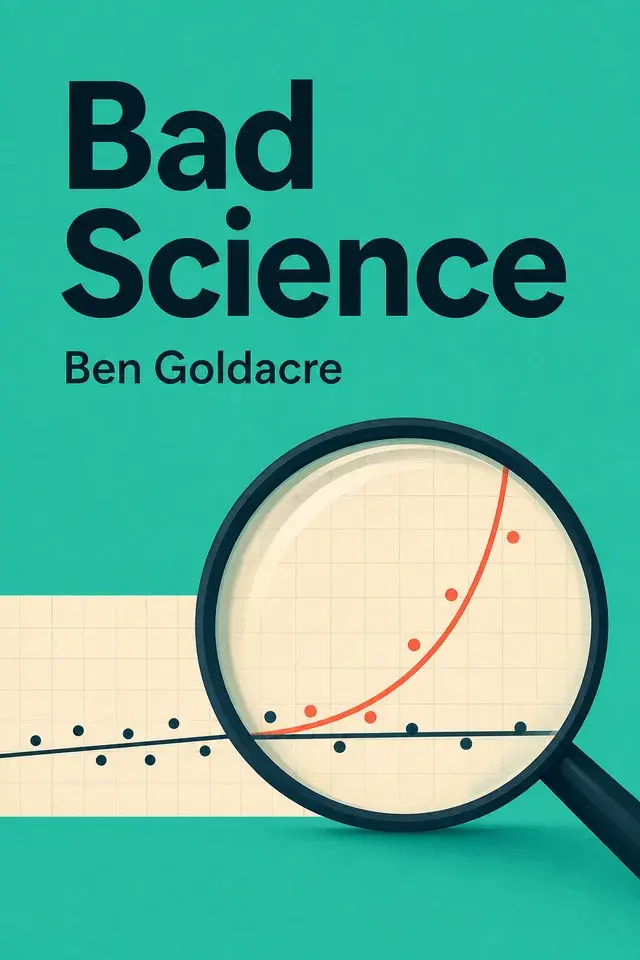
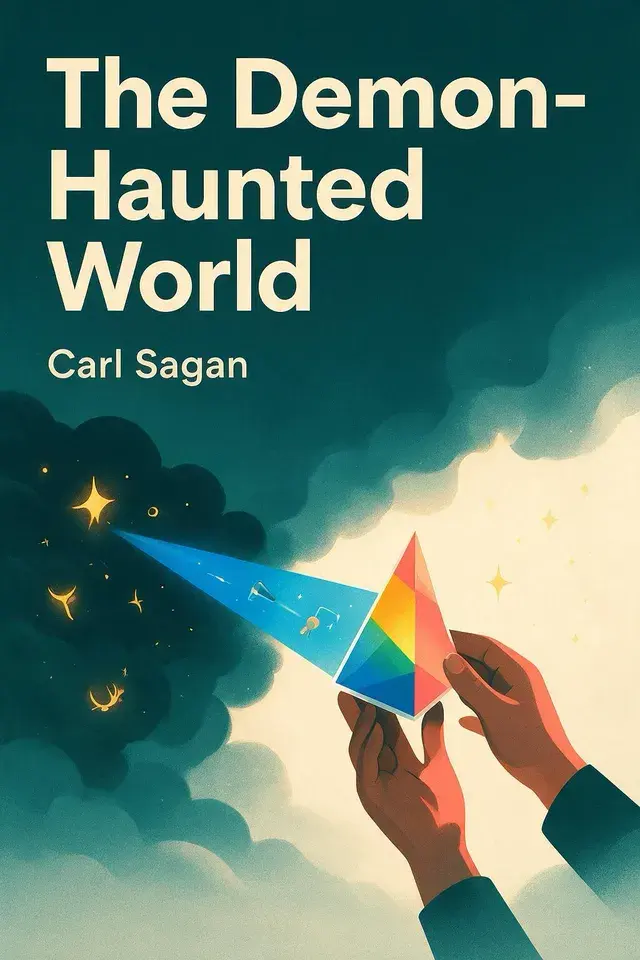
Bad Science works through treatments, nutrition claims, placebos, randomized trials, hidden evidence, statistics, and health reporting. Ben Goldacre shows how scientific language and a plausible mechanism can make a weak test look convincing. The Demon-Haunted World ranges more widely across UFOs, memory, secrecy, education, media, and public life. Carl Sagan asks how wonder can survive disciplined doubt and why a technologically powerful society needs citizens who understand science as a method of correction.
- Clinical trials, effect sizes, reporting, and medical stories: Bad Science.
- A general toolkit for testimony, extraordinary claims, and pseudoscience: The Demon-Haunted World.
- Shared standard: confidence should answer to evidence that could reveal error.
Fair tests and a baloney-detection kit
Goldacre makes comparison groups, random allocation, blinding, measurable outcomes, complete reporting, and denominator choices tangible. Sagan adds independent confirmation, alternative hypotheses, quantification, causal discipline, and the willingness to ask what would disprove a favorite explanation. Each protects against a different shortcut. Methodological rigor without imaginative alternatives can miss the right question; open-mindedness without a fair test can protect any story indefinitely.
- Ask whether the comparison isolates the claimed cause.
- Look for missing data, selective outcomes, and absolute as well as relative effects.
- Demand stronger evidence as a claim becomes more consequential or improbable.
A five-minute claim check
Write the smallest exact claim, including population, intervention or exposure, outcome, and time. Find the original evidence rather than a reposted summary. Identify the comparison and whether assignment, measurement, or selection could explain the result. Generate at least one ordinary alternative explanation. Finally, state what the evidence supports, what it does not support, and what new observation would change your confidence. This sequence combines Goldacre’s trial literacy with Sagan’s disciplined openness.
- Replace “science says” with a named study, method, and measured outcome.
- Separate a helpful behavior from an unsupported mechanism used to market it.
- Leave uncertainty visible instead of forcing a yes-or-no verdict.
Sources and scope
Book ideas are attributed to their authors. External evidence is linked directly when a claim needs more than the source book.
- Bad Science: Primary source for the treatment of fair trials, placebos, statistical errors, commercial incentives, hidden evidence, and media distortion.
- The Demon-Haunted World: Primary source for the skeptical toolkit, alternative hypotheses, memory limits, scientific correction, and civic value of scientific literacy.
To report a factual, attribution, rights, or accessibility concern, email hello@wiseley.app.
Questions readers ask
Which book is more practical?
Bad Science is more procedural for health studies, statistics, and media claims. The Demon-Haunted World travels across more kinds of belief and gives skepticism a broader civic and humane purpose.
Do these books encourage distrusting experts?
They encourage checking methods, incentives, transparency, and correction—not assuming every expert is wrong. Expertise becomes more credible when claims can be examined and errors can be acknowledged.