What you'll learn
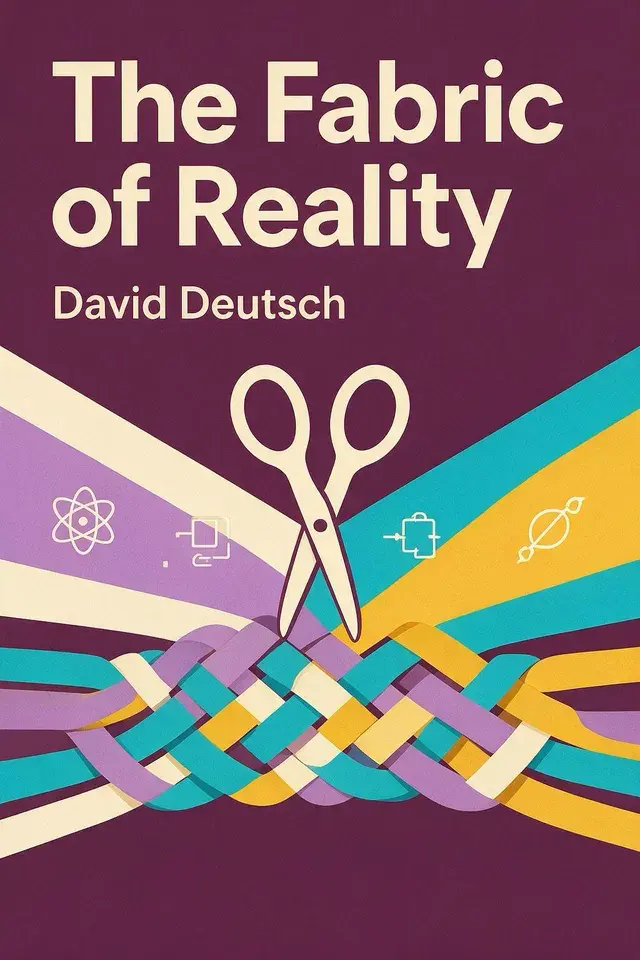
Key ideas from The Fabric of Reality
These ideas compress the book's argument without treating the author's view as settled fact. Use them as an orientation before reading the full work or listening in Wiseley.
Shadow photons provide an inferred counterpart mechanism, while parallel universes group particles that interact normally within branches and weakly across them.
Science advances by conjecturing solutions to problems in existing theories and comparing them through criticism.
Life is fundamental because it embodies and applies knowledge, not because living matter contains a special substance.
Quantum interference can make some predictable physical computations tractable for quantum machines even when classical simulation is intractable.
The present does not objectively move; snapshots form an ordered structure, while “now” is an observer-relative label.
The four strands form a non-hierarchical explanatory fabric in which knowledge is physically embodied and causally effective.
How The Fabric of Reality builds its case
Follow how the book develops its argument. Each note is a brief orientation, not a replacement for the chapter.
Why Explanations Matter
David Deutsch opens by asking what it means to understand something. Understanding is not memorizing every recorded fact.
Shadows and Parallel Worlds
To turn parallel worlds from metaphor into a physical proposal, Deutsch begins with faint light. In an empty, non-reflective room, a torch beam is invisible from the side.
Science as Problem-Solving
Science does not begin with a blank mind collecting observations and then building theories from them. Deutsch rejects that picture, called inductivism.
Explanatory Autonomy and Reality
Scientific theories are about reality, not merely the next sensation. Yet prediction alone permits almost any story.
Virtual Worlds, Universal Machines
Virtual reality turns the earlier test for reality into a working picture of experience. A simulator can make a nonexistent engine or storm seem to push back, but the real source of that complex response is the computer running it.
Evolution Turns Matter Into Knowledge
Earlier, the book rejected induction: future prediction is not justified by a bare rule that the future will resemble the past. Knowledge grows through theories that solve problems.
Quantum Computation Meets Proof
Chapter 7 joins quantum computation to mathematical proof. Both challenge the idea that formal descriptions stand apart from physical reality.
Time Without a Moving Present
Time seems to flow: a present moves along a line of moments, turning future moments into past ones. Deutsch argues that this familiar picture is incoherent.
Time Travel Without Paradox
Time travel begins with a mismatch between an external interval and the traveller’s elapsed time. If an outside clock records more time than the traveller experiences, the traveller has moved into the future relative to it.
A Future Shaped by Knowledge
Deutsch’s conclusion is that the four strands are more than a collection of useful theories. Quantum physics, universal computation, Darwinian evolution, and Popperian epistemology form a non-hierarchical explanatory fabric.