What you'll learn
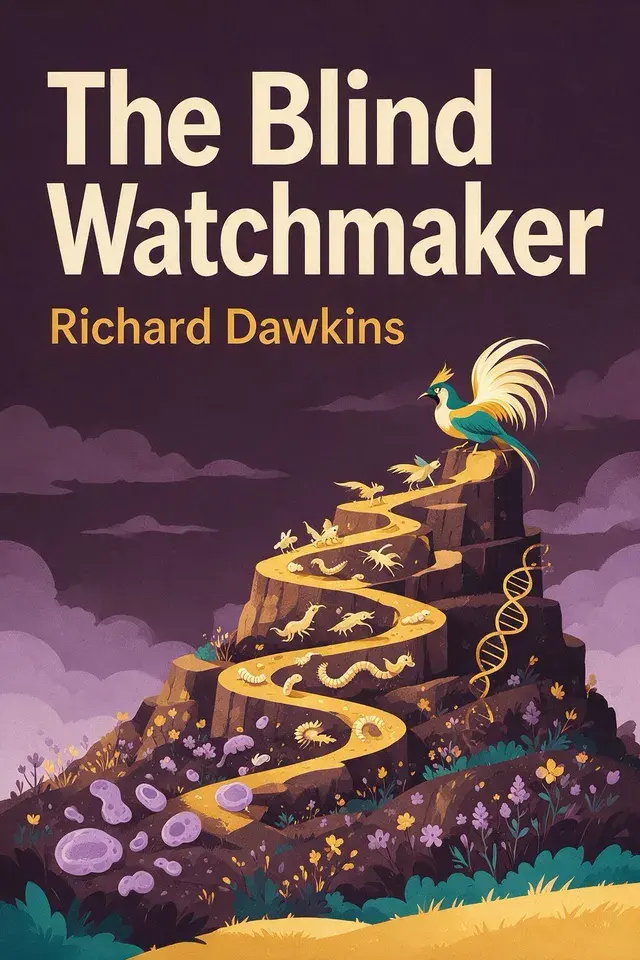
Key ideas from The Blind Watchmaker
These ideas compress the book's argument without treating the author's view as settled fact. Use them as an orientation before reading the full work or listening in Wiseley.
Paley identified the apparent-design problem, while the blind watchmaker names a natural process without foresight or purpose.
Cumulative selection retains small inherited improvements, allowing later generations to build on earlier successes rather than starting again with independent trials.
Partial organs can provide useful functions before reaching modern complexity, while real pathways still require successive viable advantages.
Genes persist as discrete digital information, while organisms are temporary developmental vehicles that carry and express it.
Geographic isolation interrupts gene flow, allowing populations to diverge until hybrid weakness or sterility completes reproductive separation.
Common descent makes biological classification a factual, nested family tree rather than a merely convenient filing system.
Mutation is physically biased and developmentally constrained, yet random with respect to anticipating adaptive advantage.
Higher-order selection can favor developmental systems that generate richer viable variation across generations.
How The Blind Watchmaker builds its case
Follow how the book develops its argument. Each note is a brief orientation, not a replacement for the chapter.
Why Life Looks Designed
Living things create a special explanatory problem. They are not merely complicated because they contain many parts.
The Logic of Cumulative Selection
Once a biological structure looks designed, it is tempting to say evolution could not have produced it. Dawkins calls this an argument from personal incredulity: it reports difficulty imagining a process, not a demonstrated failure.
Paths Through Animal Space
Once cumulative selection is understood as preserving small advantages, the question becomes anatomical: can real organisms move through a huge space of possible forms by workable steps? Dawkins's answer is that they do not leap from one finished design to another.
Genes, Replicators, and Origins
Evolution needs an archive that preserves useful differences while organisms change. The book identifies DNA as that archive, not a special life substance.
Cooperation, Arms Races, and Choice
Once cumulative selection is in place, the question is not only how it weeds out failure. It is how it constructs systems whose parts work together.
Rates, Gaps, and Speciation
Once gradual evolution is understood as change accumulated across generations, another puzzle appears: the history of life often looks abrupt. Fossils show long intervals of little visible change, then a different form appears.
The One Branching Tree
Once evolution is understood as descent through time, classification becomes more than a filing system. A library can be arranged in several equally useful ways.
Rivals of Natural Selection
The remaining question is not whether evolution occurred. The dispute concerns which process can explain organized complexity.
The Evolution of Evolvability
Chapter 8 left an important qualification. Mutation is random with respect to adaptive improvement, but it is not free to produce every imaginable body.