What you'll learn
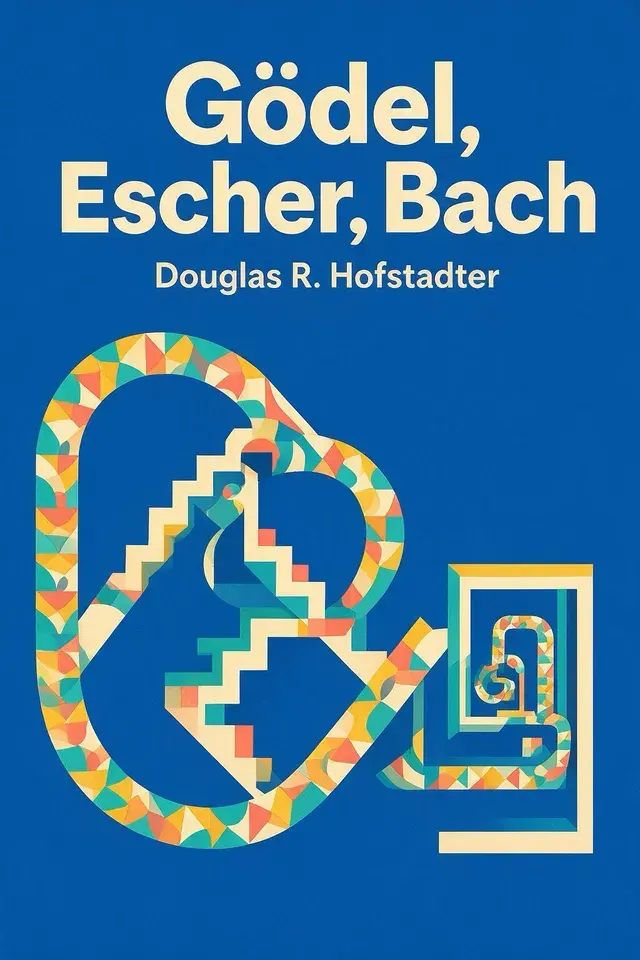
Key ideas from Gödel, Escher, Bach
These ideas compress the book's argument without treating the author's view as settled fact. Use them as an orientation before reading the full work or listening in Wiseley.
Bach’s Musical Offering provides the governing metaphor: one theme can return through transformed levels while remaining recognizably connected to itself.
Assuming TNT’s proofs are reliable, the self-referential Gödel sentence is true but unprovable, so formal completeness has a limit.
Levels of description can hide implementation while preserving real explanatory power, as computer layers and collective organization show.
Adding Gödel sentences enlarges the system, but another diagonal construction still applies to any sufficiently expressive, effectively recognizable, consistent extension.
The Central Dogmap reveals a conceptual kinship between genetic translation and logical self-reference without making biology and logic identical.
Intelligent AI requires useful representations and reframing, not merely more search or rules.
A strange loop lets high-level meaning and agency arise from fixed lower-level rules without requiring an escape from causality.
How Gödel, Escher, Bach builds its case
Follow how the book develops its argument. Each note is a brief orientation, not a replacement for the chapter.
The Pattern Behind Three Arts
At the center of Gödel, Escher, Bach is a question: how can a finite system seem to reach beyond itself by turning back on itself? Hofstadter approaches that question through three different media.
Rules Before Meaning
Before a formal system can mean anything, it must distinguish a legal move from an illegal one. Hofstadter makes that concrete with MIU, a tiny production system using M, I, and U.
Recursion Makes Levels Move
Recursion is often described as a process that refers to itself. Hofstadter’s useful emphasis is operational: recursion is controlled nesting.
TNT and the Gödel Sentence
Once informal logic has exposed how easily ordinary words slide between meanings, the book changes strategy. It builds a language with exact grammar, where every legal proof step is visible.
Levels from Hardware to Mind
The earlier discussion of levels now meets physical systems. One event can be described as bits, machine instructions, a program, or a meaningful activity.
Diagonalization Beats the Decider
After the first Gödel construction, the limit can look like a fact about formulas. This chapter makes it executable.
Self-Reference in Living Code
Self-reference becomes more demanding when an object does not merely describe itself but helps produce another instance. ENIUQ makes this concrete.
AI Needs More Than Rules
Once the book has shown how simple rules can support higher-level organization, artificial intelligence becomes a test. Alan Turing replaces the loaded question, “Can machines think?”
Strange Loops, Beauty, and the Self
At the end of Gödel, Escher, Bach, Hofstadter returns to a problem that has been changing shape throughout the book: how can a system built from fixed parts contain meaning, agency, or a self? A strange loop appears when levels that remain useful and distinct begin to determine one another.