What you'll learn
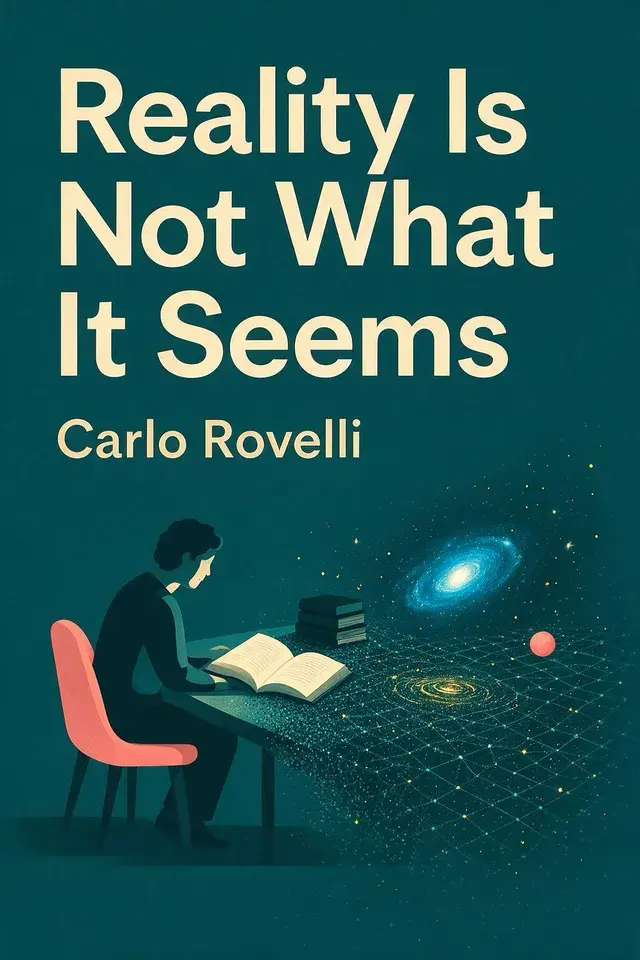
Key ideas from Reality Is Not What It Seems
These ideas compress the book's argument without treating the author's view as settled fact. Use them as an orientation before reading the full work or listening in Wiseley.
Scientific knowledge grows by testing and revising models instead of treating inherited pictures as final reality.
Special relativity fused space and time, removed absolute simultaneity, and unified mass with energy while reconciling mechanics with electromagnetism.
General relativity makes spacetime a dynamic gravitational field whose curvature replaces gravity as a separate force.
Bohr, Heisenberg, and Dirac replace continuous atomic histories with quantized possibilities, interaction-dependent properties, and intrinsically probabilistic predictions.
General relativity and quantum mechanics become incompatible where quantum effects and strong curvature meet.
At the fundamental level, time is not a universal parameter; ordinary temporal order emerges from relations among local processes.
Information is physical correlation and a possible bridge among thermodynamics, quantum theory, and gravity.
How Reality Is Not What It Seems builds its case
Follow how the book develops its argument. Each note is a brief orientation, not a replacement for the chapter.
Atoms, Evidence, and Doubt
Rovelli opens with a methodological claim: science advances by replacing pictures that feel obvious with models that can be examined, criticized, and improved. Human beings repeatedly mistake limited descriptions for reality, so the history of physics is also a history of correcting inherited certainty.
From Local Motion to Universal Laws
Physics grows by replacing limited pictures with broader ones, while preserving what earlier models did well. Aristotle produced the first known systematic physics, and his framework separated the heavens from Earth.
Gravity Becomes Geometry
After special relativity made space and time inseparable, Einstein faced an old difficulty: Newtonian gravity did not fit comfortably with the new picture. Newton could calculate falling bodies and planetary orbits, but gravity still looked like an unexplained influence between distant bodies.
Quantum Mechanics Changes Reality
Quantum mechanics begins where the classical picture of continuous change starts to fail. If general relativity supplies one great pillar of modern physics, quantum theory supplies the other.
The Crisis of Spacetime
Two theories have earned extraordinary trust in modern physics: quantum mechanics and general relativity. Quantum theory describes matter and interactions through discrete, probabilistic events.
Space, Time, and the Cosmos
Once space itself is made from quantum excitations, a further question becomes unavoidable: what does it mean for anything to happen? In ordinary experience, things occupy space and change in time.
Black Holes, Tests, and Infinity
Quantum gravity becomes scientifically interesting at two levels: it must be confronted by nature, and it must clarify what the established theories leave pathological. Rovelli keeps those levels separate.
Information, Emergence, and Mystery
At the end of the book, the central question is how the familiar world—objects, change, memory, and meaning—can arise from a deeper description. Rovelli’s final synthesis brings general relativity, quantum mechanics, thermodynamics, and information into one conversation.