What you'll learn
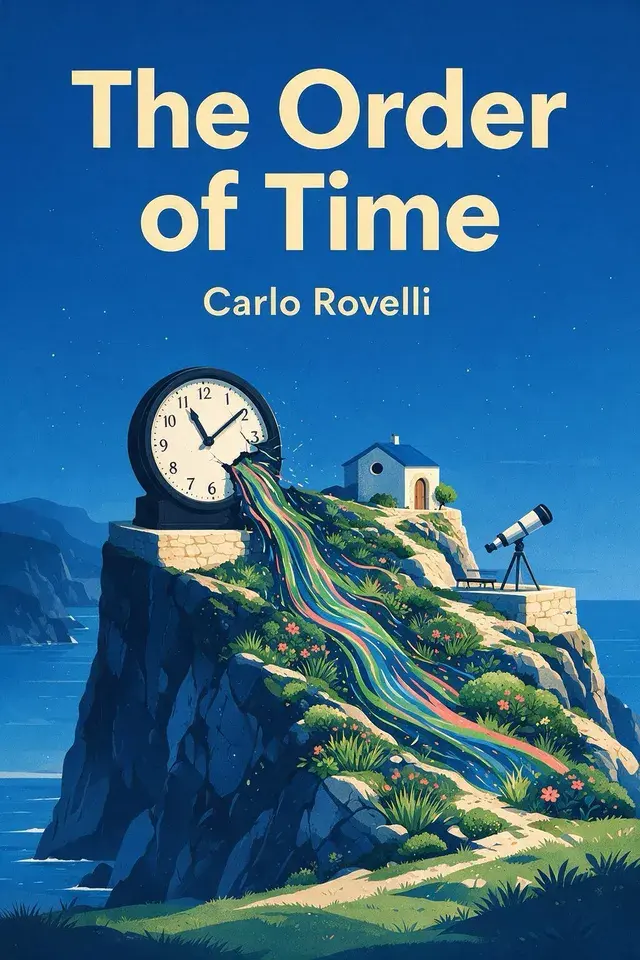
Key ideas from The Order of Time
These ideas compress the book's argument without treating the author's view as settled fact. Use them as an orientation before reading the full work or listening in Wiseley.
Gravity and motion make each object’s proper time dependent on its location and trajectory, so no clock carries a universal duration.
Distant simultaneity has no objective global answer; local presents and synchronization preserve useful temporal relations without creating a cosmic now.
Macroscopic irreversibility comes from heat flowing hot to cold and entropy increasing, not from a time-directed microscopic law.
The statistical account still cannot explain why the universe began in the special low-entropy condition that makes an arrow possible.
Time-free equations describe probabilistic correlations among events, not a universe unfolding against an external clock.
Irreversible heat-producing processes leave physical traces, giving the past records that the future does not yet contain.
Memory turns fading neural traces into continuity, identity, and a narrative linking scattered moments of a life.
How The Order of Time builds its case
Follow how the book develops its argument. Each note is a brief orientation, not a replacement for the chapter.
No Universal Clock or Now
Time seems to be the simplest feature of the world. We imagine one universal clock, ticking everywhere, carrying the present forward from a fixed past toward an open future.
Entropy Gives Time a Direction
The key difference between past and future is not the rate at which time passes. It is that ordinary processes have a recognizable direction.
Events Beneath Smooth Spacetime
Once spacetime is understood as a physical gravitational field, a new question becomes unavoidable: what happens when that field is quantum? Quantum mechanics requires the gravitational field itself to be treated as a quantum entity.
Time from a Situated World
If fundamental equations contain no universal clock, why does time appear to pass for us? Rovelli begins with a change of scale and viewpoint.
Entropy Leaves Traces
Taking the previous qualification as given, the question now is not merely why time seems to flow. It is why the world contains organized activity and physical records that make a direction of time visible.
Memory Builds a Lived Present
Earlier chapters removed a universal clock from fundamental description. They also showed how irreversible processes leave traces, making an effective past available.