What you'll learn
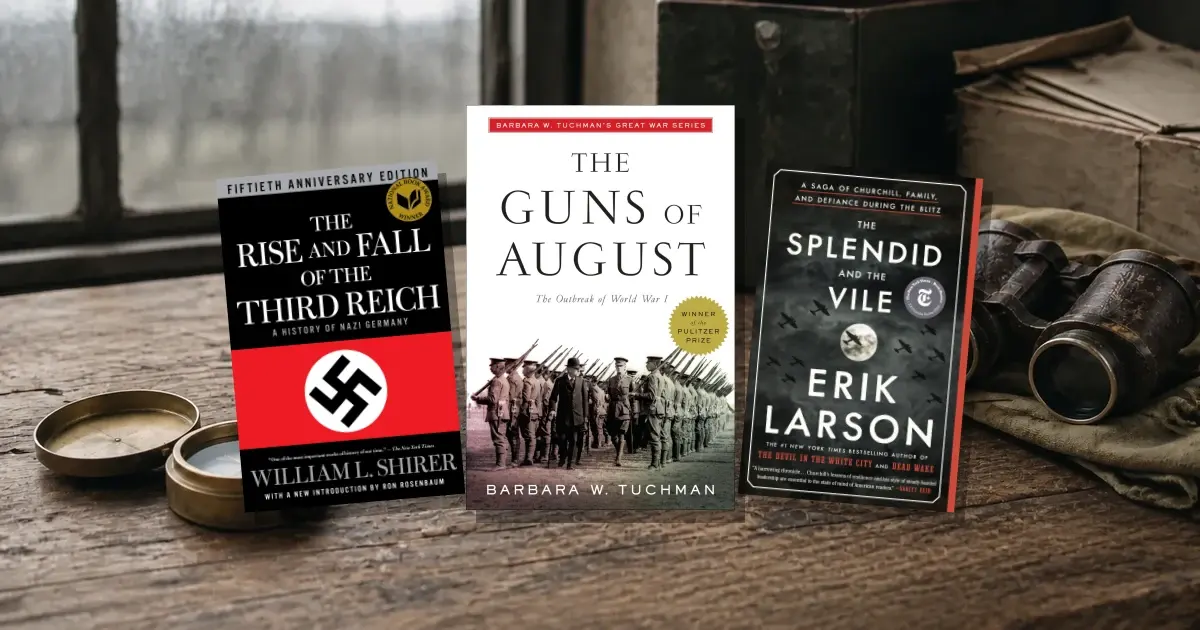
Key ideas from The Splendid and the Vile
These ideas compress the book's argument without treating the author's view as settled fact. Use them as an orientation before reading the full work or listening in Wiseley.
Churchill accelerated government by concentrating responsibility, compressing communication, and making officials answerable for immediate decisions.
Skeptical calculations and a search flight moved Knickebein from an improbable inference to a confirmed signal pattern requiring countermeasures.
Mers el-Kébir converted a feared naval risk into an attack on former allies, producing strategic protection and human loss.
The opening air battle turned on weather, escort range, radar, home territory, intelligence errors, and command choices rather than a simple contest of aircraft.
The Blitz became a daily social system in which work, music, shelter, and routine coexisted with fear and almost certain loss somewhere in London.
Lend-Lease and Hopkins turned public sympathy into contested political aid and a personal Anglo-American channel.
Churchill’s wartime triumph was followed by electoral defeat, showing that a leader suited to survival was not automatically suited to reconstruction.
How The Splendid and the Vile builds its case
Follow how the book develops its argument. Each note is a brief orientation, not a replacement for the chapter.
A Nation Bracing for Disaster
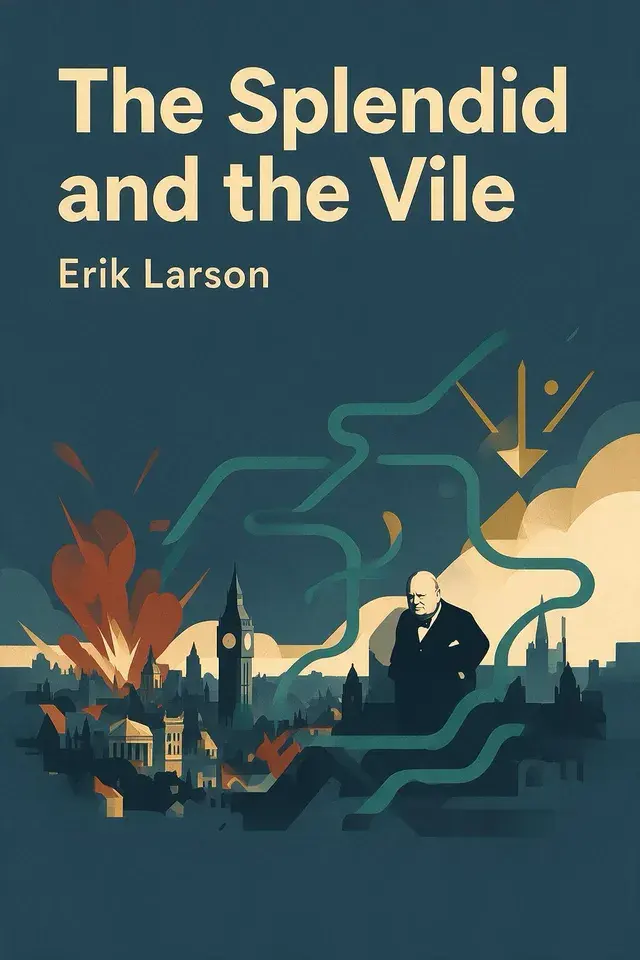
Larson frames The Splendid and the Vile around one year, from May 10, 1940, to May 10, 1941. It is an intimate account of Churchill’s first year as prime minister, built from historical documents and eyewitness testimony.
Power in a Hurry
Churchill’s first achievement as prime minister was not a battlefield victory. It was a faster way of making decisions while the battlefield was collapsing.
Rescue Was Not Victory
At Dunkirk, Britain experienced a rescue that looked like victory because it preserved an army, yet the military facts pointed elsewhere. Operation Dynamo began with grim expectations: the Admiralty expected at most forty-five thousand men, Churchill estimated fifty thousand, and only seven thousand seven hundred reached safety on the first day.
The War of Hidden Signals
As France collapsed and German bases moved closer to England, Britain’s emergency became an information problem as well as a military one. Ground radar offered an advantage, but it could not reliably bring night fighters close enough for visual combat.
Alone Against the Fleet
After France’s armistice, Britain was officially alone. The loss of an ally also gave Churchill strategic freedom: Britain no longer had to coordinate with a collapsing government, but it faced Germany without knowing the French fleet’s fate.
The RAF Takes the Sky
In late summer 1940, invasion was no longer an abstract fear. Parliament, Buckingham Palace, parks, coasts, and towns were fortified, while government advice told civilians to stay home rather than flee.
From Battle to Blitz
On Eagle Day, the Luftwaffe tried to make Britain’s survival an overwhelming test. Göring assembled 949 bombers, 336 dive-bombers, and 1,002 fighters to destroy Fighter Command and clear the way for invasion.
London Becomes the Target
An attack can matter even when it barely damages its target. The first British raid on Berlin killed no one and caused little physical harm, but it punctured Nazi claims that the capital was unreachable.
Living Through the Blitz
The Blitz was not simply a sequence of raids. It became a social system that compressed London’s life into daylight, damaged nights, and repeated adjustment.
The Leader as Target
During the Blitz, Churchill’s body became part of Britain’s war effort. He watched raids from rooftops, visited anti-aircraft sites, walked while bombs fell nearby, and often returned to work instead of entering a shelter.
Aid, Intelligence, and Coventry
Roosevelt’s reelection in November 1940 brought Britain relief. His Electoral College victory was overwhelming, and British officials read it as evidence that American partnership might be closer.
Winter, Shelters, and Rumor
Winter changed the problem Britain faced. The immediate invasion danger eased, but only temporarily.
The Americans Arrive
Roosevelt’s December 29 Fireside Chat opened the American arc by making Britain’s survival an American concern. After reelection, he spoke more freely, called the United States the arsenal of democracy, rejected appeasement, and warned that an Axis victory would put the Americas at the point of a Nazi gun.
A Year of Reversals
Spring 1941 opened with a disturbing contradiction. Londoners still danced as if ordinary life could be protected by habit, even while bombs proved otherwise.
The Vote and the Bombshell
By early May 1941, Churchill’s first year converged on political scrutiny, family uncertainty, technological limits, and sudden catastrophe. Britain had endured, but endurance was not safety.
Beyond Survival, Into Memory
Pearl Harbor changed the meaning of the year, but it did not make victory immediate. In December 1941, Churchill still feared that Hitler might defeat the Soviet Union and turn back toward Britain.