What you'll learn
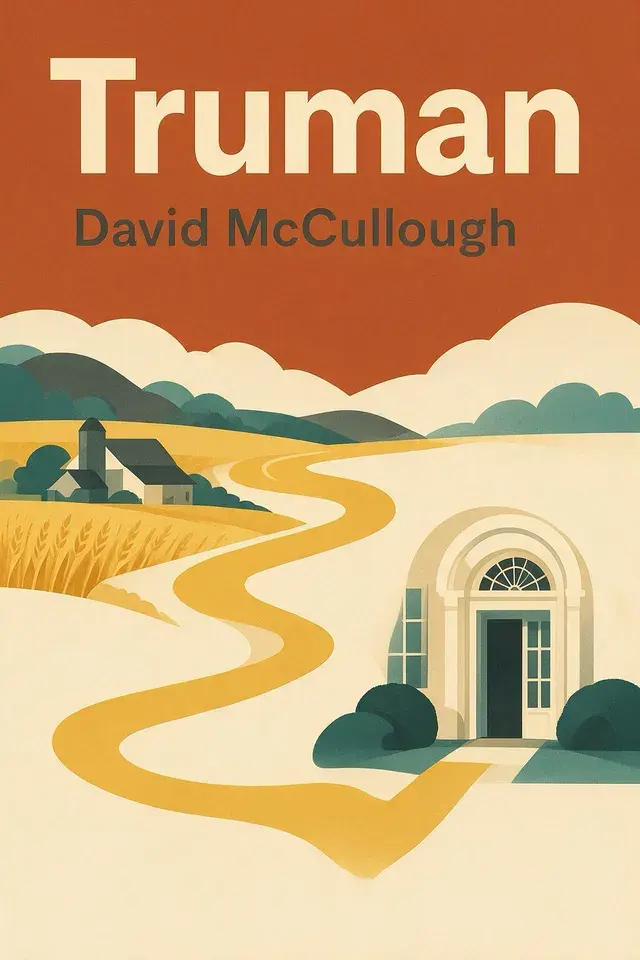
Key ideas from Truman
These ideas compress the book's argument without treating the author's view as settled fact. Use them as an orientation before reading the full work or listening in Wiseley.
Affection, discipline, reading, piano practice, and practical work turned shyness into persistence and close observation.
The committee turned Truman’s diligence and fairness into independent authority through deterrence, reform, and public confidence.
Truman built provisional authority through continuity, direct appeals for help, rapid self-education, and a plain public voice.
Truman's atomic choice combined invasion fears, Japanese resistance, total-war logic, and institutional momentum, while alternatives and moral dissent remained visible.
The Marshall Plan treated European recovery as both humanitarian duty and strategic protection for democratic institutions and the American economy.
The dismissal and hearings established that civilian control outweighed military fame when limited war protected against global escalation.
His final legacy joins decency, resilience, and democratic connection with major errors that no posthumous praise can erase.
How Truman builds its case
Follow how the book develops its argument. Each note is a brief orientation, not a replacement for the chapter.
Frontier Roots, Model Boy
Harry S. Truman was not a ready-made ordinary man. He was formed in a Missouri world shaped by migration, slavery, violence, hardship, and modernization. Families came from Kentucky to Jackson County for fertile soil and a new Eden, encouraged by Missouri’s status as a slave state. Their culture prized hard work, independence, large families, Baptist faith, Democratic politics, and loyalty to their own kind. It could also be narrow, quarrelsome, and hostile to outsiders. Slavery was part of this inheritance, not…
From Farm to Front
Harry Truman’s adult life began with financial ruin rather than a planned career. Within a year of high-school graduation, his father lost nearly forty thousand dollars through wheat speculation.
Machine to Senate
Truman’s route to national office began with the collapse of his haberdashery. In 1922, the business with Eddie Jacobson failed under about $35,000 in debt.
Oversight Makes a Reputation
Truman’s route to national credibility began with a discovery: defense mobilization was an emergency system of overlapping agencies, unclear authority, rushed contracts, and discarded safeguards. Speed brought waste and private advantage.
The Succession Shock
Truman became Franklin Roosevelt’s running mate through a succession emergency disguised as an election problem. Roosevelt’s failing health made the vice presidency potentially decisive, while Democrats calculated which candidate could do the ticket the least harm.
Atomic Choice at Potsdam
By the summer of 1945, Truman faced two linked tests of judgment. One was whether to use a weapon whose wartime power no government had experienced.
Postwar Crisis, Personal Test
Truman entered peace expecting cooperation, but demobilization exposed how different wartime command was from peacetime management. His September 1945 message proposed a twenty-one-point program for employment, wages, housing, and stabilization.
Turning Principle into Policy
By 1947, Truman's presidency had acquired an organized policy center. This was growth under pressure, aided by advisers with experience he lacked.
1948: Principle, Berlin, Victory
By 1948, Truman had to decide whether to seek a presidency he had inherited but never won in his own right. The exact moment is unknown.
Nuclear Fear, Korean War
Truman entered his renewed presidency with a practical sense of obligation. The election had not convinced him he was the best president; it convinced him he was responsible for acting.
MacArthur and Limited War
By late 1950, Korea had become a test of Truman’s role as commander in chief. The retreat toward Pusan exposed how little conventional strength lay behind America’s nuclear superiority.
The Final Tests of Power
After MacArthur’s dismissal, Truman’s presidency entered its most punishing phase. Korea settled into a static war around the thirty-eighth parallel, with fortified hills, failed talks, and mounting casualties.
Citizen Truman, Living Legacy
Leaving the White House did not make Harry Truman private. He returned to Independence hoping to become just another citizen, but fame and his appetite for useful work kept public identity close.