What you'll learn
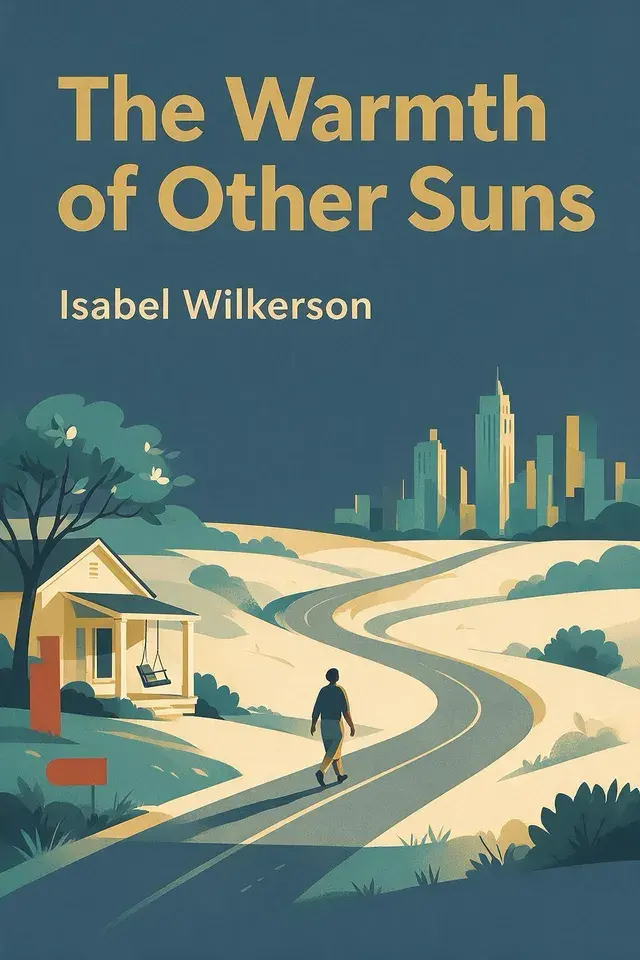
Key ideas from The Warmth of Other Suns
These ideas compress the book's argument without treating the author's view as settled fact. Use them as an orientation before reading the full work or listening in Wiseley.
Together, the three biographies make a leaderless, six-decade movement legible as millions of private acts of independence, escape, and possibility.
Reconstruction’s civic gains were reversed into a legally enforced caste system that restored racial hierarchy and preserved Black dependence.
World War I created destinations and labor demand that turned separate departures into a mass movement, but only temporarily widened leverage.
Its long distances and escape from Jim Crow make the movement more refugee-like than a simple search for nearby jobs.
Kin networks routed migrants toward cities and offered shelter, referrals, and orientation, but Milwaukee’s shrinking labor market limited what connections could secure.
Migrants made segregated districts into institutional and cultural worlds, even when overcrowding and racialized rents confined them.
Northern exclusion was decentralized, but housing barriers, police, custom, and white flight still reproduced racial inequality.
Leaving reshaped descendants, education, politics, cities, Southern society, and American culture across generations.
How The Warmth of Other Suns builds its case
Follow how the book develops its argument. Each note is a brief orientation, not a replacement for the chapter.
Three Decisions, One Movement
Three people can leave the same region for entirely different reasons. In 1937, Ida Mae Brandon Gladney prepared to leave Mississippi with her husband and young children.
The World That Made Leaving Necessary
To understand why leaving became thinkable, Wilkerson first shows what the South had made unlivable. After the Civil War, Reconstruction briefly opened a different future for Black Southerners.
Ambition Behind the Color Line
For Robert Joseph Pershing Foster, migration begins as an inner rehearsal. Before he physically leaves Monroe, he learns to imagine a different life, perform the person who might inhabit it, and measure himself against the limits around him.
Work, Debt, and Small Defiance
Work is where Jim Crow became a daily calculation. In Mississippi, Ida Mae and her husband lived in a fragile cabin on Edd Pearson’s cotton plantation, giving their best hours to the fields.
The Triggers of Departure
Accumulated injury does not automatically become departure. The decision arrives when the danger of staying enters a person’s home, body, or future—and when somewhere else begins to look possible.
Leaving Before the Future Is Known
Once immediate triggers have made leaving imaginable, the question changes. How does a movement grow when no single person directs it?
Crossing the Racial Border
Leaving the South was not a single moment when a traveler crossed a line and became free. It was a passage through shifting racial borders.
Arrival in Unfamiliar Cities
Arrival did not feel like a smooth beginning. For migrants leaving the rural South, the first Northern or Western city could seem like another world: full of possibility, but also speed, scale, and unfamiliar rules.
Building Lives Under Constraint
Migration did not end when a train reached Chicago, New York, or Los Angeles. It became a second task: making a city partly one’s own.
Rights, Networks, and Risk
Migration opened doors, but a door was not safe passage. In receiving cities, people could vote, earn wages, seek care, travel, and challenge officials.
When the North Disappoints
The Great Migration promised safety, work, and room to become someone else. Yet Wilkerson shows that the North was freer than the South without becoming free of racial power.
Revolutions and the Next Generation
The North’s disappointments became a civil-rights battlefield. They also changed what freedom meant for children raised after the Great Migration.
The Costs of Success
By the 1970s, migration had improved the material terms of life without healing every wound. Wilkerson presents the aftermath as reciprocal: migrants altered the economic, social, and political life of cities, while cities changed them in return.
Cities, Children, and Afterlives
By old age, the Great Migration has produced visible results without a clean victory. Robert lives in a California house, has a medical reputation, and raised daughters who avoided segregated Southern schools.
Return, Ritual, and Belonging
These lives end in double belonging: the North holds what migrants built, while the South survives through memory, worship, food, kinship, and mourning. In Los Angeles, the Monroe Club brings together ten of sixteen surviving members, all over sixty, with no new Monroe members.
What Leaving Changed
The Great Migration changed more than where millions of Black southerners lived. It changed what freedom could mean in the United States.