What you'll learn
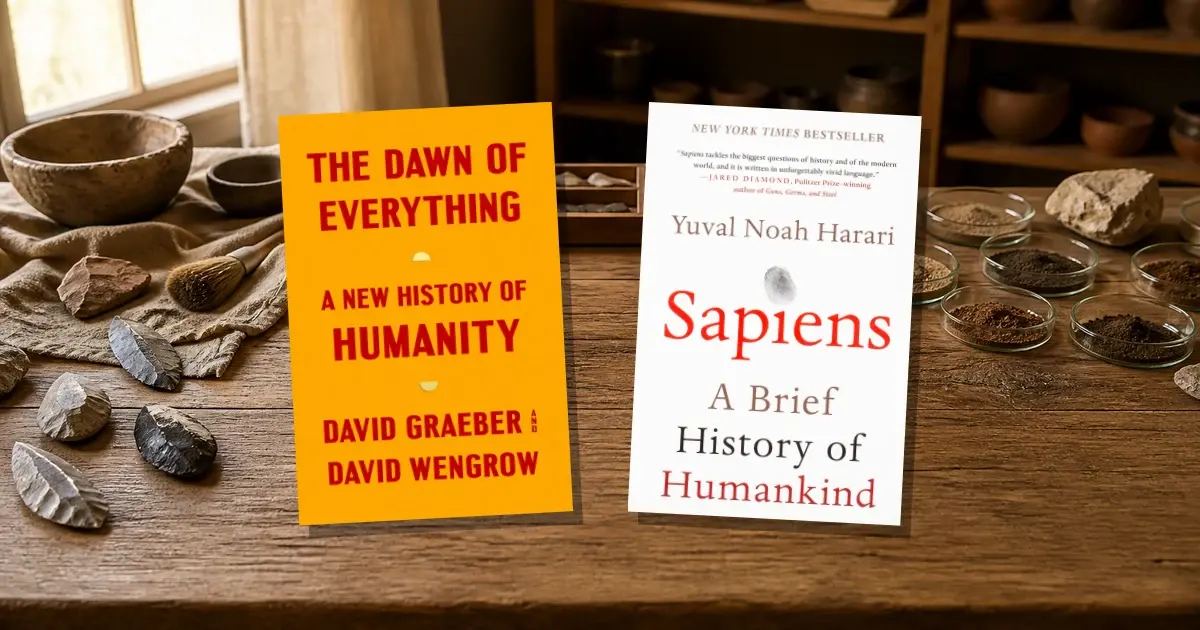
Key ideas from Sapiens: A Brief History of Humankind
These ideas compress the book's argument without treating the author's view as settled fact. Use them as an orientation before reading the full work or listening in Wiseley.
Flexible language carried practical information and social knowledge, then expanded into shared fictions that let strangers cooperate.
Agriculture increased food and population capacity, but often reduced individual health, diet diversity, security, and leisure while benefiting elites.
Money’s value is intersubjective: tokens work because people trust that others will accept them.
The Scientific Revolution made admitted ignorance, observation, mathematics, and practical power the basis of a self-correcting program of knowledge.
Modern growth turns trust in future productivity into credit, reinvestment, and expanding production.
Modern collective capability can expand without establishing that individual happiness increased.
The future remains uncertain, but humans must influence what they become and what future desires should be.
How Sapiens: A Brief History of Humankind builds its case
Follow how the book develops its argument. Each note is a brief orientation, not a replacement for the chapter.
The Fiction-Making Ape
Sapiens begins with a puzzle: for most of its existence, it was not the obvious ruler of anything. Humanlike animals appeared about 2.5 million years ago, yet for countless generations they had no more environmental impact than other organisms.
Foragers and the First Extinction
To understand Sapiens’ cognitive power, we have to leave abstractions and enter the lives of foragers. For nearly all human history, people lived in small, mobile bands.
Agriculture’s Human Bargain
For most of its existence, Sapiens lived by gathering and hunting organisms that reproduced without human management. Around ten thousand years ago, people began devoting more time to selected plants and animals.
Imagined Orders and Writing
Once farming generated reserves beyond immediate consumption, it created a coordination problem. Food could support people who did not grow it, so villages expanded into towns, cities, kingdoms, and commercial networks.
Hierarchy, Gender, and Unity
Large societies need categories that tell strangers how to treat one another. Hierarchies rank people and distribute rights, resources, and punishment.
Money’s Universal Trust
Money becomes necessary when economic cooperation outgrows personal familiarity. Hunter-gatherer bands and most early villages were largely self-sufficient, relying on favours, obligations, and limited barter.
Empires, Religions, and Humanism
Beyond economic exchange, large societies also depended on political orders that made strangers part of one world. An empire ruled culturally distinct peoples under one political umbrella, with borders flexible enough to absorb more territory.
Science, Empire, and Knowledge
Modern science did not arrive as history’s inevitable destination. Hindsight makes its victory look unavoidable, but every historical moment held several futures.
Credit, Capital, and Industry
Modern capitalism rested on confidence in the future. Earlier economies often treated wealth as a fixed pie, so one person’s gain meant another’s loss.
Modernity’s Social Contract
Modernity did not merely add machines to an old society. It reorganized the conditions of ordinary life.
The Happiness Problem
Modernity poses a personal question: did gaining power over the world make people happier? The last five centuries expanded wealth, knowledge, and collective capability.
Becoming Something Else
At the start of this final turn, the book places Sapiens within physics, chemistry, biology, and natural selection. That process shaped life without a planner: inherited variations spread when they helped organisms survive and reproduce.