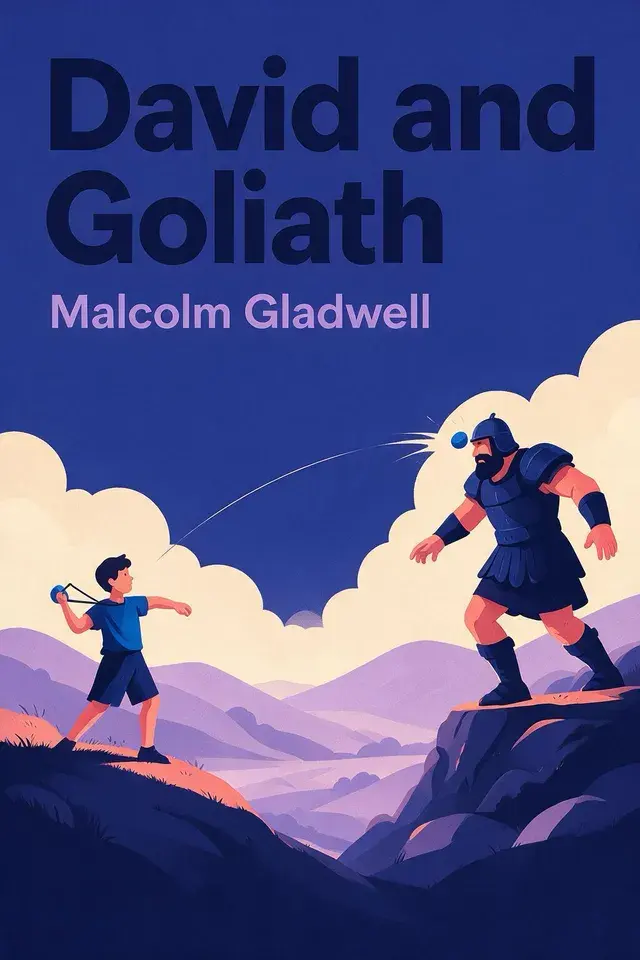
What you'll learn
Key ideas from David and Goliath
These ideas compress the book's argument without treating the author's view as settled fact. Use them as an orientation before reading the full work or listening in Wiseley.
Underdog tactics gain leverage through fit, sustained effort, and willingness to reject established rules, but they remain demanding and defeasible.
The inverted-U makes clear that more of an apparent advantage can flatten, reverse, or become harmful.
Relative standing can diminish a capable student’s confidence and persistence even when objective ability remains high.
Hardship’s possible value lies in the fit and support surrounding adaptation, not in suffering itself.
Birmingham turned an opponent’s predictable repression into public evidence of segregation’s brutality.
Authority depends on legitimacy: people cooperate more when rules are predictable, fair, and responsive to their experience.
Punishment can deter or incapacitate, yet impulsive offending and large-scale incarceration can make harsher policy ineffective or counterproductive.
How David and Goliath builds its case
Follow how the book develops its argument. Each note is a brief orientation, not a replacement for the chapter.
The Underdog’s Hidden Weapon
The opening scene in David and Goliath unfolds in the Shephelah, a region whose valleys gave armies routes from the coast toward the Judaean highlands. The Philistines had moved through the Elah Valley toward the ridge near Bethlehem, while the Israelites faced them across a ravine.
When More Becomes Less
An advantage is not always a straight line. More can help at first, then bring smaller gains, stop mattering, and finally cause harm.
The Cost of the Big Pond
An apparent advantage can become a liability in the wrong setting. Caroline Sacks’s experience at Brown shows why.
What Hardship Can Teach
Hardship can teach, but it does not teach everyone the same lesson. The book distinguishes learned compensation from an altered response to danger.
Winning by Provoking Power
An underdog movement does not always win by becoming stronger. Sometimes it wins by arranging a confrontation in which the stronger side’s normal response becomes evidence against it.
Why Force Loses Legitimacy
Power can force a person to act, but it cannot force that person to believe the authority is entitled to command. That distinction is central to Malcolm Gladwell’s account of Belfast and Brownsville.
The Limits of Punishment
Punishment has a limit. Moving from no effective penalty to some penalty can restore order: during Montreal’s sixteen-hour police strike, robbery, looting, and violence spread, then ended when police returned.