What you'll learn
Key ideas from Hillbilly Elegy
These ideas compress the book's argument without treating the author's view as settled fact. Use them as an orientation before reading the full work or listening in Wiseley.
Economic decline matters, but Vance argues that agency, choices, and blame-shifting also shape social decay.
Armco and migrant networks created real material mobility, but transplanted Appalachian ties also carried stigma, cultural unease, and incomplete belonging.
Schools and families communicated opportunity through omissions and intervention: low expectations narrowed horizons, while patient instruction exposed knowledge gaps.
Instability becomes a child’s repeated loss of safety, authority, and dependable attachment.
Mamaw’s demanding rules and educational sacrifices gave stability a practical form: better grades, work habits, and a future Vance could imagine.
The Marines revise Vance’s belief in effort while leaving room for ability, family support, and luck.
Social capital provides access, information, mentorship, and economic options that formal achievement alone cannot reliably provide.
Small interventions can improve children’s odds through kinship care, early help, and less segregated housing.
How Hillbilly Elegy builds its case
Follow how the book develops its argument. Each note is a brief orientation, not a replacement for the chapter.
Home, Class, and Contradiction
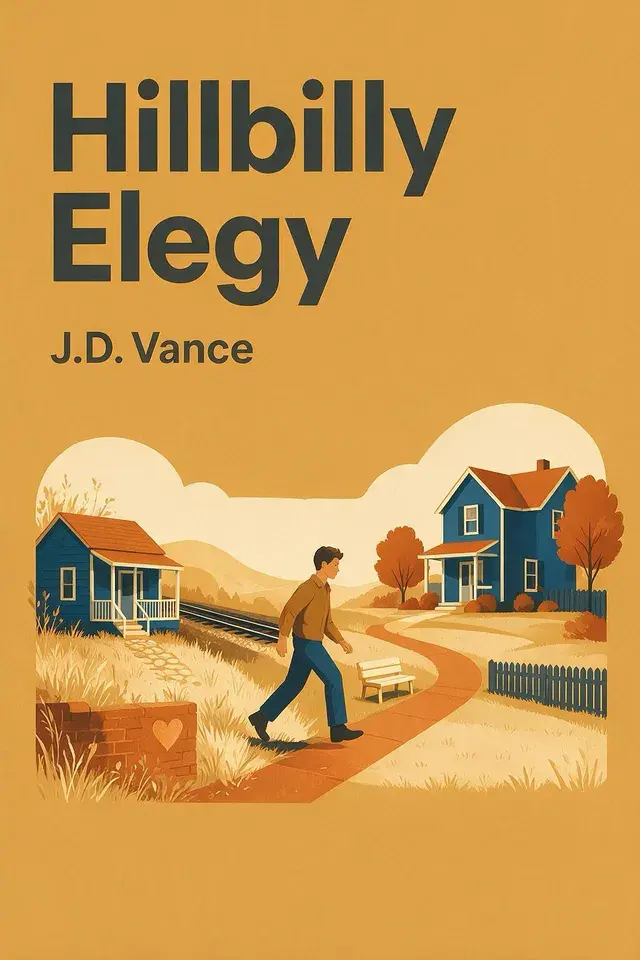
Why write a memoir about an ordinary life? That question opens Hillbilly Elegy. J. D. Vance notes that graduating from Yale Law School may sound extraordinary, yet he treats a stable career, marriage, and home as ordinary goals. What seems unusual is reaching them from his circumstances. He grew up amid poverty, addiction, unstable family life, and limited educational opportunity. The book asks what it feels like to nearly give up on yourself, how material and spiritual poverty shape children, how upward mobility…
Migration, Opportunity, and Inheritance
Migration in Vance’s family story begins as both an economic escape and a private emergency. Mamaw and Papaw married as teenagers in 1947, when staying near coal work meant accepting the limits of Appalachian poverty.
A Town Losing Its Future
Middletown does not collapse in a single dramatic event. In Vance’s account, it erodes slowly enough that residents can miss the change while living through it.
Chaos, Faith, and Attachment
Instability enters J.D. Vance’s childhood not as a theory about class but as adults who disappear, homes that change, and arguments that make ordinary life unsafe.
The Adult Who Redirected Him
One of the clearest turning points in Vance’s life began with a request no child should have had to manage. His mother needed a clean urine sample because the nursing board required random testing to preserve her license.
Learning Agency Through Service
Vance’s movement toward adulthood begins with an awkward lesson about belonging. Mamaw encourages golf because she associates it with wealthy business culture.
Mobility, Networks, and Old Wounds
After the Marines, Ohio State offers Vance an early picture of upward mobility. In 2007, classes seem manageable, Columbus is growing, and opportunities remain close enough to Middletown that leaving does not feel like exile.
Luck, Responsibility, and Repair
By the end of the book, Vance has a home, a marriage, professional prospects, and a stable life in Cincinnati. Yet his past can still arrive at his door.