What you'll learn
Key ideas from Born a Crime
These ideas compress the book's argument without treating the author's view as settled fact. Use them as an orientation before reading the full work or listening in Wiseley.
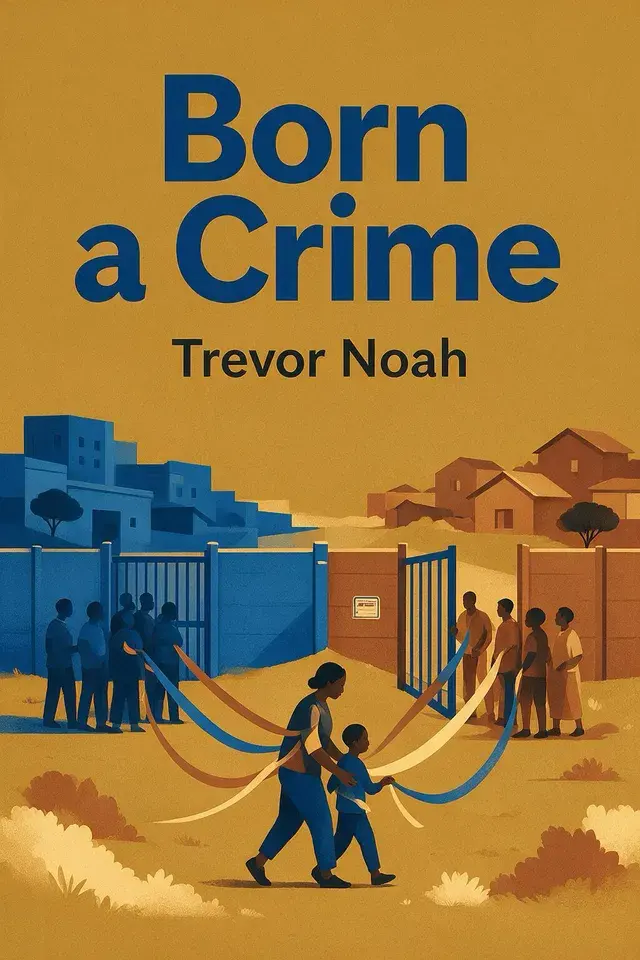
Trevor’s mixed birth exposed racial categories as legal inventions, forcing his family to conceal love through documents, disguises, and staged relationships.
Trevor’s multilingual adaptability crosses racial boundaries, while conditional family privilege shows that belonging and advantage can depend on how others perceive him.
Patricia converts childhood deprivation into literacy, books, mobility, and experiences that make Trevor’s world larger than his surroundings.
The security camera and authorities’ assumptions convert visible evidence into a racial misidentification.
Community credit and mutual aid provide belonging and services, while obligation can commodify trust and make departure socially costly.
A mismatched plate turns a reckless errand into an arrest whose consequences depend on paperwork, money, lawyers, and timing.
Police inaction, economic dependence, and social stigma narrow Patricia’s routes out of an abusive relationship, complicating the child’s simple demand to leave.
How Born a Crime builds its case
Follow how the book develops its argument. Each note is a brief orientation, not a replacement for the chapter.
Apartheid Makes a Child Illegal
To understand Born a Crime, start with apartheid as its operating system, not distant background. The regime made racial separation seem natural by classifying people, assigning unequal rights, and turning communities against one another.
Women Build Life in Scarcity
Religion in Trevor Noah’s childhood is not a replacement for older beliefs. Christianity exists alongside ancestors, traditional healers, witchcraft, curses, and fears of supernatural harm.
The Chameleon Learns Belonging
Trevor’s account of belonging begins with a simple observation: people often hear identity before they examine it. A language, accent, or phrase can make someone seem familiar; another can make the same person seem foreign.
A Mother Opens the World
Trevor’s idea of freedom begins with Patricia’s memory of not having it. She grew up in severe poverty, feeling unwanted by her parents and siblings.
Love, Fathers, and Racial Limbo
Belonging is easy to confuse with possession. Trevor learns the difference through Fufi, the dog he raised, trained, slept beside, and loved.
Outsider Economics of Desire
Adolescence gives Trevor a new test of belonging: a school can mix people without making their worlds equal. At Sandringham High, a Model C school, students from different racial and economic backgrounds share a campus.
Misrecognition Behind the Walls
When Trevor’s mother buys a neglected house in Highlands North, she takes him into an overwhelmingly white suburb whose design still carries the logic of separation. He has been the only white child in Soweto and the only mixed child in Eden Park; here, he is the only black child.
Performance, History, and Access
Trevor’s growing music business makes a larger point about talent. He can recognize demand, negotiate, and organize, but those abilities become useful only when tools, knowledge, and a route to customers are available.
The Hood's Moral Economy
Alexandra, or Alex, is easy to misunderstand if every crime is treated as the work of a bad individual. In Trevor Noah’s account, Alex is an adaptive social system.
Law, Luck, and Conditional Freedom
Trevor’s story about stealing batteries introduces his mother’s legal philosophy. At ten, after she refused to buy batteries, he shoplifted them.
Love Against Violence
At the memoir’s end, the question is no longer whether Patricia loves her family. It is whether love can keep a family safe when power, money, and institutions protect the person causing harm.