What you'll learn
Key ideas from Becoming
These ideas compress the book's argument without treating the author's view as settled fact. Use them as an orientation before reading the full work or listening in Wiseley.
Becoming begins as an unfinished process shaped by family, place, practice, and changing circumstances.
Whitney Young and Princeton widen Michelle’s world, but race, class, inherited networks, and hidden cultural rules redistribute belonging.
Journaling turns grief and comparison into questions about identity, purpose, and a career beyond law.
Michelle and Barack build marriage through negotiated commitment, cultural encounter, and repeated adaptation rather than a fixed model.
Michelle makes caregiving and family schedules explicit boundaries, turning household strain into shared responsibility rather than private failure.
Public narrative can strip speech and behavior from context, then recode racial and gendered identity as evidence of hostility or disloyalty.
Let’s Move! translates symbolic access into coalition-building across families, schools, government, media, sports, and food companies.
Optimism is truthful memory joined to voting, participation, and resistance to cynicism.
How Becoming builds its case
Follow how the book develops its argument. Each note is a brief orientation, not a replacement for the chapter.
A Self Shaped in Community
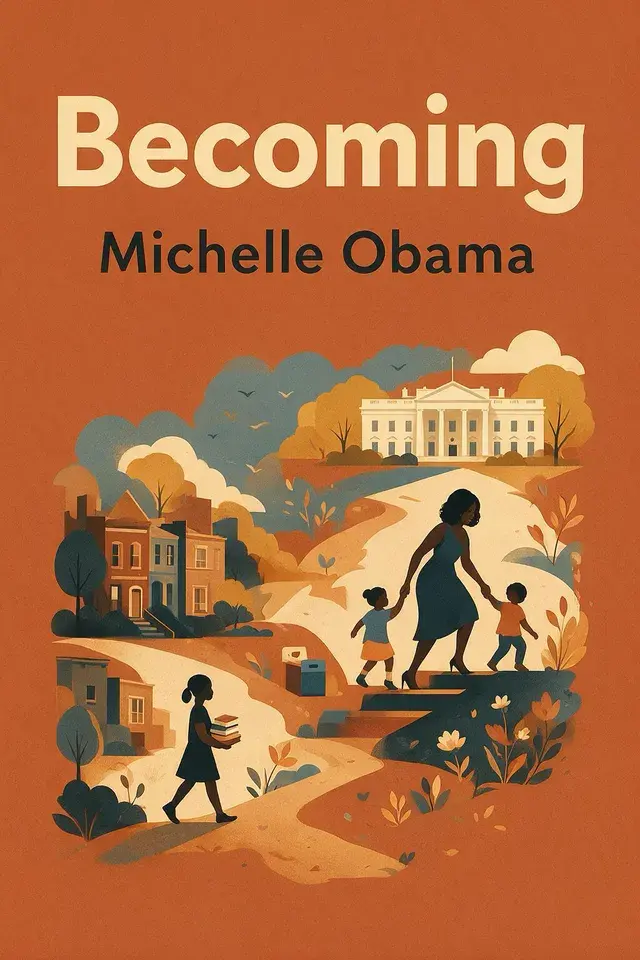
Michelle Obama’s memoir opens by refusing to treat identity as a finished answer. Its three sections—Becoming Me, Becoming Us, and Becoming More—make development the book’s architecture.
Crossing Institutions Without Losing Home
Michelle’s adolescence expands her territory without making her safer. She travels across Chicago for dance, runs errands, and spends more time beyond parental supervision, but learns to manage catcalls, dangerous blocks, and the rule never to walk alone at night.
Love, Loss, and Purpose
Michelle enters this period with a life organized around achievement. At Sidley, she is competent, busy, and planning the next respectable step.
Partnership as an Adaptive Practice
When Michelle considers leaving a successful legal career, the question is not whether she can work hard. It is whether hard work should remain her organizing principle.
Family, Campaign, and Voice
Political ambition enters a household already at its limit. Michelle wanted a full-time hospital job partly to afford child care and housekeeping, leaving more time with her daughters.
Scrutiny, Victory, and Transition
By 2008, public visibility had become a contest over meaning. Barack’s visits, meals, clothes, and choices could be treated as evidence of fitness, authenticity, class, and Americanness.
Making Power Human
After the inauguration, Michelle faced an undefined job inside an extraordinary contradiction. The White House offered grand rooms and specialized service, yet security glass, agents, controlled movement, and crowds made it a fortress.
Service Through Setbacks
By the second term, Michelle Obama’s public role is tested less by whether she can launch a visible initiative than by whether she can remain present when visibility exposes suffering. She rejects a neat redemptive story.
Becoming Beyond Office
As the White House years ended, Michelle Obama’s commencements became more than farewells. She spoke about excellence, diversity, immigration, and possibility, drawing on her family history to show students that someone shaped by invisibility could become visible and help shape the future.