What you'll learn
Key ideas from Angela's Ashes
These ideas compress the book's argument without treating the author's view as settled fact. Use them as an orientation before reading the full work or listening in Wiseley.
Angela’s labor and the children’s caregiving keep the household going when wages fail.
Limerick turns poverty into monitored routines of rent, relief, fuel, food, and inspection.
Eugene’s pneumonia exposes how cold, damp housing and delayed medical attention make repeated bereavement a household condition.
The failed altar-boy application exposes a perceived gap between shared faith and church service filtered by clothing, cleanliness, income, and respectability.
Timoney turns Francis’s reading into paid work and a private education beyond the Confraternity’s demands.
Frank’s coal work turns skill into wages, manhood, and school status, while Hannon’s damaged legs reveal the danger beneath that dignity.
Laman’s assault turns shelter and promised rewards into coercive power, forcing Frank to leave without secure refuge.
Frank’s farewell makes emigration both liberation and bereavement, with Ireland’s graves, songs, and rain carried across the Atlantic.
How Angela's Ashes builds its case
Follow how the book develops its argument. Each note is a brief orientation, not a replacement for the chapter.
Rain, Inheritance, and Hunger
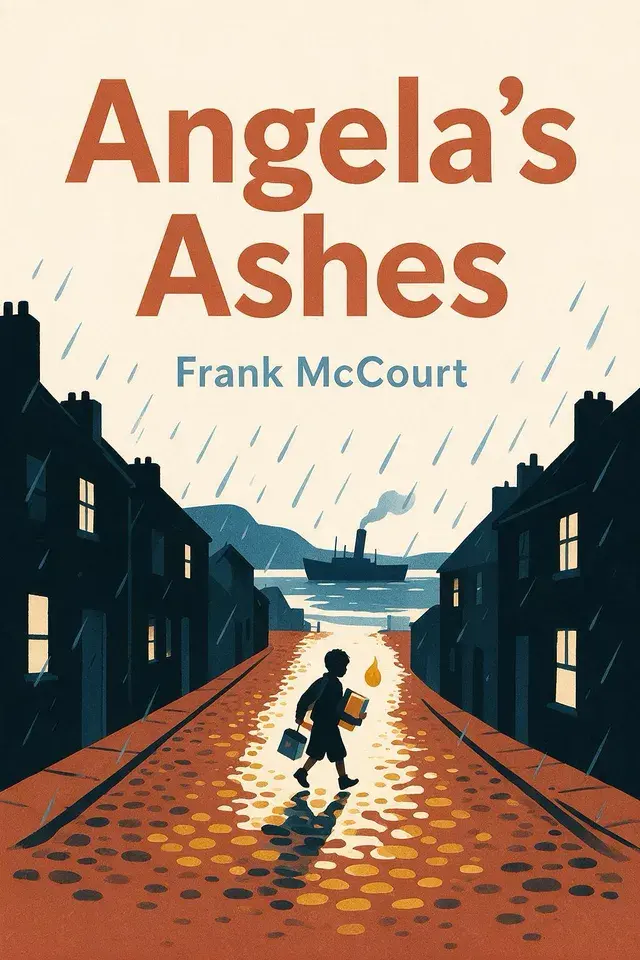
The memoir opens in a world seen through a child’s eyes, though shaped by adult memory. Poverty is not an empty cupboard alone.
Grief Sends Them Home
Margaret’s death turns the family’s chronic poverty into an emergency. At seven weeks, she is found cold and quiet, and the doctor says she is gone.
Charity, Loss, and School
After the family settles in Limerick, poverty becomes a timetable rather than a temporary emergency. Grandma rents a furnished room, but six people share one bed, and weekly relief leaves little after rent for food, clothing, and coal.
Mourning in a Flooded House
After Oliver’s death, Eugene searches under beds, too young to understand that “heaven” means Oliver will not return. Six months later, he is found cold and dead in bed.
Shoes, Wages, and Catechism
During Michael’s breathing crisis, Dad sucks what he believes is bad material from the baby’s nose and spits it into the fire, explaining that people in Antrim used the practice before doctors. The family’s poverty is also measured by how it appears to officials.
Communion and Class Boundaries
After earlier preparation, First Communion makes Catholic belonging bodily. Adults call it Frank’s happiest day, but he is also excited about The Collection and James Cagney.
Hunger, Friendship, and Learning
Chapter 7 begins with a question about what education is for. Mr. O’Neill presents Euclid as the foundation of mathematics, carpentry, buildings, movement, and ambitious futures. The boys answer from immediate danger: what use are parallel lines while Germans are bombing everything around them? O’Neill replies that Euclid made aircraft possible and praises geometry’s grace and beauty. Those claims belong to his classroom rhetoric; they do not answer the boys’ hunger and fear. The headmaster’s order to teach long…
Illness and the Literary Imagination
The reading opportunities that began as errands now become paid labor and inner freedom. Mr.
The Mind Finds an Exit
After months in the fever hospital, Frank is healthier but not restored. He spends three and a half months there, much of it in bed, and must relearn to walk.
When Wages Fail
After the decision to send Dad to England, the family learns that migration helps only when wages travel home. In the lane, Saturday becomes a public test: the telegram decides shopping, food, clothes, and the evening film.
Work, Shame, and Escape
After Mam’s pneumonia and Dad’s departure for Coventry, the children survive through relatives, charity, and improvisation. On Ash Wednesday, Aggie sends Frank, Malachy, and Michael to Mass.
Eviction and the Education Question
Frank’s coal-delivery work ends when Mr. Hannon’s leg condition requires hospitalization.
Sin Under One Roof
At thirteen, Frank briefly imagines escape through the White Fathers. A missionary’s stories of Bedouin tribes and the French Foreign Legion attract him, but a doctor turns the examination into comic horror about camel bites, ruined shoulders, and diseased eyes.
Wages, Grief, and Moral Choice
Telegram work gives Frank a new position in Limerick. Carrying other people’s news makes him a mobile witness to unequal streets.
An Atlantic Threshold
After the post-office humiliation, Frank is trapped between public judgment and private guilt. Mrs.