What you'll learn
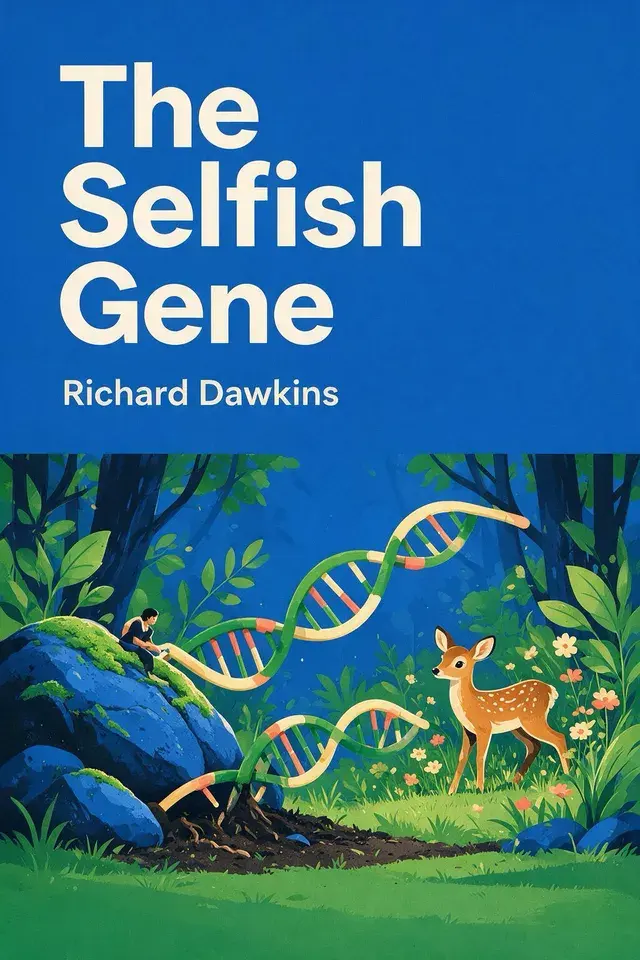
Key ideas from The Selfish Gene
These ideas compress the book's argument without treating the author's view as settled fact. Use them as an orientation before reading the full work or listening in Wiseley.
The gene’s-eye view presents persistent genes as the preferred level for explaining organismal selfishness and limited altruism.
Genes shape behavior indirectly by building bodies and nervous systems that make rapid local decisions under changing conditions.
An ESS is a population-dependent strategy that resists invasion by alternatives.
Kin selection treats altruism as a gene-level tradeoff in which relatedness and reproductive prospects can outweigh the actor’s cost.
Memes are culturally transmitted replicators whose success depends on imitation, variation, and competition for limited attention and memory.
Human foresight may let people resist inherited and acquired replicators and pursue disinterested altruism, though that possibility remains qualified.
A one-shot Prisoner’s Dilemma favors mutual defection, while repeated uncertain play creates scope for reciprocal cooperation.
The extended-phenotype theorem follows the genes a trait helps, not the body where the trait appears.
How The Selfish Gene builds its case
Follow how the book develops its argument. Each note is a brief orientation, not a replacement for the chapter.
Why Gene-Level Selection Matters
Dawkins begins with a problem that appears moral before it appears biological: why do animals sometimes behave as though their interests matter, and sometimes pay costs for others? The book is not a general defense of Darwinism.
From Replicators to Genes
To explain how simple matter could lead to living complexity, Dawkins begins with a principle broader than Darwin’s survival of the fittest: survival of the stable. Physical conditions produce patterns that persist or recur, from crystals and bubbles to intricate molecules.
Brains Built as Survival Machines
If genes survive by building temporary bodies, the next question is how they can influence behavior. Dawkins’s answer is indirect.
Aggression and Stable Strategies
Once survival machines meet, the environment becomes strategic. A rival is not passive scenery: it can block food, mates, or territory, retaliate, and pursue its own genes.
Kinship and Reproductive Economy
Once selection is followed through genes, apparent altruism becomes an accounting problem. A gene is spread across many bodies, so a costly act can favor it if it helps other bodies carrying copies.
Parent–Offspring Bargaining Under Scarcity
Kin selection explains why a parent can invest in a helpless child, but shared genes do not erase conflicting interests. A parent and child share half their genes; each child is twice as closely related to itself as to a sibling.
Sexual Conflict and Mate Choice
Sexual reproduction looks cooperative because two parents produce a child together. Yet their genes do not have identical interests.
Cooperation Beyond Kin
Group living can look like a triumph of cooperation, but the chapter begins with a narrower question: what does an association return to the genes of each participant? A flock, swarm, school, herd, or pack can make hunting easier, support a communal web, conserve heat, or reduce the effort of swimming or flying.
Memes and Human Choice
Humans occupy a special position in this chapter because culture explains much of what is unusual about them. The wider evolutionary argument still applies to any evolved being, but human language can change far faster than genes.
Repeated Games Reward Cooperation
Reciprocity becomes a real evolutionary possibility only when an interaction has a future. In a one-shot Prisoner’s Dilemma, two players secretly choose whether to cooperate or defect.
Phenotypes Beyond the Body
Genes are often described as having phenotypes inside the bodies that carry them: eye colour, shell thickness, or behaviour. Dawkins asks us to widen that definition.
Why Organisms Become Vehicles
At the end of the gene-centered argument, a puzzle remains. Replicators can pursue separate interests or disperse through different routes.