Individual risk and population patterns
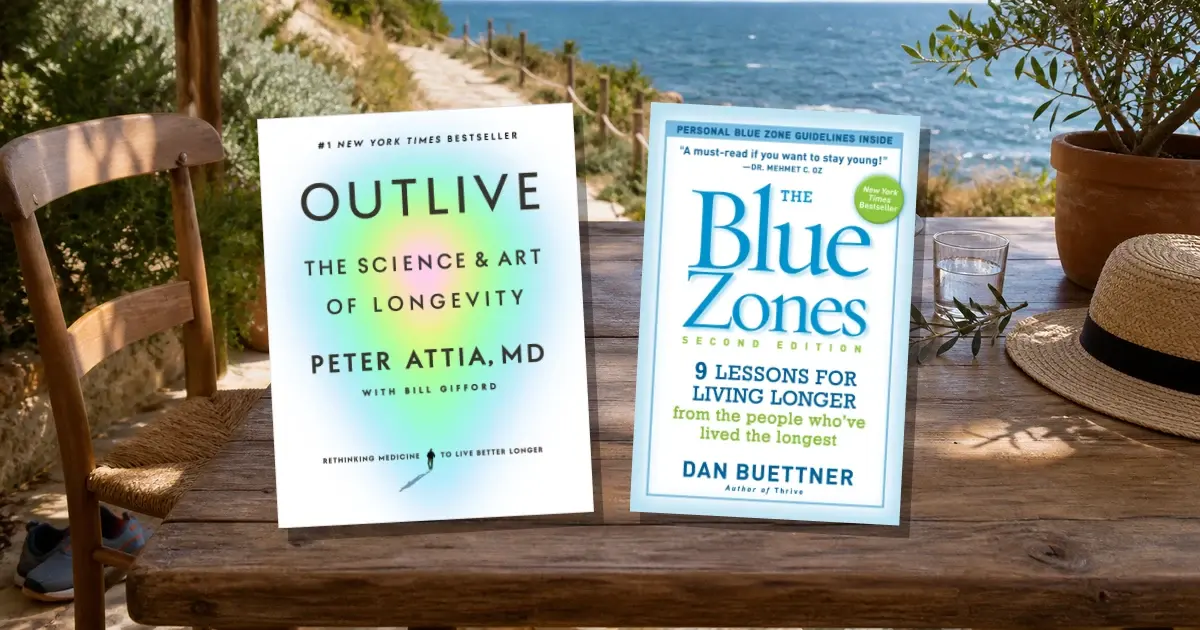
Outlive defines longevity as lifespan plus healthspan—the preservation of physical, cognitive, and emotional function. Peter Attia organizes prevention around long-term chronic-disease risk, individualized strategy, and tactics involving exercise, nutrition, sleep, and emotional health. The Blue Zones begins with populations reported to have unusual longevity and looks for recurring features such as routine movement, plant-forward eating, purpose, family, faith, and social ties. One asks how to alter a personal risk trajectory; the other asks how daily environments make certain behaviors ordinary.
- A structured, individualized prevention lens: Outlive.
- A community-and-environment lens for everyday defaults: The Blue Zones.
- A guaranteed recipe for living longer: neither book can provide one.
The evidence supports principles, not certainty
Blue-zone patterns are observational: they can generate useful hypotheses but cannot by themselves show which feature caused longevity or how well it transfers to another population. Outlive openly works with incomplete evidence, yet its individualized testing, screening, exercise, nutrition, and medication discussions still require clinical context. The National Institute on Aging describes healthy aging as influenced by both genetics and modifiable areas including activity, food, sleep, medical care, and mental health. Federal physical-activity guidance is evidence-based population guidance, not a personalized clearance or prescription.
- Separate an association, a general guideline, and an individualized intervention.
- Do not infer that one biomarker or one community habit determines lifespan.
- Discuss screening, medication, major diet changes, and demanding exercise with a qualified clinician.
Build a conservative combined plan
Use The Blue Zones to inspect defaults: Is walking convenient? Do meals, relationships, and rest have reliable places in the week? Use Outlive to define a functional goal and bring relevant history, symptoms, and risk questions to a clinician. Start with one safe, observable change rather than a longevity overhaul. The outcome worth tracking is not a promised extra decade but whether the routine is sustainable and supports function, connection, sleep, or another clearly chosen goal.
- Choose one environmental change that reduces friction for a healthy behavior.
- Measure consistency and function before optimizing a surrogate marker.
- Stop and seek professional guidance if a plan conflicts with symptoms, treatment, or physical limitations.
Sources and scope
Book ideas are attributed to their authors. External evidence is linked directly when a claim needs more than the source book.
- Outlive: Primary source for the healthspan, upstream prevention, individualized-risk, exercise, nutrition, sleep, and emotional-health framework.
- The Blue Zones: Primary source for the observational longevity-population cases and recurring environmental, behavioral, and social patterns.
- What Do We Know About Healthy Aging? — National Institute on Aging, National Institutes of Health
- Current Physical Activity Guidelines for Americans — Office of Disease Prevention and Health Promotion, U.S. Department of Health and Human Services
To report a factual, attribution, rights, or accessibility concern, email hello@wiseley.app.
Questions readers ask
Which book should I read first?
Read The Blue Zones first for accessible environmental and social patterns. Read Outlive first if you want a denser framework for risk, function, and questions to discuss with a clinician.
Does either book prove how to live to 100?
No. Longevity reflects many interacting factors, and observational patterns do not establish a transferable causal recipe. Use the books to frame questions and habits, not to predict an individual lifespan.