What you'll learn
Key ideas from The 4-Hour Body
These ideas compress the book's argument without treating the author's view as settled fact. Use them as an orientation before reading the full work or listening in Wiseley.
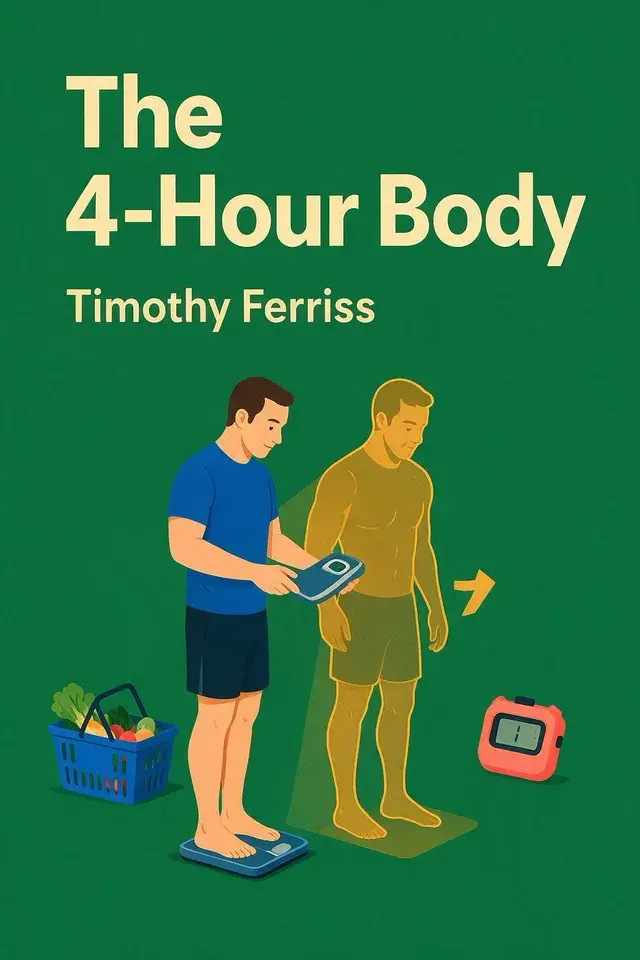
The book recasts body change as a measurable experimental loop of baseline, intervention, observation, and revision.
Slow-Carb centers each repeatable meal on protein, legumes, and vegetables while excluding white carbohydrates, caloric drinks, and most fruit on diet days.
Continuous glucose monitoring maps individual meal responses; lower glucose does not automatically predict greater fat loss.
Physique change is framed around the minimum effective dose, with stimulus matched to fat loss, abdominal definition, or muscle gain.
Sleep quality is studied through REM, deep-wave patterns, sleep onset, and realistic tracking rather than hours alone.
The injury framework ranks movement correction, soft-tissue treatment, medication, and reconstruction as staged options, with objective outcomes guiding escalation.
Performance gains are framed as the result of measurable bottlenecks and precise mechanics, not automatically longer training.
Self-experimentation can reveal practical effects, but personal results, weak controls, and selective samples do not establish universal causation.
How The 4-Hour Body builds its case
Follow how the book develops its argument. Each note is a brief orientation, not a replacement for the chapter.
The Experimental Body
Most body goals begin as wishes: become healthy, lose fat, get stronger, or sleep better. Ferriss’s opening move is to make each wish testable.
Slow-Carb Fat Loss by Design
The book’s principal fat-loss engine is deliberately repetitive. Ferriss calls it Slow-Carb: build meals around protein, legumes, and vegetables, then remove convenient carbohydrates and caloric drinks.
Controlled Metabolic Levers
Once the basic diet is in place, Ferriss adds adjunct levers for people who want to manipulate fat loss more deliberately. Overfeeding, supplements, cold exposure, meal timing, and glucose control become adjustable inputs.
Minimalist Physique Engineering
Physique change begins with choosing the right problem. Losing fat, revealing abs, and adding muscle are different assignments, so the same training prescription cannot serve all three equally well.
Sex, Sleep, and Hormones
This chapter takes the book’s experimental method into systems that are intimate, fluctuating, and easy to misread. Sexual function, sleep, hormones, and fertility appear as connected rather than isolated: attention and consent shape sexual practice, sleep affects recovery, endocrine changes can alter libido, and reproductive outcomes require measurements beyond how healthy someone feels.
Repair Before Reconstruction
Once pain is already present, the book changes the question from adding capability to finding the source of limitation. Ferriss describes an injury-reversal project built on more than twenty fractures, more than twenty dislocations, two joint surgeries, chronic tears and sprains, and severe cervical-disc degeneration.
Precision Performance Across Sports
Performance training changes once the target is a stopwatch, a jump marker, a stroke count, a ball-speed reading, or a breath-hold time. The useful question is not simply how hard to work.
Evidence, Longevity, and Choice
By the end of The 4-Hour Body, the most durable subject is not a particular diet, supplement, or exercise. It is the problem of deciding what to believe when evidence is incomplete.