What you'll learn
Key ideas from Stiff
These ideas compress the book's argument without treating the author's view as settled fact. Use them as an orientation before reading the full work or listening in Wiseley.
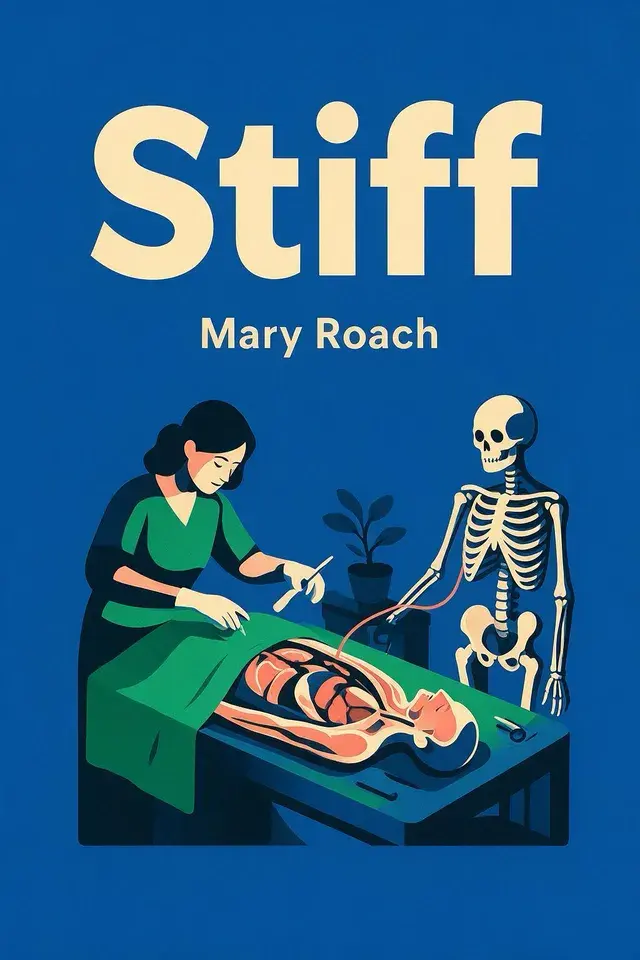
Cadavers can aid medicine and science, but usefulness does not erase the person whose body was donated.
Anatomy’s legal shortage turned grave robbing into organized resurrectionist labor and exposed the poor to bodily theft.
Impact research helped produce more forgiving windshields, collapsible steering columns, belts, airbags, and padded interiors.
Brain death makes legal death compatible with continued heartbeat and organ recovery.
Plausible biological mechanisms can coexist with association, natural recovery, placebo effects, or active ingredients unrelated to the human material.
Body donation and plastination reveal that consent to science or preservation may leave donors without control over later use, display, or storage.
How Stiff builds its case
Follow how the book develops its argument. Each note is a brief orientation, not a replacement for the chapter.
Why Bodies Become Useful
Stiff begins with a provocative premise: some people may become more useful dead than alive. Mary Roach presents the cadaver as an often-unrecognized partner in medical and scientific progress.
From Grave Robbing To Decay
Anatomy’s demand for bodies became dangerous when medical schools expanded faster than lawful supply. In eighteenth- and nineteenth-century Britain, donation did not exist, and many feared dissection might prevent bodily resurrection.
Bodies That Prevent Injury
A crash dummy can tell engineers how much force reached a body region. It cannot, by itself, tell them whether that force breaks a rib, tears an aorta, or damages the brain.
Reading Damage As Evidence
When an aircraft vanishes into deep water, its passengers may become the most readable surviving record of the event. Injury analysts correlate autopsy reports with seating charts, body locations, and injury clusters.
When Death Moves Into The Brain
Death seems like a clean event: the heart stops, the body cools, and the person is gone. Organ transplantation unsettles that sequence.
The Body, The Brain, And Identity
Transplantation turns an old philosophical question into an operating-room fact: if a heart can leave one body, beat in another, and continue without a brain, where does identity reside? A removed human heart may beat for a minute or two.
Bodies As Medicine And Taboo
Human remains have repeatedly been treated as medicine and, sometimes, as food. Stiff uses these practices to separate three questions: might a substance have a biological effect, did it actually help, and did anyone consent to its use?
A Dignified End To Matter
At the close of Stiff, the question is no longer simply whether a body can be useful. It is how society can acknowledge that a body is material without making mourners feel that a person has become waste.