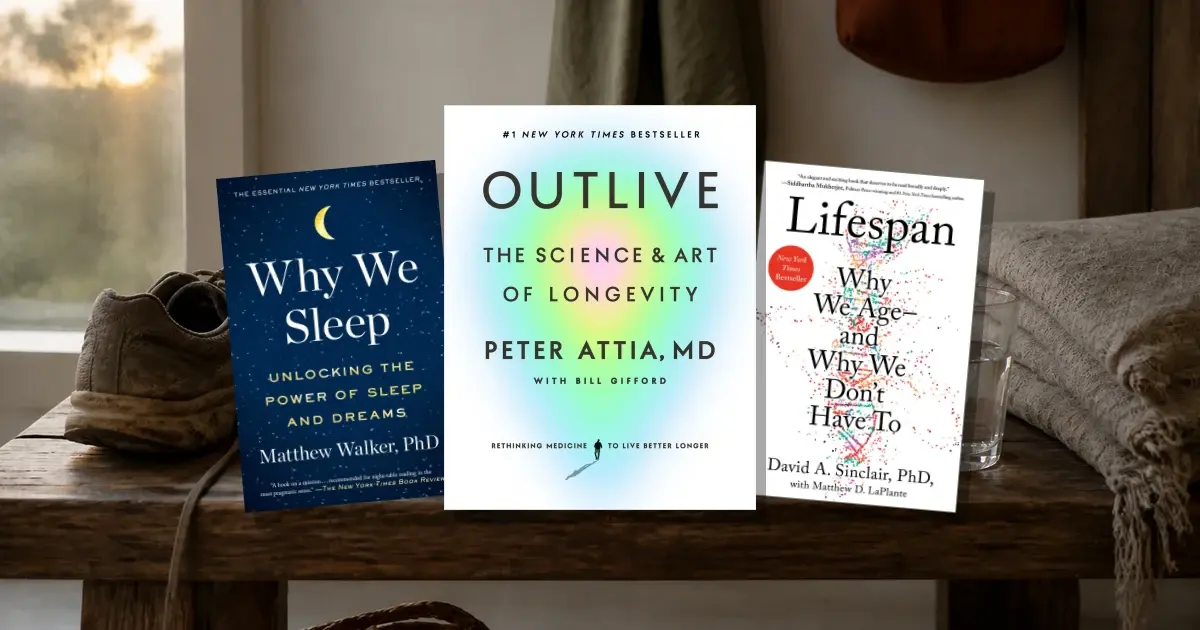
Choose by lever
Longevity advice sprawls because aging has many inputs. One reader needs a framework for medical risk before symptoms appear; another cannot remember their last full night of sleep; another wants the underlying biology; another thrives on community patterns rather than protocols. Each book below owns one lever and is honest about what that lever cannot do.
- Want a complete, individualized healthspan strategy: Outlive.
- Sleep is the neglected variable: Why We Sleep.
- Curious whether aging itself can be modified: Lifespan.
- Prefer culture and environment over protocols: The Blue Zones.
- Interested in the overlooked mechanics of breathing: Breath.
What each book adds
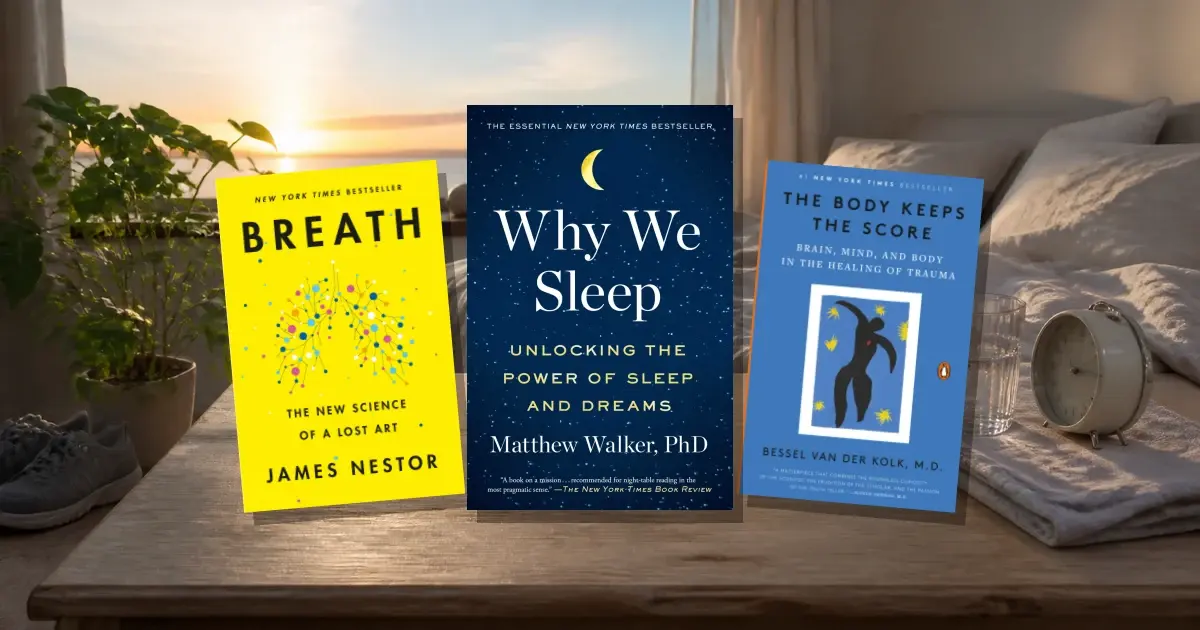
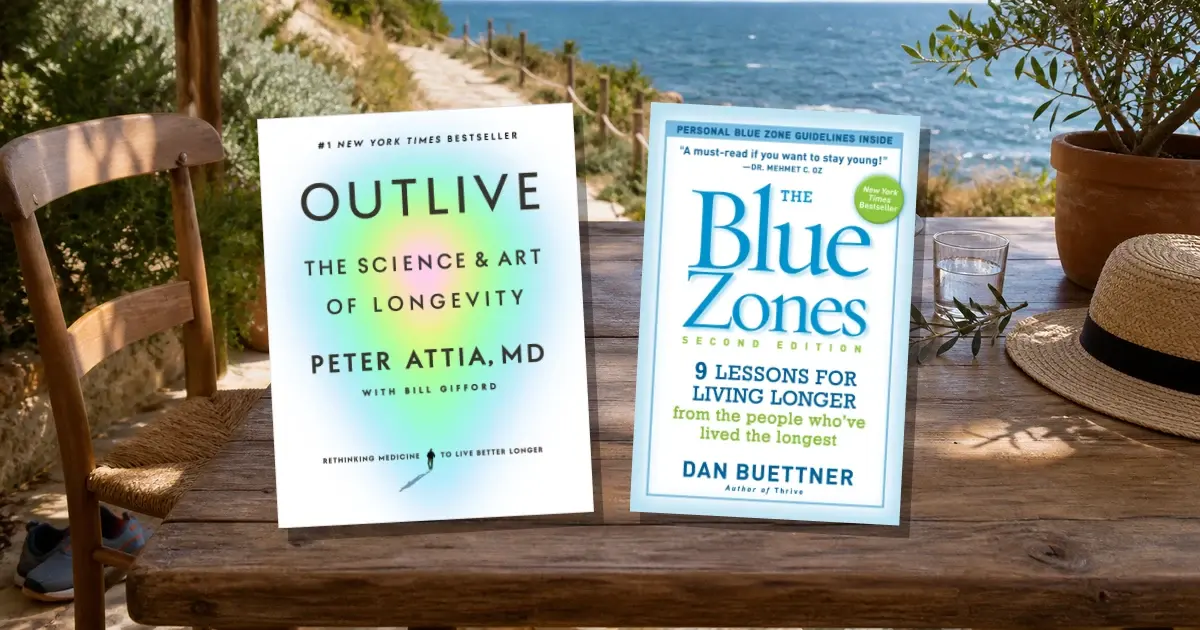
Attia reframes prevention as Medicine 3.0: treat atherosclerosis, metabolic dysfunction, cancer, and neurodegeneration as accumulating risk decades before diagnosis, with exercise as the most powerful general tool — trained backward from the Centenarian Decathlon you want to still be able to do. Walker argues sleep is whole-body regulation, not downtime: NREM consolidates memory while REM recalibrates emotion. Sinclair proposes that aging is epigenetic information loss — modifiable through stress-response pathways, though he flags human evidence as limited where molecules are concerned. Buettner's Blue Zones shift scale to culture: natural movement, plant-slant diets eaten to eighty percent, purpose, downshifts, and tribe. Nestor reopens the ignored variable of breath — nasal conditioning, full exhalation, carbon dioxide's role — with explicit safety warnings.
- Best single comprehensive framework: Outlive, from risk markers to emotional health.
- Best first habit to fix tonight: Walker's cool, dark, regular wake-time prescription.
- Most evidence-humble read: The Blue Zones, which treats patterns as association, never proof.
A reading order from framework to detail
Outlive works best first because it organizes every other input — including sleep, nutrition, and emotional health — under one risk-based frame. Deepen whichever chapter hits hardest next: sleep with Walker, nutrition-adjacent mechanisms with Sinclair's biology, or daily-life design with Buettner. Nestor rounds out the set when the big levers are already moving and small mechanical ones deserve attention.
- List which chronic risks run in your family before choosing protocols.
- Adopt one Blue Zones pattern — walking, beans, purpose — rather than all at once.
- Treat any molecule or fasting claim in Lifespan as frontier science, not settled practice.
Sources and scope
Book ideas are attributed to their authors. External evidence is linked directly when a claim needs more than the source book.
- Outlive: Source for Medicine 3.0, cumulative risk framing, the Centenarian Decathlon, Nutrition 3.0, and emotional health as healthspan.
- Why We Sleep: Source for circadian rhythm and sleep pressure, NREM memory consolidation, REM emotion processing, and sleep-smart conditions.
- Lifespan: Source for the Information Theory of Aging, survival-circuit signaling, epigenetic reprogramming evidence, and its stated limits.
- The Blue Zones: Source for validated longevity regions, natural movement, plant-slant eating, purpose, downshifts, and social ties.
- Breath: Source for nasal airway function, exhalation mechanics, carbon dioxide balance, overbreathing, and safety-flagged techniques.
To report a factual, attribution, rights, or accessibility concern, email hello@wiseley.app.
Questions readers ask
Which longevity book should I start with?
Outlive gives the most complete map: it connects cardiovascular and metabolic risk, exercise, nutrition, sleep, and emotional health into one framework aimed at healthspan rather than mere lifespan. Readers overwhelmed by its clinical depth often do better starting with Why We Sleep or The Blue Zones and returning later.
Is Lifespan's science accepted?
Its information-theory framing of aging and enthusiasm for molecules like metformin sit closer to the research frontier than to consensus. Sinclair himself notes that human evidence remains limited. Read it for the genuinely important idea that aging may be modifiable, not as a protocol book.
Are these books medical advice?
No — they are science journalism and expert frameworks. Individual risk profiles differ enormously, several topics here interact with medications, and each author recommends professional supervision for testing or treatment changes. Use these books to ask better questions, not to skip clinicians.