What you'll learn
Key ideas from Food Rules
These ideas compress the book's argument without treating the author's view as settled fact. Use them as an orientation before reading the full work or listening in Wiseley.
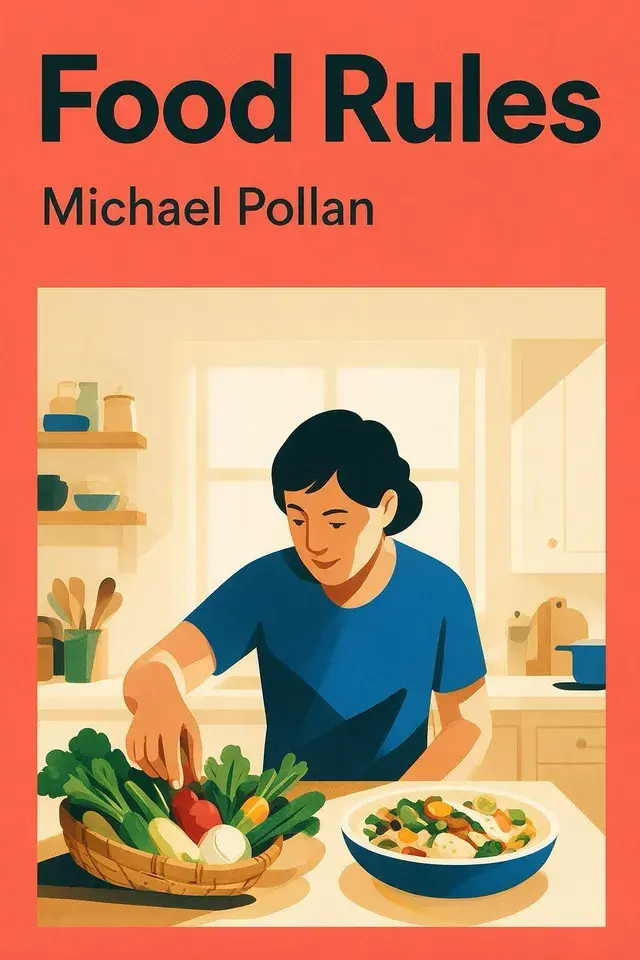
Eat food, not too much, mostly plants becomes a flexible framework of personal policies.
Ancestral recognition and familiar pantry ingredients create quick tests for separating recognizable food from industrial foodlike substances.
Mostly plants means a diverse plant-centered diet, not strict vegetarianism; animal foods remain selective parts of an omnivorous pattern.
Slow eating, delayed satiety, diminishing returns, and smaller vessels turn bodily awareness and pleasure into practical portion design.
Structured meals create boundaries against the all-day, distracted intake associated with cars, screens, work, and grazing.
Home cooking restores practical control over ingredients and portions; its health case is associated, not automatic.
How Food Rules builds its case
Follow how the book develops its argument. Each note is a brief orientation, not a replacement for the chapter.
Escape Nutrient Confusion
Food should be ordinary, yet Pollan says modern eaters increasingly outsource decisions to doctors, diet books, media reports, government advice, food pyramids, and package claims. We are urged to see meals as calories and nutrients while arguments shift among fats, carbohydrates, sugars, gluten, sweeteners, and supposed health foods.
Recognizing Real Food
The practical question in this chapter is how to recognize real food before a package turns that choice into a puzzle. Pollan’s first nine rules answer with overlapping shortcuts.
Shop Against Industrial Design
Pollan’s next move is to stop treating every package as a puzzle. Rules 10 through 21 shift attention from label language to the settings and habits surrounding food.
Make Plants the Center
Once real food is on the table, a further question arises: which real foods should receive priority? Pollan does not answer with a single perfect formula.
Trust Tradition, With Judgment
Once whole foods and plants are at the center, a subtler question remains: how should they be prepared, combined, and judged? Pollan’s answer is to look backward before embracing every new product.
Eat Less, Notice More
After the book has worked through what counts as food and which foods deserve priority, its third part turns to the phrase “not too much.” Pollan treats moderation as a learned relationship with appetite, not merely a calculation.
Rebuild the Meal
Pollan turns from the eater’s bodily awareness to the setting of the meal. Food, he argues, is shaped by context: a table, a screen, a car, and other people can influence both how much we eat and what eating means.
Cook, Grow, Stay Flexible
The final movement of Food Rules shifts the question from what to choose toward how to reconnect with food. Pollan’s last rules make eating less about managing an abstract nutritional system and more about recovering contact with ingredients, effort, and the people and places that sustain us.