What you'll learn
Key ideas from Enlightenment Now
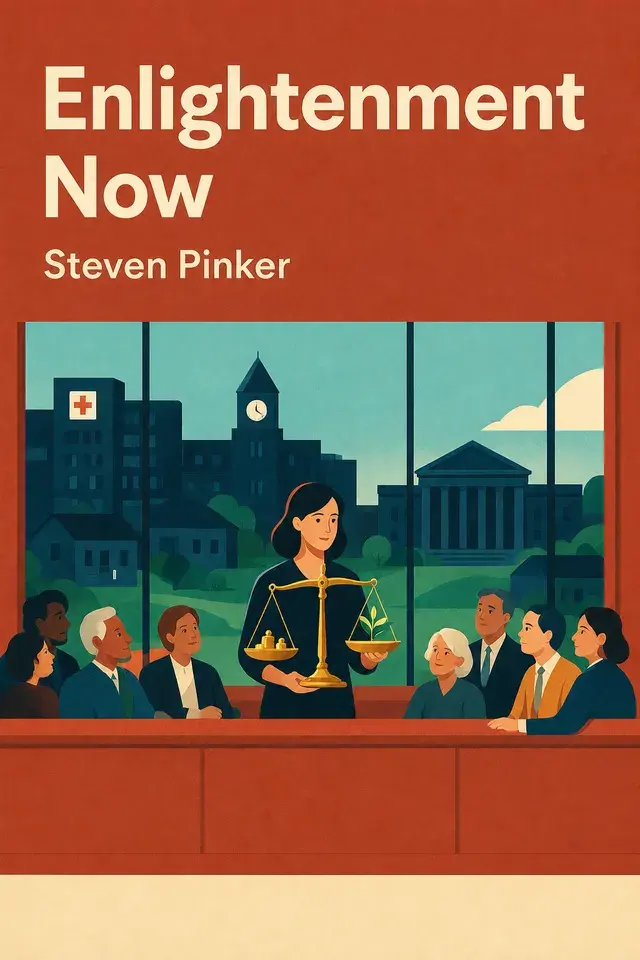
These ideas compress the book's argument without treating the author's view as settled fact. Use them as an orientation before reading the full work or listening in Wiseley.
Reason, science, humanism, and progress form a connected framework for understanding and improving human life.
Progress is measured by changes in humanistic goods, rates, and trends, not by isolated headlines or metaphors.
Scientific knowledge recast infectious disease as a problem of prevention, transmission control, and treatment rather than an unavoidable fate.
Climate change is presented as a serious exception to broader environmental improvement, requiring deliberate emissions cuts rather than passive confidence.
Trade, prosperity, democratic constraints, deterrence, peacekeeping, and international law reinforced one another in reducing war.
Human-rights progress becomes durable when modernization, sympathy, institutions, generations, and moral campaigns reinforce one another, though measurement remains imperfect.
Institutional rules, active education, adversarial collaboration, and depoliticized framing can improve collective judgment without making individuals perfectly rational.
Humanism gives knowledge a moral direction: progress serves the broad flourishing of all people, not mastery for its own sake.
How Enlightenment Now builds its case
Follow how the book develops its argument. Each note is a brief orientation, not a replacement for the chapter.
Why Enlightenment Still Matters
Pinker opens with a question: if science has displaced belief in an immortal soul, what can make life meaningful? His answer begins with asking for reasons, which commits us to reason.
Counting Progress Against Pessimism
Progress is easy to miss because human attention is not a neutral measuring instrument. We notice vivid, recent, and frightening events, then use whatever comes easily to mind as evidence of how common they are.
Surviving Disease and Hunger
Before modern public health, infectious disease was one of the strongest forces of death. Epidemics killed millions, disrupted societies, and produced sudden local misery.
Creating Wealth, Sharing Gains
Modern prosperity begins with a distinction: poverty has no cause in the same sense wealth does. In an entropic world, food, shelter, and comfort require organized effort.
Greener Growth Without Retreat
Environmental damage is real, but Steven Pinker argues that prosperity need not destroy nature, and protecting nature need not require retreat from modern life. His Enlightenment environmentalism uses knowledge, technology, and institutions to combine human well-being with cleaner air, water, and protected habitats.
Choosing Energy for Decarbonization
Climate change is the environmental problem for which optimism cannot mean waiting. Carbon dioxide is accumulating faster than natural sinks absorb it, raising atmospheric concentrations and temperatures.
How the Long Peace Emerged
War was once treated as normal, with peace merely an interval between wars. Over roughly four and a half centuries, great-power wars became shorter and less frequent, even as weapons made them more lethal.
Safety, Terrorism, and Fear
Safety is one of progress’s least dramatic achievements. People remain vulnerable to violence, falls, drowning, fire, poisoning, transport, dangerous work, and natural hazards.
Democracy and Expanding Rights
Democracy is an Enlightenment answer to two old dangers: anarchy, where no authority restrains violence, and tyranny, where authority preys on citizens. Its value is not that voters are perfectly informed.
Knowledge Turns Time into Choice
Progress is not only a rise in income. It is an expansion of what people can know, do, and choose with their time.
What Happiness Evidence Shows
Progress cannot be judged only by objective capabilities. A complete account also asks how people experience their lives.
Meaning Under Modern Freedom
Modern freedom changes the emotional texture of life. It gives people more control over whom to marry, where to live, and what work to pursue, but it weakens some inherited scripts.
Reasoning About Existential Risk
Existential risk is a category for thinking, not a license for prophecy. It concerns events that could destroy humanity, civilization, or the long-term future.
Reducing Nuclear Danger
Pinker treats nuclear war as a real, uniquely destructive danger, not an automatic consequence of technology. Its probability depends on state relations, deterrence, warning systems, military procedures, and political choices.
Progress, Populism, and Possibility
The book’s historical record supports a sober conclusion: progress is real, cumulative, and unfinished. Human flourishing has expanded across survival, wealth, safety, freedom, knowledge, and other measures, yet severe poverty, preventable death, autocracy, inequality, environmental damage, climate risk, and nuclear danger remain.
Reason Against Tribal Identity
Reason is not merely another creed. When someone argues against reason, the argument still presupposes it: persuasion requires claims assessable for coherence and accuracy.
Science Across Human Inquiry
Steven Pinker presents science as a portable way of learning: a practice that asks whether ideas fit the world, seeks explanations beneath appearances, and increases confidence as evidence accumulates. It is not a priesthood of wise people or a catalogue of facts accepted on authority.
Humanism Without Supernaturalism
Science can tell us what is possible and true, but not which possibilities are worth pursuing. The same knowledge can protect life or increase destructive power.