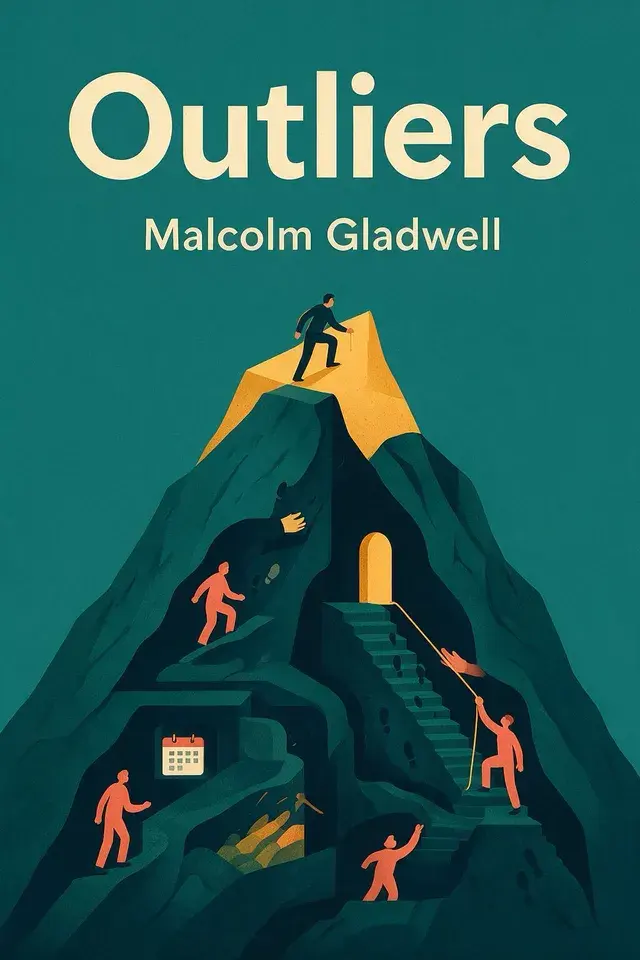
What you'll learn
Key ideas from Outliers
These ideas compress the book's argument without treating the author's view as settled fact. Use them as an orientation before reading the full work or listening in Wiseley.
The Matthew Effect describes how initial advantages attract further opportunities, making institutional selection systems central to success.
Practice creates expertise, but reaching it usually depends on time, support, and access to sustained opportunities.
Birth cohorts benefited when their age matched major economic or technological transitions, though birth year alone never guaranteed success.
Intelligence helps people reach demanding work, but around an approximate IQ threshold, extra points add little measurable real-world advantage.
Analytical brilliance does not ensure achievement; practical intelligence and supportive institutions help convert ability into opportunity.
Cultural legacies can influence behavior and performance long after the conditions that produced them have disappeared.
Crew Resource Management, escalation rules, and reduced hierarchy made speaking up and taking control expected safety behavior.
Success emerges as opportunity joined with agency, inherited cultural resources, and historical conditions rather than isolated talent.
How Outliers builds its case
Follow how the book develops its argument. Each note is a brief orientation, not a replacement for the chapter.
From Roseto to Opportunity
Roseto offers the book’s first important puzzle. In the middle of the twentieth century, this small Pennsylvania town seemed unusually protected from heart disease and a range of social problems.
Practice Before Mastery
When people explain extraordinary achievement, they often begin with a neat formula: talent plus preparation. A gifted person works hard, and success follows.
Luck, Access, and Timing
Prolonged practice matters only when people can obtain the time and access to accumulate it. Bill Joy, the Beatles, and Bill Gates each found an unlikely opening that turned ability into thousands of hours.
Intelligence Has a Threshold
People often imagine that achievement follows intelligence in a straight line: higher IQ should mean greater accomplishment. Malcolm Gladwell uses genius to test that assumption.
Practical Intelligence and Upbringing
Chris Langan and Robert Oppenheimer are presented as men with extraordinary intellectual gifts. The chapter does not explain their different outcomes by claiming one had a better mind.
Joe Flom and the Outsider’s Opening
Joe Flom’s career can look like a classic rags-to-riches story. He became the last living named partner of Skadden, Arps, a firm that grew from a tiny Wall Street startup into a global organization with nearly two thousand attorneys and more than one billion dollars in annual revenue.
Meaningful Work, Inherited Drive
Joe Flom’s professional success points toward a broader family story. His father sewed shoulder pads and his mother did piecework at home.
The Inheritance of Honor
To understand the violence associated with Harlan, Malcolm Gladwell begins with its setting. Harlan County sits in Kentucky’s rugged Cumberland Plateau, with steep mountains, narrow valleys, dense forests, and coal.
Crashes, Communication, and Hierarchy
Airline disasters rarely begin with one spectacular failure. The chapter presents them as cascades: weather that is poor but manageable, schedule pressure, fatigue, unfamiliarity, and several human errors that go uncorrected.
Rewriting Culture in the Cockpit
At Guam, a warning existed in the cockpit without becoming shared action. Korean Air’s recovery therefore depended on changing how people spoke, listened, and understood their roles, not simply on asking individuals to try harder.
Rice, Language, and Persistence
The chapter opens with a rice-paddy proverb: rising before dawn, almost every day, is presented as a way to make a family wealthy. Gladwell uses that image to introduce a broader question.
Marita’s Bargain for Opportunity
Achievement gaps are often described as differences inside children: ability, motivation, or family background. This chapter shifts attention to a less visible force, the school calendar.
The History Behind Success
One of the book’s final lessons is that a success story can be true in its details and still be false as an explanation. The epilogue returns to that idea through the story of Malcolm Gladwell’s mother, Joyce.