Keep the dopamine claim narrow
The National Institute on Drug Abuse explains that dopamine is more closely tied to reinforcement—learning to repeat an activity—than to pleasure itself, and that addictive drugs can produce much larger signals than ordinary rewards. Evidence about drugs cannot automatically prove that food, shopping, phones, or every enjoyable habit works identically. The World Health Organization’s gaming-disorder criteria also require impaired control, increasing priority, persistence despite harm, and significant functional impairment; frequent or enthusiastic use alone is not enough.
- Do not use “dopamine” as a synonym for pleasure, vice, or addiction.
- Assess loss of control, consequences, duration, and impaired functioning—not screen time alone.
- Treat a book’s neurochemical story as a model with limits, not a personal diagnosis.
Run a behavior experiment, not a dopamine detox
Choose one behavior and write what happens before it, what reward it supplies, and what cost appears afterward. Add modest friction or a time-and-place boundary, then replace the function rather than merely removing the object. Track sleep, work, relationships, money, or another concrete outcome for a week. If stopping creates withdrawal risk, the behavior causes significant impairment, or attempts repeatedly fail, seek qualified assessment instead of escalating a self-directed abstinence challenge.
- Change one cue or access rule so the result remains interpretable.
- Plan a satisfying alternative for the need the behavior was meeting.
- Use professional support for substance use, severe distress, or functional impairment.
Sources and scope
Book ideas are attributed to their authors. External evidence is linked directly when a claim needs more than the source book.
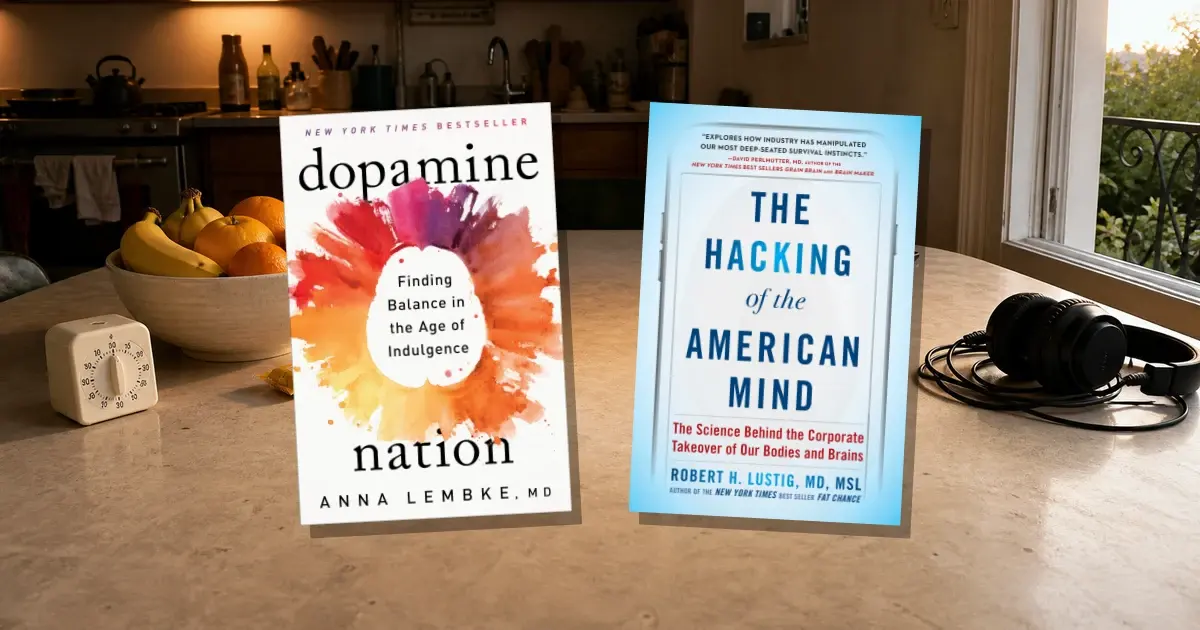
- Dopamine Nation: Primary source for the clinical cases and practices involving abstinence, self-binding, discomfort, honesty, and belonging.
- The Hacking of the American Mind: Primary source for the pleasure-contentment distinction and argument involving stress, food, technology, markets, and the four Cs.
- Drugs, Brains, and Behavior: The Science of Addiction — National Institute on Drug Abuse, National Institutes of Health
- Addictive Behaviours: Gaming Disorder — World Health Organization
To report a factual, attribution, rights, or accessibility concern, email hello@wiseley.app.
Questions readers ask
Is a dopamine detox medically necessary?
The phrase oversimplifies normal neurobiology. A bounded behavior break may reveal cues and consequences, but it does not remove dopamine. Substance withdrawal or serious impairment calls for professional guidance.
Which book is more practical?
Dopamine Nation offers a more explicit sequence for examining compulsive behavior. The Hacking of the American Mind is stronger when you want to connect individual habits with stress, commercial design, relationships, and social context.