What you'll learn
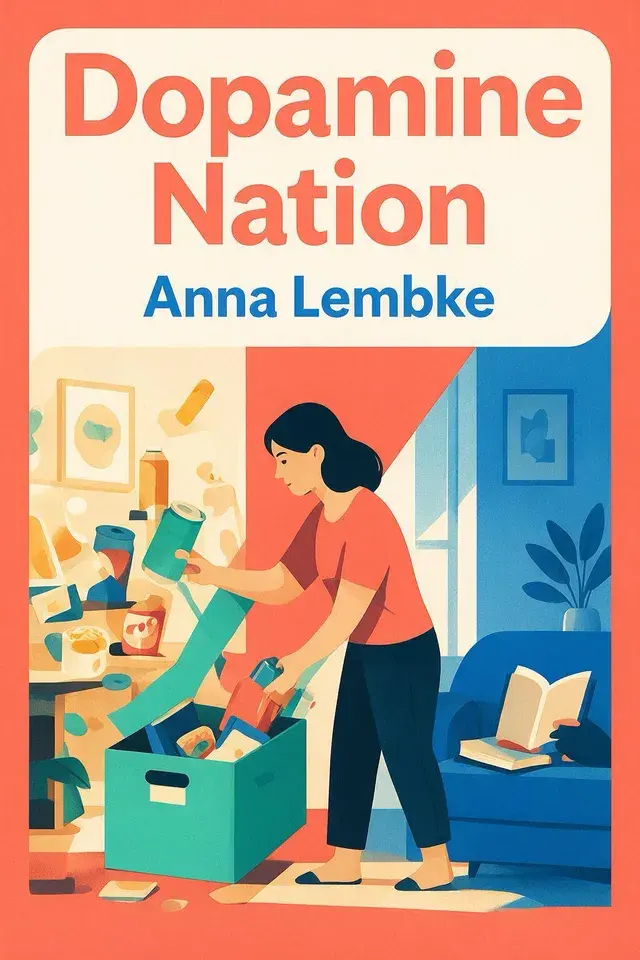
Key ideas from Dopamine Nation
These ideas compress the book's argument without treating the author's view as settled fact. Use them as an orientation before reading the full work or listening in Wiseley.
Abundance makes high-reward substances and behaviors easier to access, repeat, intensify, and normalize, without making addiction universal.
Repeated potent rewards recruit opposing pain, producing tolerance, reduced ordinary pleasure, and relapse driven by withdrawal.
A roughly four-week abstinence period can clarify whether a reward is causing symptoms, relieving withdrawal, or leaving another disorder unchanged.
Physical self-binding works by placing a barrier between desire and action before craving narrows voluntary choice.
Chosen, bounded pain can produce a delayed pleasurable rebound by recruiting the body’s adaptive responses.
Radical honesty turns automatic or denied behavior into a narratable pattern that can be examined.
Shame becomes destructive when rejection and secrecy isolate a person, but prosocial when connection pairs wrongdoing with a path to repair.
Immersion in meaningful reality offers an alternative to compulsive escape, with progress often visible only in retrospect.
How Dopamine Nation builds its case
Follow how the book develops its argument. Each note is a brief orientation, not a replacement for the chapter.
Abundance Builds Its Own High
Jacob spent years trying to stop masturbating. Religious teaching had turned the behavior into a secret double life.
Why Relief Becomes Misery
Relief can become misery when it answers every difficult feeling. In Dopamine Nation, Anna Lembke asks why people reach for pills, screens, or pleasurable stories whenever anxiety, pain, boredom, or uncertainty appears.
How Pleasure Teaches Pain
To understand why pleasure can turn into pain, Lembke begins with dopamine. It is an important neurotransmitter in reward, but not simply a chemical of pleasure.
Reset the Reward Loop
The practical question is not simply whether a reward feels good. It is what the reward is doing in a person’s life, and whether its benefit survives time without it.
Build Barriers Before Craving
Once craving takes over, willpower has to argue with a system organized around immediate relief. Anna Lembke presents self-binding as precommitment: while voluntary choice is still available, a person creates a barrier between themselves and a desired substance or behavior.
Make Time and Meaning Protective
After physical barriers, the book turns to time and meaning. Chronological self-binding means deciding in advance when a reward is allowed—on weekends, after an assignment, or at a milestone.
The Promise and Cost of Medication
Medication can look like the most direct answer to a broken reward system. If craving overwhelms judgment, perhaps supplying a missing chemical can restore ordinary life.
Use Measured Pain to Heal
When pain appears, the usual impulse is to remove it. The author turns that impulse around and asks whether a controlled dose of discomfort can help the body and mind recover.
When Pain Becomes Another Drug
Pain may help restore the pleasure-pain balance, but that does not make it morally superior to pleasure. The same reward circuitry that makes a drug or behavior compelling can make the painful challenge itself the object of craving.
Honesty Turns Recovery Outward
Abstinence can interrupt access to a reward, but it does not automatically make the pattern visible or the person truthful about it. Deception often keeps compulsive behavior private.
Shame With a Way Back
Shame is not simply the same as guilt. The author keeps the conceptual difference—shame judges the self, while guilt judges an action—but says both can feel like regret, fear of punishment, and fear of abandonment.
Immersion Makes Balance Daily
By the end, the question is no longer how to defeat desire once and for all. It is how to keep returning to life while escape remains available.