What you'll learn
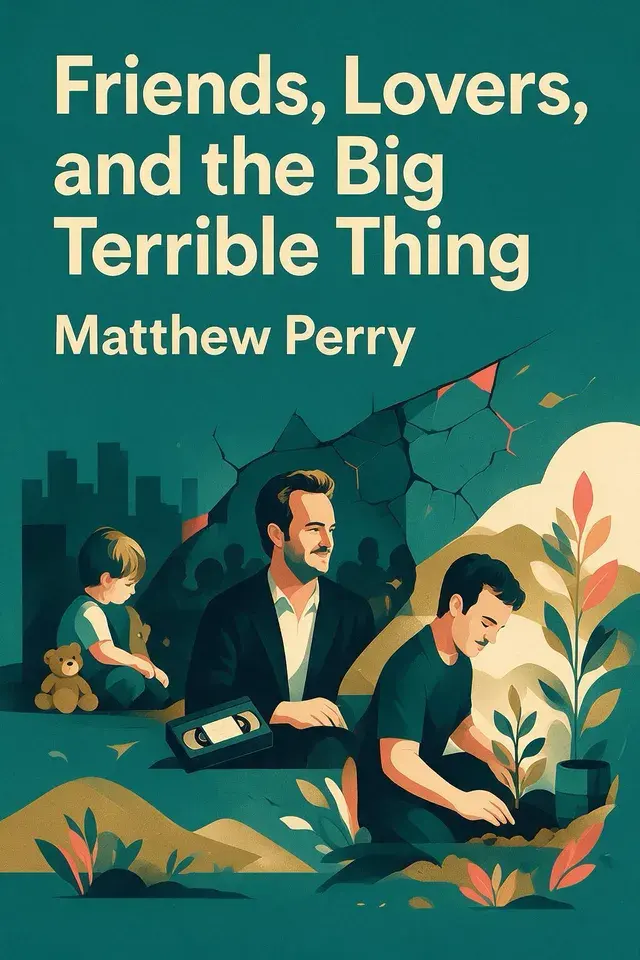
Key ideas from Friends, Lovers, and the Big Terrible Thing
These ideas compress the book's argument without treating the author's view as settled fact. Use them as an orientation before reading the full work or listening in Wiseley.
Abandonment teaches Perry to seek safety through distance, substitute fathers, humor, performance, and achievements that might earn approval.
Acting becomes a second drug because applause supplies safety, competence, attention, and belonging while alcohol already begins to damage him.
The fame Perry wanted as proof of worth brought global recognition but also exposure, performance pressure, secrecy, and isolation.
Tolerance turns opioids from a source of euphoria into a daily requirement for avoiding withdrawal.
AA, long-term treatment, disclosure, and community turn short abstinence into daily practice, though relapse remains possible.
Cirque frames recovery as uncovering trauma, discarding destructive patterns, and extending self-forgiveness beyond insight.
Perry’s wish for marriage and children makes intimacy a recovery test, because being fully known feels linked to abandonment.
Addiction remains patient and potentially fatal, so sobriety is an ongoing priority rather than proof of moral victory.
How Friends, Lovers, and the Big Terrible Thing builds its case
Follow how the book develops its argument. Each note is a brief orientation, not a replacement for the chapter.
Pain, Abandonment, and the View
Matthew Perry opens by saying he should be dead. He briefly looks back on an abdominal crisis that led to emergency surgery, a coma, and a life-support machine called ECMO.
Acting as a Second Drug
In 1984, Perry leaves Ottawa for Los Angeles believing that a new place might make him happy. He wants distance from family alienation and a humiliating sexual problem he treats as a private, permanent defect.
From the Formosa to Friends
At the Formosa Café, drinking first looked social. Perry spent nights with Hank Azaria, David Pressman, and Craig Bierko, a comic circle he calls their mini–Rat Pack.
Fame Makes the Hole Visible
Friends did not become a phenomenon merely because six actors happened to land in the same room. Perry remembers the cast as unusually connected from the start, but he also describes chemistry being cultivated.
Relief Turns Into Captivity
At first, Perry does not think he is looking for addiction. While filming Fools Rush In, he crashes a Jet Ski on Lake Mead and injures his neck.
When the Set Goes Dark
Friends ends with a small ritual. In the final episode, the six actors leave the apartment, place their keys on the counter, and form a line.
Recovery Becomes a Practice
After Friends, his films, and a six-year relationship, Perry calls the next phase a six-year odyssey, not the idle life of a wealthy man. Cirque Lodge, his third rehabilitation center, becomes the place where abstinence acquires a wider meaning.
Love Tests the New Sobriety
By his forties, Perry says, casual sex no longer answered what he wanted. He imagined a dependable teammate, marriage, and perhaps children.
A Life Beyond Performance
At the end of Perry’s account, addiction is neither a villain defeated once nor a verdict on character. He calls it a disease: cunning, baffling, powerful, and patient.