What you'll learn
Key ideas from These Truths
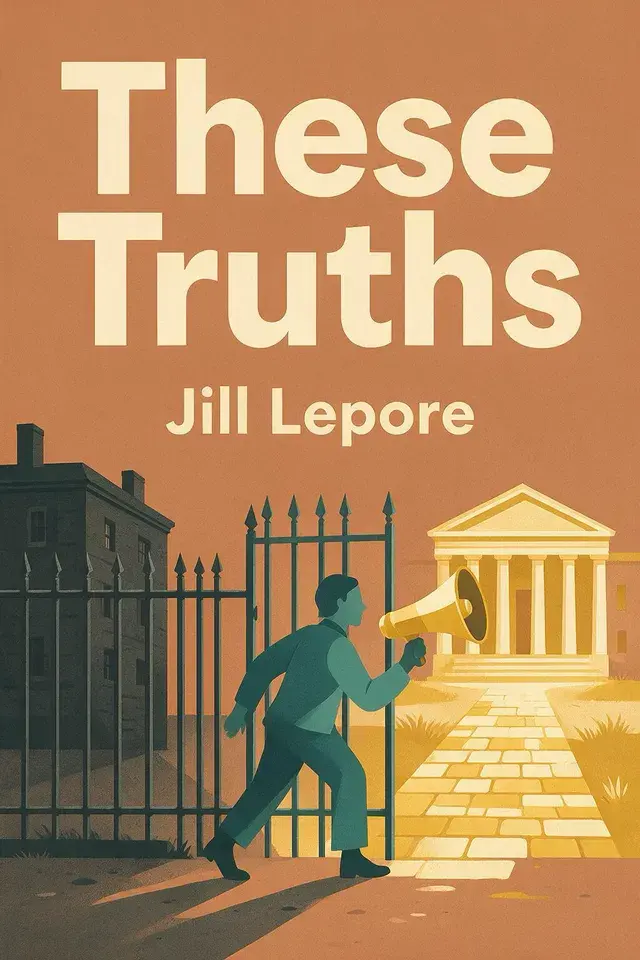
These ideas compress the book's argument without treating the author's view as settled fact. Use them as an orientation before reading the full work or listening in Wiseley.
Historical knowledge is assembled from an uneven archive in which surviving evidence and missing voices both shape what can be known.
Colonial self-government and English liberty developed alongside Indigenous dispossession and hereditary racial slavery.
The three-fifths compromise increased slave-state representation, while constitutional silence and delayed action shielded slavery from immediate federal challenge.
Enslaved people’s flight and Black military service made emancipation an active struggle and tied freedom to national belonging.
FDR made executive power intimate through radio, while the New Deal expanded relief, regulation, labor rights, and social insurance.
Civil-rights activism forced federal reform, while Vietnam, urban unrest, and law-and-order backlash fractured liberalism.
Deregulated media and scandal politics replaced shared deliberation with segmented audiences, celebrity conflict, and evidence that could be dismissed as bias.
The conclusion presents democratic survival as rebuilding institutions around truth, goodwill, equality, consent, and self-government amid digital disruption.
How These Truths builds its case
Follow how the book develops its argument. Each note is a brief orientation, not a replacement for the chapter.
Evidence, Conquest, and Origins
American history begins with a problem of knowledge: the past survives unevenly. Historians work with what chance, preservation, and power leave behind—documents, objects, maps, ruins, and memories.
Liberty Beside Slavery
American political liberty did not begin as a universal promise and then become distorted. In the colonies, self-rule and coercion grew together.
Revolutionary Rights, Revolutionary Limits
The Revolution began as a quarrel over imperial authority, then became an argument about legitimate government. The French and Indian War had united the mainland colonies, but Britain’s victory left it with heavy debt, new borders to defend, and a demand for colonial revenue.
Constitutional Power and Compromise
After the Revolution, Americans had to turn popular sovereignty into working government. The states first wrote, printed, and popularly ratified constitutions, experimenting with rights, voting rules, legislative design, and antislavery arguments.
Numbers, Machines, and Majorities
After the founding, American democracy became a problem of numbers. Who counted as the people, and when could a majority be trusted?
Expansion and Sectional Breakdown
Expansion promised republican opportunity, but Texas exposed its cost. John Tyler and Abel Upshur sold annexation as a safety valve and defense against European power, while avoiding slavery’s centrality.
War, Emancipation, and Citizenship
The Civil War did more than decide whether the Union would survive. It changed what the Union was for, how much power government could exercise, and what freedom required.
Citizenship, Capital, and Exclusion
After the Civil War, the urgent question became who belonged to the nation, what citizenship promised, and whether federal power would enforce it. The Constitution had used “citizen” without defining it.
Efficiency, Empire, and Mass Opinion
By the early twentieth century, the United States was industrial, urban, unequal, and hard to govern through older arrangements. Factories, immigration, cheap goods, concentrated wealth, and mass media created prosperity and bewilderment.
Crisis and the Liberal State
Radio promised to make democracy unified and intelligent. Herbert Hoover treated broadcasting as a partnership between government and business, but recognized that the airwaves could spread propaganda.
Postwar Machines, Rights, and Backlash
At the threshold of the information age, the book places John Mauchly’s ENIAC beside Toshiko Sasaki’s injury in Hiroshima, where falling books crushed her. The pairing makes knowledge double-edged.
Polarization and the Truth Crisis
By the late twentieth century, disagreement had become more than a dispute. It was a struggle over identity, constitutional meaning, information, and truth.
Choosing an Unfinished Future
At the end of the book, the founding question returns: can people deliberately establish good government, or must they live by accident and force? The question now unfolds under changed conditions.