What you'll learn
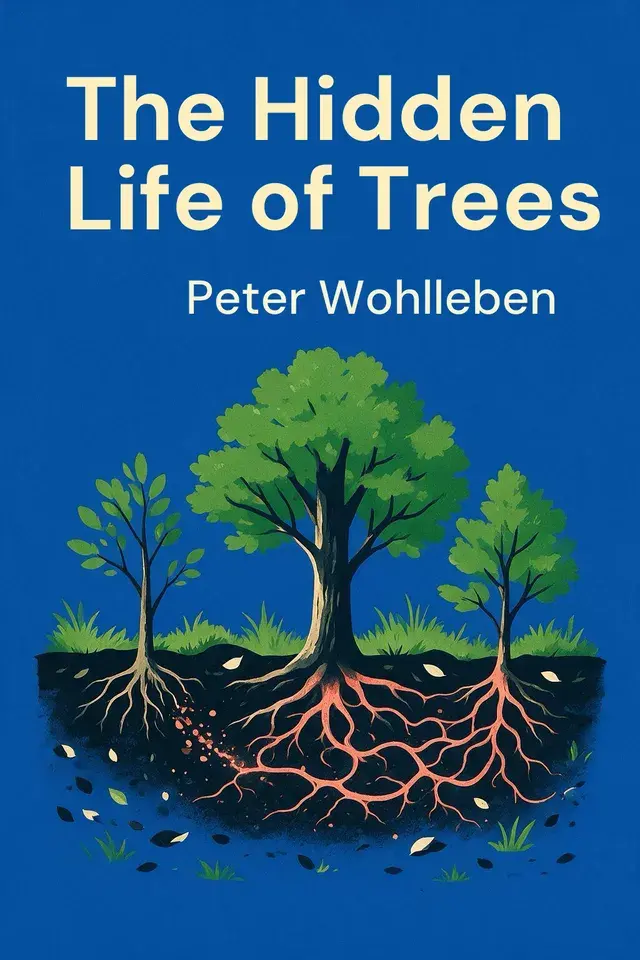
Key ideas from The Hidden Life of Trees
These ideas compress the book's argument without treating the author's view as settled fact. Use them as an orientation before reading the full work or listening in Wiseley.
The forest is presented as an interdependent community that creates stable conditions and supports vulnerable trees.
Mycorrhizal fungi expand root reach, exchange nutrients and protection for tree carbohydrates, and connect partners while remaining costly and partly selective.
Mature forests retain carbon in wood, cool soil, and humus, so tree death does not automatically return all stored carbon.
Forest soil acts as a reservoir, releasing water slowly and helping springs and streams remain more stable.
Dead wood supports specialized decomposers, recycles nutrients, and can serve as a temporary nurse log for new spruce.
Seasonal timing combines cold history, warmth, and daylight, and mistiming can damage new growth or deplete reserves for spring.
Seed design, animal dispersers, geography, and browsing make tree migration a slow and uneven response to changing climate.
Forest recovery is framed through natural succession, mixed ages, natural death, protected areas, and species-appropriate selective use.
How The Hidden Life of Trees builds its case
Follow how the book develops its argument. Each note is a brief orientation, not a replacement for the chapter.
A Society Beneath the Canopy
Forests are easy to misread. From a distance, they look like collections of separate trees, each seeking light, water, and space.
Growing Slowly, Built for Constraint
Trees do not survive by growing as fast as possible. In a mature forest, a young beech may stand only three to seven feet tall, yet the persistent swellings beneath its annual buds can show that it is at least eighty years old.
Roots, Soil, and Qualified Signals
Forest continuity is not held only in trunks and crowns. It also persists below the surface, where roots remain active, fungi bind different plants into exchanges, and soil organisms turn remains into the material that supports future growth.
Forests Make Their Climate
A mature forest is not simply a collection of trees growing under weather made elsewhere. It helps make the conditions around it.
The Forest as Shared Habitat
A forest is not a delicate arrangement in which every organism helps every other. Peter Wohlleben presents it as a contested resource system.
Clocks, Energy, and Health
Trees do not simply wait out winter. They spend late summer and autumn preparing for a period when water may freeze and new growth is impossible.
Movement Through a Changing World
A tree cannot relocate once it is rooted, but its lineage can travel. The seed is its brief mobile stage: it leaves the parent, crosses some distance, and may establish where conditions differ.
Human Stress and Forest Recovery
Once the book’s forest community is set beside a street, a park, or a plantation, tree illness stops looking like an isolated failure. It becomes a problem of missing relationships and simplified conditions.