What you'll learn
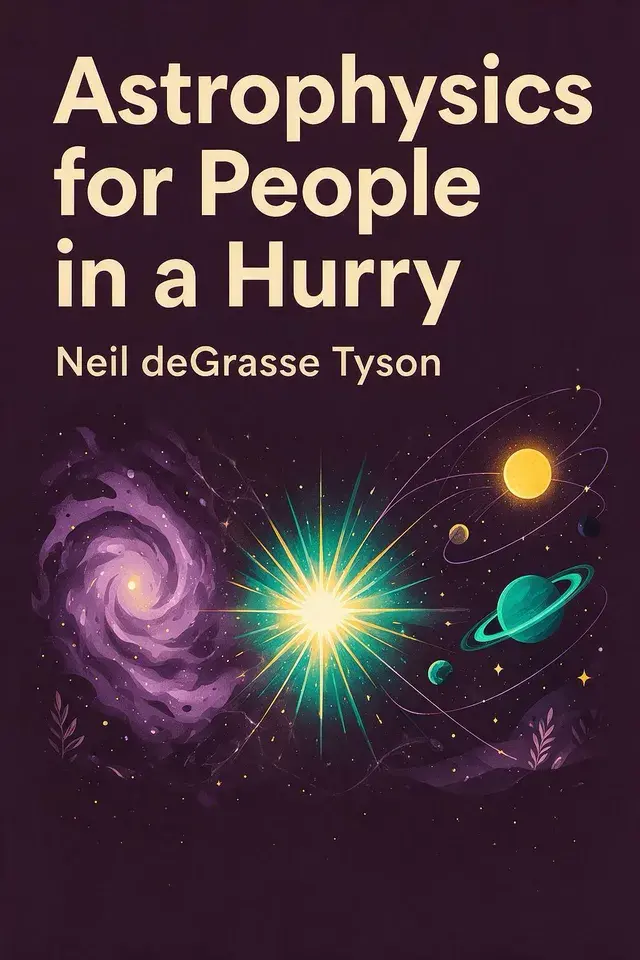
Key ideas from Astrophysics for People in a Hurry
These ideas compress the book's argument without treating the author's view as settled fact. Use them as an orientation before reading the full work or listening in Wiseley.
The universe expanded and cooled from an extreme early state into particles, atoms, stars, galaxies, planets, and life.
Galaxy and cluster motions reveal extra gravity, making dark matter’s cosmic role robustly measured while its substance remains unidentified.
Supernova distances show that cosmic expansion accelerates, giving dark energy a measured effect without settling its physical identity.
Stellar fusion transformed primordial material into carbon, oxygen, iron, and most heavier elements.
Visible light is only one band of the electromagnetic spectrum, so astronomy extends human perception with radio, infrared, ultraviolet, X-ray, and gamma-ray observations.
Remote evidence narrows possibilities without proving life or intelligence from one signal alone.
Earth is physically small but precious as humanity’s only home for the moment, making care compatible with humility.
How Astrophysics for People in a Hurry builds its case
Follow how the book develops its argument. Each note is a brief orientation, not a replacement for the chapter.
From Origin to Cosmic Structure
The cosmic story begins in a condition unlike anything we can directly observe. All known space, matter, and energy occupied a volume far smaller than a printed period, hot enough for the basic forces to be unified.
The Invisible Cosmic Majority
Astrophysics often identifies a thing by what it does before it knows what it is. Dark matter and dark energy are prime examples.
The Periodic Table as History
When you look at the periodic table, you are looking at a compressed history of the universe. It is not merely a chart of symbols; it records when familiar matter became possible.
Shapes That Reveal Forces
Shape is physical information. It records which forces acted, which constraints resisted them, and how long a system had to change.
Seeing Beyond Visible Light
Human vision samples only a narrow slice of what the universe sends us. For a long time, light mostly meant visible light.
A Busy Space Between Planets
A planetary system is not empty space around isolated worlds. The space between planets occupies almost all the solar system’s volume and remains busy.
Reading Earth from Afar
Imagine Earth observed by astronomers who cannot visit it. As their distance increases, fine surface details disappear first.
A Perspective Without a Center
The book’s scientific journey ends with a question less about where the universe is than how we should live within it. Astronomy enlarges the mind by revealing scales and relationships that can lift us above narrow prejudice.