What you'll learn
Key ideas from I Contain Multitudes
These ideas compress the book's argument without treating the author's view as settled fact. Use them as an orientation before reading the full work or listening in Wiseley.
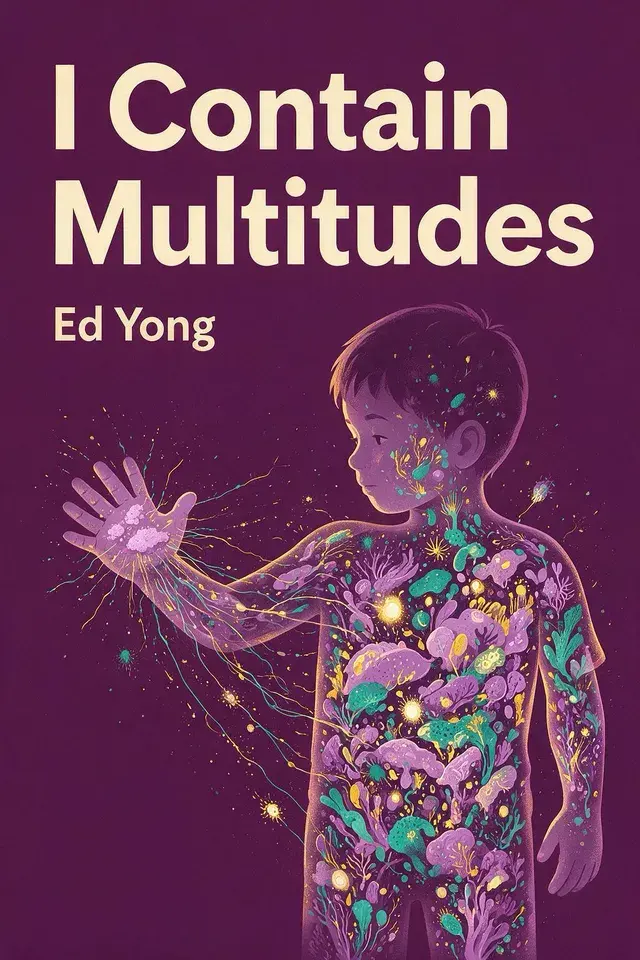
Animals are host–microbe ecosystems, with distinct microbial communities inhabiting body sites and connecting each host to its surroundings.
Microbes can trigger animal development, maintain tissues, and support regeneration, making bodily construction a continuing host–microbe process.
A microbe’s role changes with strain, body location, host state, and circumstance, so mutualism and pathogenicity describe relationships, not fixed identities.
Dysbiosis is a useful ecological warning but not a proven cause: disease can reshape communities, and communities can also help sustain disease.
Rare environmental encounters become durable symbioses only when microbes survive host filters, benefit hosts, and persist through reliable transmission.
Chemosynthetic and digestive symbionts let animals exploit dark habitats, plant fibre, wood, and nutritionally poor foods.
Microbiome treatment outcomes depend on hosts, nutrients, microbes, and ecological conditions acting together.
Excessive sterilization can remove harmless competitors and create ecological openings, while sanitation remains essential for controlling dangerous pathogens.
How I Contain Multitudes builds its case
Follow how the book develops its argument. Each note is a brief orientation, not a replacement for the chapter.
Life Is a Collective
Ed Yong begins with Baba, a white-bellied pangolin. A cotton swab from his face collects cells and opens a second view of the animal.
From Germs to Partners
The shift from seeing microbes as invisible curiosities to seeing them as partners began with a change in what scientists could observe. For most of human history, microbes were known through effects: illness, decay, and fermentation.
Bodies Built by Microbes
Earlier developmental examples showed that bacteria can initiate animal change. The deeper lesson is that the relationship does not end when the visible transformation is complete.
When Ecosystems Break
An ecological relationship can fail without a single villain. A body may still contain many familiar microbes, yet a change in diet, immunity, development, or environment can alter who thrives, what they eat, and what chemicals they release.
Partnerships That Become Inherited
A partnership between an animal and a microbe need not begin as a partnership. It may begin as an accident.
Microbes Expand Animal Possibility
An animal’s apparent range is not set by its own genes alone. Microbial partners supply chemistry that lets a host eat poor food, survive without sunlight, tolerate plant poisons, or repel enemies.
Engineering the Microbial World
Once microbes are understood as an ecosystem, medicine has to change its question. It is no longer enough to ask which organism causes trouble, or which helpful species can be added.
A Microbial Future of Place
By the end of the book, the body is no longer the largest useful unit of analysis. People shed and exchange microbes with the places around them, so the question becomes not only which organisms live in us, but which communities move through homes, institutions, cities, and ecosystems.