What you'll learn
Key ideas from Thus Spoke Zarathustra
These ideas compress the book's argument without treating the author's view as settled fact. Use them as an orientation before reading the full work or listening in Wiseley.
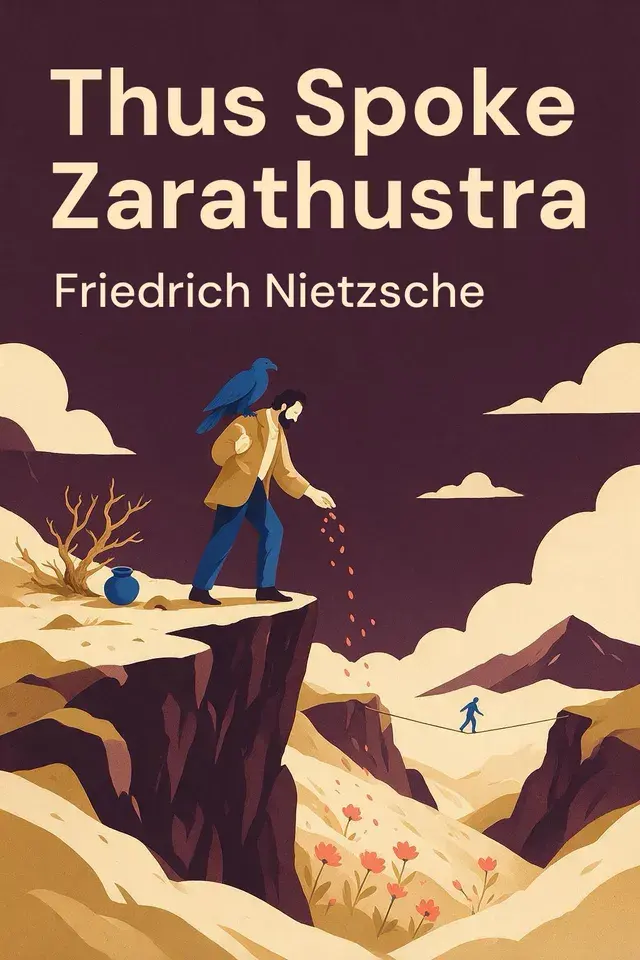
Humanity is presented as a precarious bridge, while the last human names comfortable nihilism and the overman names a difficult possibility beyond it.
The spirit’s path runs from chosen burden-bearing through a liberating No to the child’s innocent Yes.
Different peoples create moral values from their conditions and struggles, leaving humanity without one inherited goal.
Will to power includes obeying oneself, commanding, risking, creating, destroying, and overcoming one’s own values.
Redemption would transform the unchangeable past from “it was” into “thus I willed it,” but Zarathustra leaves that possibility unresolved.
Eternal recurrence tests whether affirmation can include the same life, with its pain, chance, past, and smallest events.
Part IV turns the search for the higher human into a cave drama that tests earlier ideals through visitors rather than presenting a finished doctrine.
Midnight joy embraces recurrence by willing pain, failure, and the whole chain of life again, while the higher men remain incomplete.
How Thus Spoke Zarathustra builds its case
Follow how the book develops its argument. Each note is a brief orientation, not a replacement for the chapter.
A Prophet Without a Creed
To read Thus Spoke Zarathustra faithfully, begin with a problem rather than a doctrine. The book imagines a world in which inherited moral and transcendent guarantees no longer command belief.
The Three Metamorphoses
Zarathustra’s overman is not a finished creature beyond humanity. It becomes imaginable through self-overcoming: a person must carry what has shaped them, resist it, and learn to begin without merely reacting.
Creating Values Beyond the Herd
After personal transformation, Zarathustra asks what a transformed person should create. He starts from a plural fact: peoples disagree about good and evil because their moral tables express their land, needs, struggles, and desired forms of overcoming.
Power, Resentment, and Beauty
Liberation is not complete when a person merely escapes an old command. It remains compromised if the new virtue still expects payment, fears punishment, seeks retribution, or repeats inherited duty and revenge.
The Abyss and the Past
Zarathustra’s distrust begins with people who claim to know. He leaves the scholars because their table leaves his soul hungry.
The Burden of Recurrence
The earlier riddle of eternal recurrence now becomes Zarathustra’s hardest practical test. If everything returns in the same configuration, affirmation cannot mean escaping pain, improving the past, or waiting for a better world.
The Cave of Transitional Figures
The Fourth Part changes the form of the search. Whether treated as a late appendix or an integral continuation, it retreats from public teaching and stays on Zarathustra’s mountain.
The Great Noon Begins
The cave episode now becomes a communal test. The men gathered around Zarathustra arrive with hunger, despair, and longing, but their arrival does not create the community he seeks.