What you'll learn
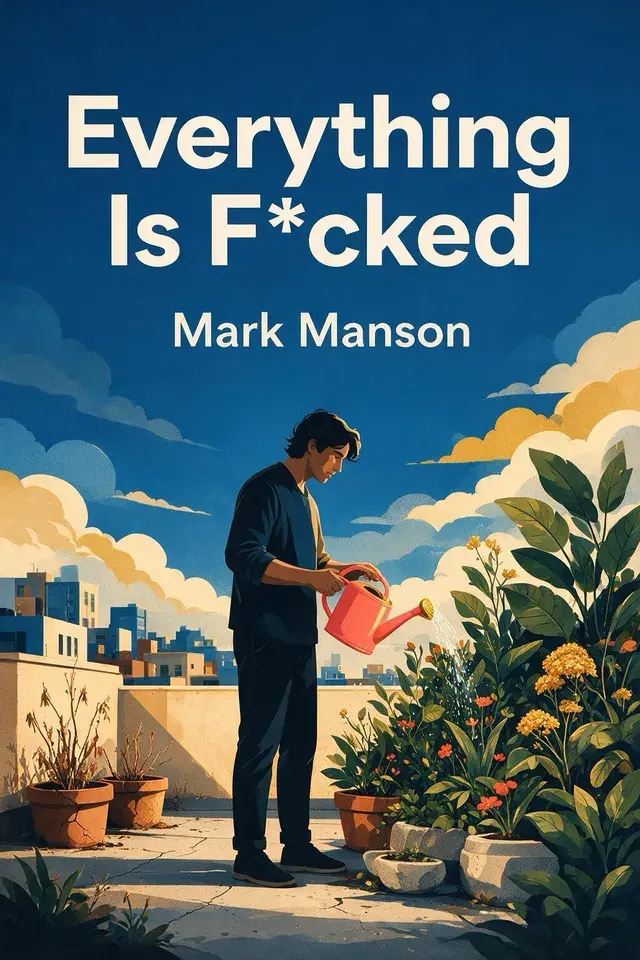
Key ideas from Everything Is F*cked
These ideas compress the book's argument without treating the author's view as settled fact. Use them as an orientation before reading the full work or listening in Wiseley.
Sustainable hope depends on control, worthwhile values, and a community that shares the goal and its significance.
Self-control emerges through emotional dialogue, small compromises, and gradual alignment rather than direct command or suppression.
Values are stories about feelings and deservingness; repeated stories form identities that people defend as intensely as their physical bodies.
Amor fati accepts suffering, mortality, and uncertainty while calling for responsible action without dependence on a promised future.
Kant’s Formula of Humanity treats conscious beings as ends, making self-respect, honesty, courage, and humility forms of dignity.
Antifragility is associated with engaging manageable adversity and learning from stress instead of shrinking life around what feels safe.
Real freedom grows through chosen limits, sustained commitments, sacrifice, and tolerance for discomfort rather than endless options or accelerated mastery.
How Everything Is F*cked builds its case
Follow how the book develops its argument. Each note is a brief orientation, not a replacement for the chapter.
The Problem of Hope
At the opening of Everything Is F*cked, Mark Manson sets a disturbing paradox. Human beings have gained safety, health, literacy, rights, wealth, and longevity.
The Feeling Brain
Imagine retaining a high IQ, strong memory, fluent conversation, and the ability to explain consequences, yet losing the ability to choose what to do. The author opens with Elliot, a successful, socially connected man whose severe headaches led doctors to find a large frontal-lobe tumor.
How Pain Becomes Identity
Pain does more than hurt. In Manson’s account, it creates a moral gap: something feels wrong because suffering or benefit seems undeserved.
The Machinery of Faith
Earlier, the book showed how feelings become values, values become stories, and shared stories pull people into communities. This chapter asks what happens when that emotional gravity becomes a system that coordinates lives.
After Hope Dies
Nietzsche’s declaration that “God is dead” is not presented as an atheist’s celebration. It sounds more like a watchman’s warning.
Maturity Means Human Dignity
Once hope is no longer treated as a promise that the future will redeem the present, morality has to stand on its own. The chapter describes hope as a bargain: present behavior is exchanged for an imagined pleasant future.
The Value of Necessary Pain
One of the chapter’s central reversals is that pain is not a temporary defect in an otherwise complete life. It is a recurring feature of being alive.
Freedom Requires Limits
Once the value of necessary pain is applied to society, the problem changes scale. A culture can reduce real suffering while teaching people to flee every unpleasant feeling.
A Human Future Beyond Hope
The book's final turn begins with chess. Deep Blue's 1997 victory over Garry Kasparov changed public ideas about technology and intelligence, even if later computer superiority seemed obvious.