What you'll learn
Key ideas from The Autobiography of Malcolm X
These ideas compress the book's argument without treating the author's view as settled fact. Use them as an orientation before reading the full work or listening in Wiseley.
Family terror, Garveyite independence, color hierarchy, hunger, and welfare surveillance make vulnerability a political inheritance.
Malcolm condemns his own predation while locating it within racial exclusion, poverty, lost legitimate work, and an uneven legal order.
Dictionary work and intensive reading expand Malcolm's language and historical frame, allowing guilt to become an interpretable account of power and dispossession.
Businesses, schools, mosques, buses, security, and rallies translate self-determination rhetoric into national organizational scale.
Psychological separation redirected Malcolm’s earned followership toward a Black political lobby and Muslim Mosque, Inc.
After Mecca, Malcolm combines Black solidarity and self-defense with conditional universalism and a warning against treating human leaders as infallible.
The OAAU translated post-Hajj revision into nonsectarian Black human-rights work that retained self-defense, international solidarity, and selective cooperation.
Haley presents Malcolm’s post-Mecca transformation as real but unfinished, leaving history to weigh militancy, manhood, responsibility, and martyrdom.
How The Autobiography of Malcolm X builds its case
Follow how the book develops its argument. Each note is a brief orientation, not a replacement for the chapter.
Inheritance, Custody, and the Road North
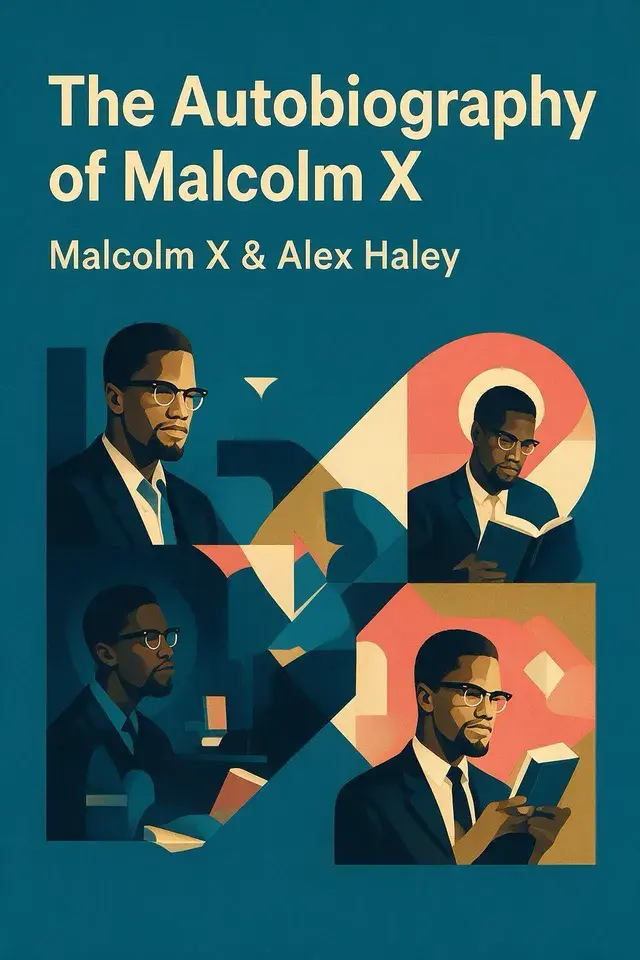
Handler’s introduction gives this autobiography two dimensions. It is Malcolm X’s personal account, but also a testimony about Black identity, suffering, and redemption.
Roxbury, Jazz, and Self-Invention
Roxbury is Malcolm’s first sustained lesson in how a city distributes belonging. Arriving from Michigan, he feels conspicuously rural: his haircut, ill-fitting suit, short sleeves, and short trousers mark him as an outsider.
The Hustler Economy and the Criminal Trap
Once hustling becomes full-time, Malcolm says, it stops being a flexible way to get by and becomes a system of constant alertness. Older operators teach him through clothing, reputation, contacts, knowledge of detectives, and selective trust.
Prison, Submission, and Self-Education
Prison first strips Malcolm down to a number. After sentencing, Charlestown makes identity bureaucratic, and he says confinement leaves a mark former prisoners cannot erase.
A Faith Becomes a Household and Movement
Parole in spring 1952 moved Malcolm into a test of whether prison discipline could survive ordinary life. His brother Wilfred arranged custody and work at a Detroit furniture store, while relatives directed him toward a temple of practicing Muslims.
Nation of Islam: Public Power and Scale
The Nation of Islam’s public power begins with a test of disciplined action, not a planned publicity campaign. In Malcolm’s account, two white policemen breaking up a Harlem street fight beat Johnson Hinton, a Muslim bystander, with nightsticks after he refused to scatter.
Scandal, Rupture, and an Independent Political Base
After the Nation of Islam had made Malcolm a powerful public representative, its authority still rested on a moral image he had defended almost without qualification. The reported scandal involving Elijah Muhammad therefore threatened more than a leader’s reputation.
Hajj, Africa, and Conditional Brotherhood
After the organizational rupture that preceded it, the Hajj gives Malcolm a new education. The change comes through voluntary affinity, physical practice, and hospitality.
Authorship, OAAU, and Life Under Threat
The autobiography takes shape inside guarded access. Alex Haley first approached Malcolm X as a journalist studying the Nation of Islam, but Malcolm suspected white reporters and spies.
Assassination, Mourning, and Unfinished Legacy
At the final Audubon meeting, Malcolm arrived shortly before two o’clock, walking heavily rather than with his usual stride. He told assistants he did not want people attending because of personal troubles.