What you'll learn
Key ideas from Night
These ideas compress the book's argument without treating the author's view as settled fact. Use them as an orientation before reading the full work or listening in Wiseley.
Ghettoization, deportation, and selection turn a shared town into a system that sorts people for labor or death.
Choiceless choices arise when collective punishment makes every response dangerous, while perpetrator and bystander roles remain ethically distinct.
Eliezer’s shameful wish to escape his father’s burden coexists with acts of care, making responsibility a struggle rather than a pure virtue.
Night presents faith as a tradition of questioning, and atrocity strips away inherited answers without eliminating the address to God.
The survivor’s voice preserves the dead without claiming that language can repair what atrocity destroyed.
Lemkin, Jeremiah, and Wiesel’s public life connect memory with enacted solidarity and future-oriented protection of human life.
Multiple testimonies, gendered perspectives, and retrospective mediation prevent Night from becoming a single sacred substitute for every victim’s experience.
How Night builds its case
Follow how the book develops its argument. Each note is a brief orientation, not a replacement for the chapter.
Why Night Still Questions
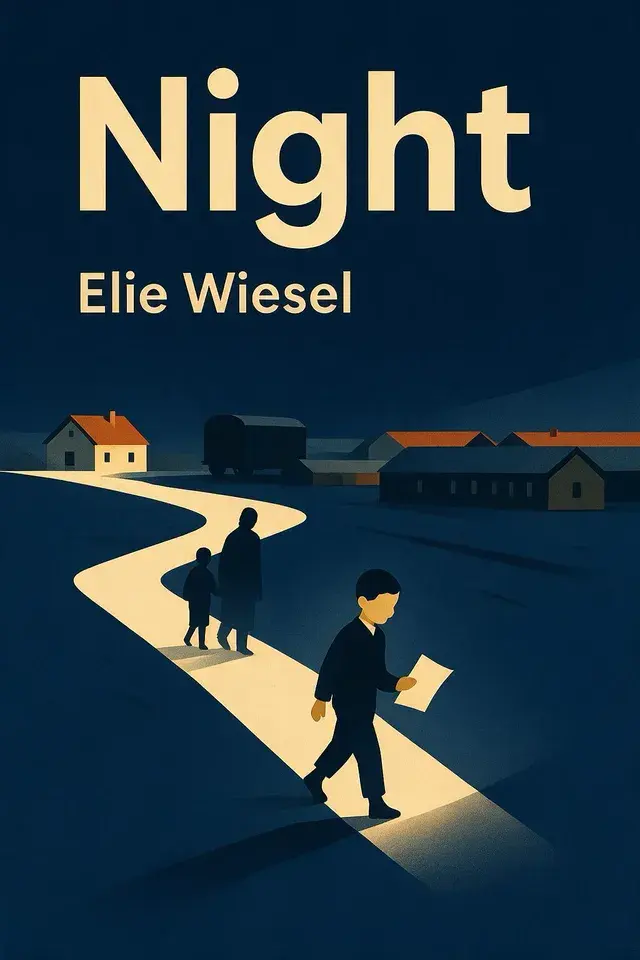
To begin with Night, we need to hold two truths at once. The book is a survivor’s testimony about a historical catastrophe, and it is also a crafted object: selected, arranged, voiced, and addressed to readers.
From Boyhood to the Camps
Night opens in a world where a young person is expected to grow into an inherited life. Eliezer is a pious boy in Sighet, immersed in Talmudic study and Jewish mysticism.
The Ethics of Staying Alive
Night’s camp world is organized around immediate bodily facts. Hunger narrows attention until time is measured by soup, bread, and a starved stomach.
The Father, the Broken God
Night’s deepest moral test is not stated as an abstract rule. It appears in the changing relationship between Eliezer and his father.
Faith in the Darkness
Night begins with faith as a living inheritance, not as a theory. Eliezer is a pious boy immersed in Talmudic and mystical study.
Silence Becomes Witness
Night does not treat silence as the simple opposite of speech. It turns their conflict into a struggle over whether experience can enter memory at all.
The Survivor in the Mirror
Night is often treated as a direct window onto one survivor’s experience. Its publication history complicates that image without making the witness disappear.
From Memory to Responsibility
Night’s ending leaves Eliezer facing a corpse-like reflection: survival has not restored a whole self or a usable future. Later Wiesel does not revise that darkness into a completed spiritual lesson.
Reading Against Indifference
To read Night responsibly, hold two responses together. Let the memoir affect you, then return to ask how its language, structure, memory, and historical situation create that response.