What you'll learn
Key ideas from I Am Malala
These ideas compress the book's argument without treating the author's view as settled fact. Use them as an orientation before reading the full work or listening in Wiseley.
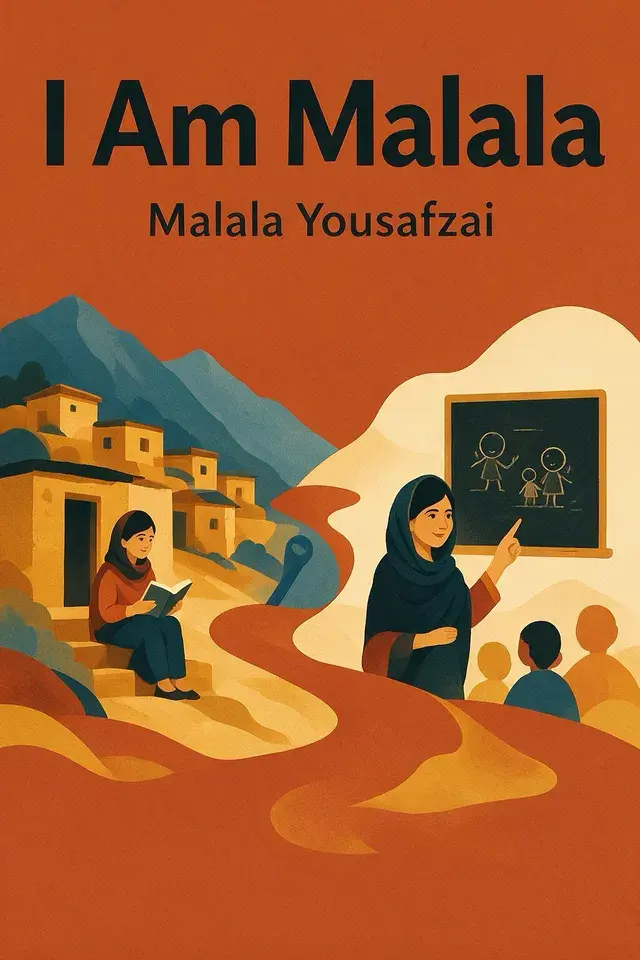
Malala’s public voice begins in a family that challenges the devaluation of daughters through naming, education, and speech.
Taliban authority appealed through faster justice and relief, then normalized control of women, schools, public space, donations, labor, and resources.
School preserves academic identity, friendship, humor, and a future that militants try to close.
The Gul Makai diary turns ordinary fear, school routines, and Taliban restrictions into testimony that reaches beyond Swat.
The peace deal reduced violence briefly but left the Taliban with authority over daily life.
A militarized school and unequal return show that rebuilding requires civilian protection, functioning schools, and support beyond official victory.
Prayer, study, friendship, and family routines preserve ordinary agency until the school bus is intercepted and Malala’s memory stops before impact.
The United Nations appeal reframes Malala’s fame as a universal demand for free education, peace, and nonviolent power through books and pens.
How I Am Malala builds its case
Follow how the book develops its argument. Each note is a brief orientation, not a replacement for the chapter.
A Valley That Raised a Voice
The memoir’s frame places Malala’s later danger around her schooling, but this chapter begins earlier, on 12 July 1997, in a two-room shack beside Ziauddin’s first school. Because she was a girl, villagers sympathized with her mother rather than congratulating her father, and the family held no customary seventh-day celebration.
The Wars Behind the Valley
The forces that later made Swat vulnerable did not begin in Swat, and they cannot be explained by religion alone. They grew from a country founded as a Muslim homeland but still arguing over Islam’s place in public life.
How Militant Rule Took Hold
Earlier relief work had shown how militant-linked networks could earn trust by reaching places the state neglected. In Swat, Maulana Fazlullah turned that visibility into wider authority.
School as a Line of Defense
By this point, occupation is no longer encountered only in speeches or distant battles. It enters the timetable, the road home, the electric supply, the games children play, and the silence of adults.
A Diary Under Occupation
When school became uncertain, Malala found a way to make daily life visible beyond Swat. BBC correspondent Abdul Hai Kakar sought a female teacher or schoolgirl to describe the catastrophe.
Peace, Exile, and Forced Departure
By February 2009, Swat’s residents were ready to welcome almost any pause in the violence. A peace deal offered one: the government would impose sharia throughout Swat, while the Taliban would stop fighting for a ten-day truce.
Recovery Without Resolution
After the military operation, the government announces that Swat is cleared and services are returning. Malala’s return in July two thousand nine shows why that is not the same as recovery.
The Politics of a Public Girl
Having become a public voice through Swat’s crisis, Malala now looks beyond the valley. Her questions concern what a state owes its citizens, what sovereignty means when allies act alone, and whether recognition changes a child’s chances.
The Bullet Finds Its Target
By early 2012, Malala’s public work had carried her beyond Swat. A visit to Karachi, after a girls’ school was renamed in her honor, made her ask what freedom meant in ordinary life.
Between Trauma and Rescue
After the gunman leaves the bus, the emergency is tangled with delay. Malala is conscious enough to be recognized, but bleeding from her head and left ear.
A Second Life for Education
Malala’s second life begins not with clarity but with confusion. On 16 October, a week after the shooting, she wakes in Birmingham with a breathing tube in her neck and no voice.