What you'll learn
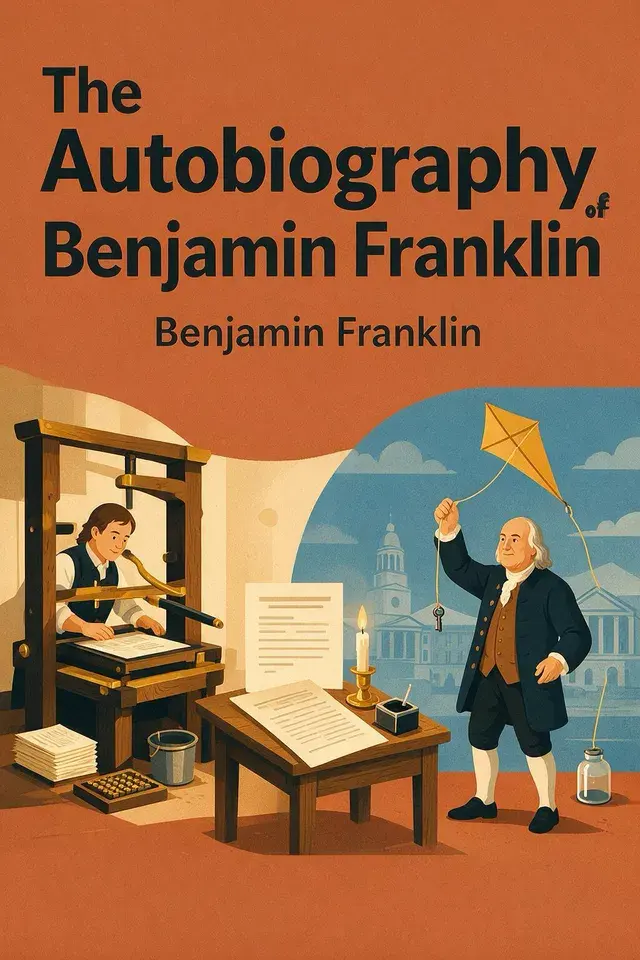
Key ideas from The Autobiography of Benjamin Franklin
These ideas compress the book's argument without treating the author's view as settled fact. Use them as an orientation before reading the full work or listening in Wiseley.
Reading, imitation, revision, and economical use of time make writing and broader study teachable practices.
A voyage journal converted accumulated failures into a deliberate plan for regulating conduct.
Franklin defines thirteen virtues so moral improvement can be observed through specific conduct rather than broad intention.
Franklin extends the same public-minded logic through popular print and free invention, treating useful knowledge as something to circulate.
Franklin turned Plain Truth into a voluntary defense association, but its success depended on persuasion, shared interests, and uneasy accommodation with Quaker principles.
Tactful compromise protected public credit and kept aid moving, but it did not reconcile the rival claims of governors, proprietors, Assemblies, and the crown.
Franklin’s electrical authority grows through repeated experiments, accessible publication, public demonstrations, and independent verification.
How The Autobiography of Benjamin Franklin builds its case
Follow how the book develops its argument. Each note is a brief orientation, not a replacement for the chapter.
Learning Against Circumstance
Franklin begins by explaining why he is telling his life at all. He addresses his son, saying family anecdotes may be agreeable and useful.
Errors Become a Method
Franklin’s first advancement was not a clean ascent. In Philadelphia and London, work, frugality, useful printing skill, reading, and sociability improved his prospects.
Virtue as Daily Practice
Franklin’s method begins with a failure of simple moral reasoning. He first hoped that knowing right from wrong would produce faultless conduct.
Institutions That Multiply Usefulness
Franklin's public usefulness becomes durable when it stops depending on one person's energy. A private habit can improve its owner; an institution lets many people contribute, coordinate, and continue the work.
Public Power Under Constraint
Franklin’s civic method meets its hardest test when war turns public usefulness into questions of command, money, loyalty, and authority. He responds with voluntary organization, fair incentives, local knowledge, tact, and legislative accountability.
Experiment, Evidence, and Limits
Franklin’s public authority rests on a standard he applies to science and practical life: an idea becomes trustworthy when experience tests it, others can understand it, and independent observers can check it. The Autobiography also exposes a tension.