What you'll learn
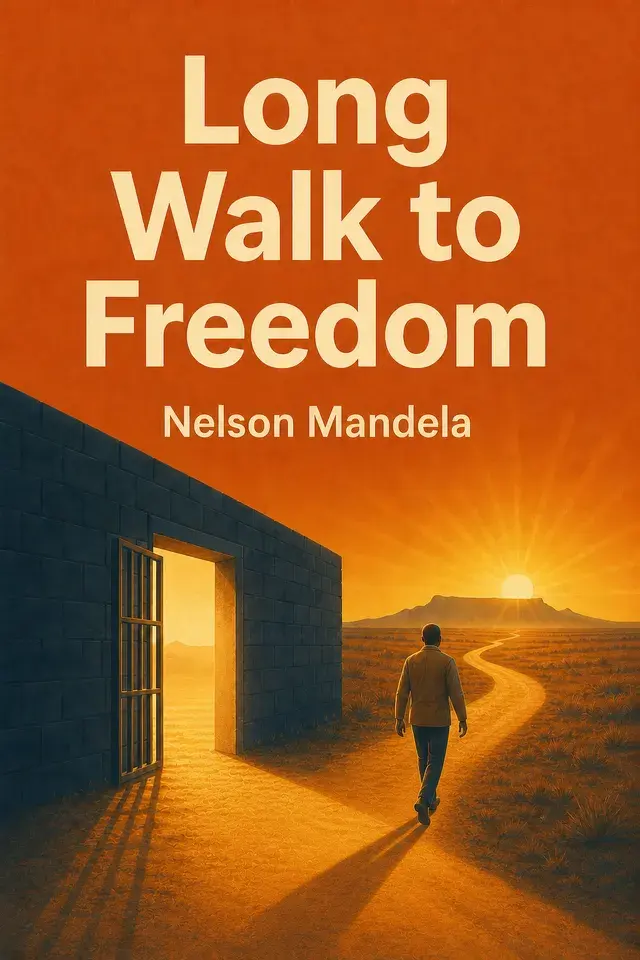
Key ideas from Long Walk to Freedom
These ideas compress the book's argument without treating the author's view as settled fact. Use them as an orientation before reading the full work or listening in Wiseley.
Mandela’s politicization accumulated through daily slights, poverty, work, solidarity, and debate rather than one conversion.
The Defiance Campaign used disciplined, staged lawbreaking to expose apartheid and build a mass movement, producing organizational gains rather than regime change.
The Freedom Charter turns scattered demands into a multiracial program for popular government, equal rights, land, and shared wealth.
Sabotage targeted state capacity rather than people, but an accidental death showed that ethical limits could not remove violence’s risks.
Collective knowledge, rule literacy, study, coded communication, and news circulation preserved political capacity under confinement.
Mandela rejects conditional personal release because freedom without collective political rights remains another form of control.
The 1994 election ended formal racial domination, but poverty and deprivation showed that political emancipation was not social freedom.
Mandela defines freedom by whether it enlarges the freedom of others, including former enemies.
How Long Walk to Freedom builds its case
Follow how the book develops its argument. Each note is a brief orientation, not a replacement for the chapter.
Custom, Authority, and Origins
Mandela’s political character begins in a rural Thembu world where identity was communal, authority customary, and dignity learned through daily relations. He belonged to the Madiba clan and royal household but not to the succession: his Ixhiba line traditionally counseled rulers and settled disputes.
Education, Defiance, and Escape
At Healdtown, Mandela entered an educational oasis built on Xhosa dispossession. Its English-model Christian liberal-arts curriculum opened doors while teaching students to admire English institutions and white authority.
Johannesburg Makes a Freedom Fighter
Johannesburg did not make Mandela a freedom fighter through one dramatic revelation. It accumulated the evidence.
Learning How Mass Resistance Works
Mandela presents 1946 as a turning point because two campaigns taught him that resistance depended on organization as much as anger. The African Mine Workers Union organized roughly 70,000 miners around demands for a ten-shilling minimum wage, housing, and paid leave.
Law Under a Racial State
After the Defiance Campaign, the state tightened the law around public resistance. Banning orders could remove leaders without proof or charges, restrict movement and meetings, and limit conversation.
A Nation Beyond Tribal Rule
Sophiatown’s defeat forced a diagnosis larger than one failed campaign. Speeches, deputations, marches, strikes, stay-aways, and imprisonment had not stopped removal.
The Personal Price of Politics
Politics does not stay at the office. It enters the home through arrest, legal danger, and children’s confusion.
Treason, Sharpeville, and Emergency
The Treason Trial showed how apartheid could use legal procedure to manufacture suspicion. Proceedings were delayed by years of arrests, hearings, changing indictments, and maneuvering.
The Trial Moves Underground
When the Emergency made lawyer-client consultation nearly impossible, the Treason Trial became more than a contest over evidence. It became a struggle over whether an unjust state could define democratic opposition as treason.
Choosing Sabotage and Wider Support
With the ANC driven underground, the question became whether its methods still matched the danger. The May twenty-ninth stay-at-home tested that choice.
Rivonia and the Meaning of Resistance
Rivonia was not simply a criminal case about secret acts. For Mandela and his co-defendants, it was the moment to explain what resistance meant after repression had closed peaceful politics.
Robben Island as Political Front
Robben Island did not interrupt the struggle; it relocated it. The authorities used prison to isolate political prisoners, erase individuality, and enforce obedience.
Prison University and Political Renewal
On Robben Island, time became a political resource as well as a punishment. Reforms could be won and withdrawn, yet each gain widened space for organization.
Family, Memory, and the Opening
Apartheid reached into family life as deliberately as public politics. After the Soweto uprising, authorities sent Winnie into internal exile at Brandfort because her influence with young radicals persisted.
Negotiation Without Surrender
Mandela presents negotiation as a change in the form of struggle, not an abandonment of it. By the late nineteen eighties, the conflict had lasted decades, the state remained militarily stronger, and a battlefield victory was remote.
Freedom as Unfinished Work
Release did not end Mandela’s struggle; it changed its form. The ANC had to become a legal, nationwide mass movement after decades underground, uniting exiles and internal leaders.