What you'll learn
Key ideas from Nudge
These ideas compress the book's argument without treating the author's view as settled fact. Use them as an orientation before reading the full work or listening in Wiseley.
Every choice environment has an architecture, and its details can steer behavior even when designers claim neutrality.
Libertarian paternalism permits welfare-oriented influence while keeping alternatives open and opting out easy and cheap.
Temptation creates dynamic inconsistency when the Planner’s long-term aims can lose to the Doer’s immediate hot-state impulses.
Error-forgiving design, actionable feedback, and clear mappings reduce predictable mistakes and clarify consequences.
Informational influence and peer pressure can guide cooperation, but conformity can also turn arbitrary beliefs into durable group norms.
Automatic enrollment and Save More Tomorrow use defaults and precommitment to make participation and future contribution increases easier.
Environmental policy combines disclosure, salient feedback, taxes, and emissions trading, while political difficulty and large spillovers limit nudges alone.
Legitimate nudging depends on competence, honest motives, transparency, accountability, and opt-outs that remain easy to use.
How Nudge builds its case
Follow how the book develops its argument. Each note is a brief orientation, not a replacement for the chapter.
Choice Is Never Neutral
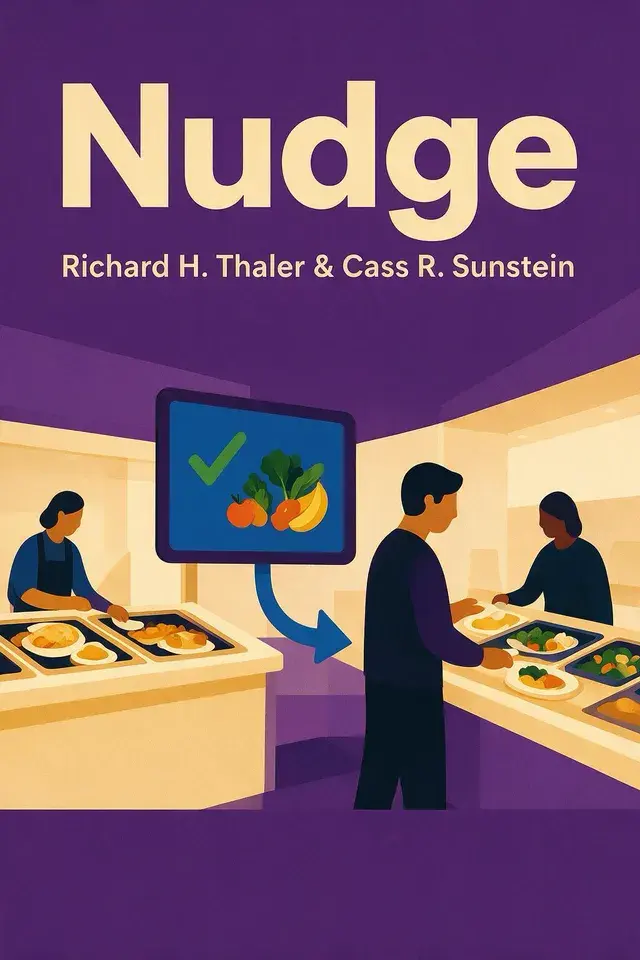
Choice is never neutral, even when nobody intends to influence anyone. Consider a school cafeteria.
How Humans Actually Choose
People can be highly capable and still make predictable mistakes. A visual illusion in which identical tabletops seem differently proportioned shows how context can distort confident perception; removing the surrounding context restores accuracy.
The Nudge Design Toolkit
The behavioral model becomes useful when it changes how environments are built. The authors call this work choice architecture: arranging a setting so its signals, sequence, and available actions help real people navigate it.
Social Forces and Timing
People are influenced by other people in ways that can improve judgment or magnify error. The authors distinguish informational influence, treating others’ actions as evidence, from peer pressure, the wish for approval or fear of disapproval.
Saving and Investing
Retirement saving tests how people actually choose. Standard theory assumes workers can calculate lifetime earnings, decide what retirement requires, and follow an optimal saving path while resisting present spending.
Choice Under Financial Complexity
When people must borrow, compare contracts, or select investments from a huge menu, choice alone may be a weak safeguard. Products can be useful, and higher prices can compensate lenders for genuine risk.
Health, Donation, and Environment
Health coverage, organ donation, and environmental protection test choice architecture under unusual pressure. The choices are complex or delayed, and some affect vulnerable people or impose costs on others.
Education, Law, and Marriage
Choice architecture matters most when a right exists on paper but not in practice. This chapter carries the framework beyond ordinary purchases into school assignment, medical liability, and family law.
Mininudges, Ethics, and Limits
The mininudge examples show how far the framework can travel beyond any single policy area. Give More Tomorrow transfers delayed commitment to charitable giving: people begin with a small donation, agree to future increases, and retain an easy opt-out.