What you'll learn
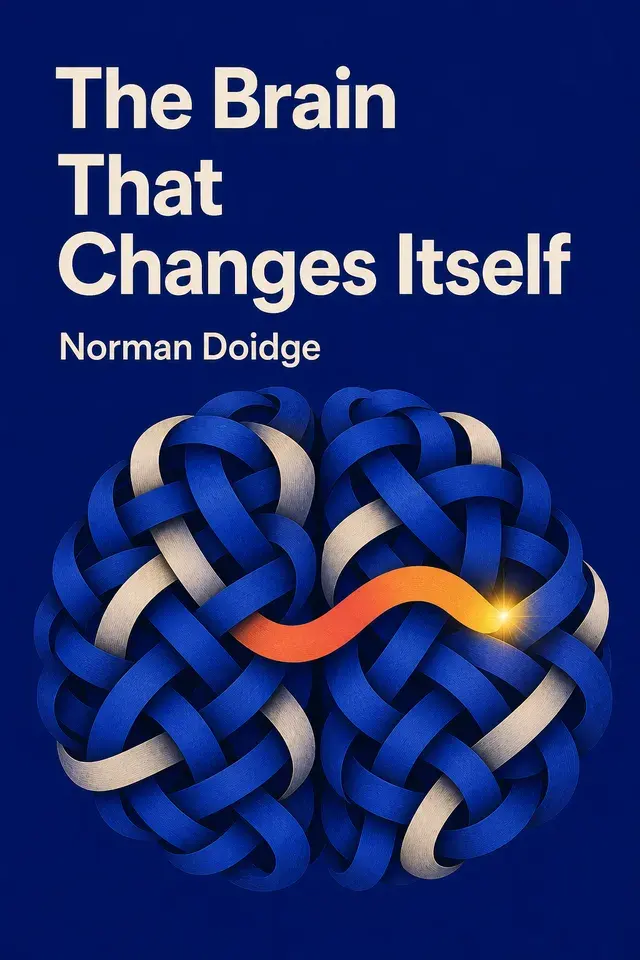
Key ideas from The Brain That Changes Itself
These ideas compress the book's argument without treating the author's view as settled fact. Use them as an orientation before reading the full work or listening in Wiseley.
The fixed-brain model treated adult abilities as permanently localized, but activity can reorganize circuits and sometimes let other regions support lost functions.
Cortical maps reorganize through competition: active inputs expand while deprived territory is taken by neighboring representations.
Constraint-induced therapy pairs limiting the stronger limb with shaping and concentrated practice to rebuild usable movement.
OCD can become a self-reinforcing loop in which intrusive alarms, compulsions, and brief relief strengthen one another.
Expertise grows through concentrated repetition that makes long-term memory rapidly usable, while repeated responses can also harden into efficient, resistant neural tracks.
Plasticity continues in later life, but demanding novelty may matter more than repeating familiar skills.
Culture reshapes inherited neural systems through sustained practices such as literacy, music, navigation, and technology.
How The Brain That Changes Itself builds its case
Follow how the book develops its argument. Each note is a brief orientation, not a replacement for the chapter.
The Fixed Brain Reconsidered
Doidge begins with a reversal of an older picture of the brain. For centuries, mainstream science treated the adult brain as something that could decline but not meaningfully rebuild itself.
Training a Different Brain
Someone can be gifted at remembering facts yet struggle to understand relationships, read fluently, or navigate a room. In Doidge’s account, such uneven performance is not evidence of low intelligence.
Maps, Timing, and Practice
To understand plasticity at the map level, Doidge asks us to stop imagining the cortex as a set of fixed territories. Wilder Penfield electrically stimulated the exposed cortex of conscious surgical patients and found organized sensory and motor maps.
Desire Learns Its Objects
Neuroplasticity changes the meaning of desire. In Doidge’s account, attraction is not simply a fixed biological command waiting for its object.
Recovery Through Constraint
When a stroke leaves an arm motionless, the visible problem is damaged brain tissue. Doidge asks us to notice a second problem: learned nonuse.
Rewriting Locked Body Maps
Neuroplasticity is not automatically benevolent. The same capacity that strengthens useful pathways can also strengthen a false alarm.
Practice, Imagination, and Therapy
Plasticity does not require the body to move. It can begin with a movement imagined, rehearsed, and held in attention.
Plasticity Across a Lifetime
Plasticity does not disappear when the brain ages; its conditions change. The later-life brain may process information more slowly and with more neural noise, yet it can still reorganize when experience demands genuinely new work.
Culture Rewires Human Nature
Earlier chapters establish that experience can reorganize an individual brain. The cultural synthesis widens the claim: the brain does not simply produce culture; culture trains the brain in return.