What you'll learn
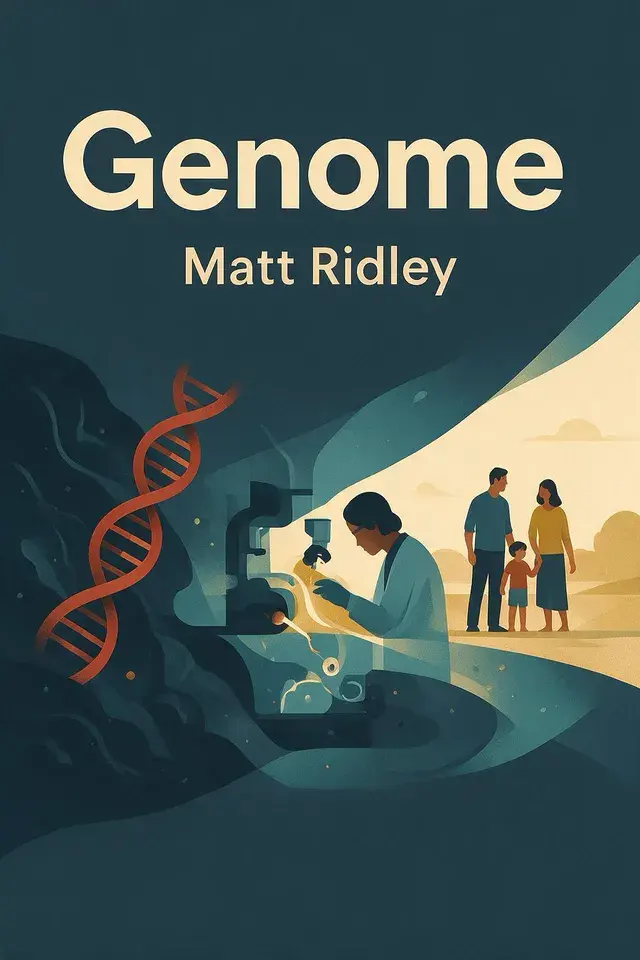
Key ideas from Genome
These ideas compress the book's argument without treating the author's view as settled fact. Use them as an orientation before reading the full work or listening in Wiseley.
Life combines approximate self-replication with energy-consuming order-making, making information central without making genes a complete human blueprint.
Evolution is framed as adaptation through contingency, not progress toward a human pinnacle or a deterministic genetic script.
The genome is presented as a coalition in which genes can serve conflicting interests rather than one harmonious organism-wide program.
ABO and sickle-cell variants show how infectious disease preserves trade-offs instead of selecting one universally optimal allele.
Cultural practices such as pastoral milk use can redirect natural selection, producing genetic adaptation without Lamarckian inheritance.
Genes create brains that adapt by changing synapses in response to experience.
Modern reproductive screening differs from state eugenics through private control, but medical, financial, and cultural pressure can weaken voluntariness.
How Genome builds its case
Follow how the book develops its argument. Each note is a brief orientation, not a replacement for the chapter.
Code Beneath Life
Genome opens with a literary device. Its twenty-three chapters correspond to the twenty-three human chromosomes, and each chromosome becomes a route into a theme of human nature.
The Ape Within Us
Human evolution is reconstructed from genes, fossils, bodies, environments, and behavior. The starting surprise is how close humans remain to chimpanzees: genetic comparisons place humans nearer to chimpanzees than chimpanzees to gorillas, and comparable DNA segments differ by fewer than two letters per hundred.
Inheritance Becomes Matter
Before genes became sequences, heredity was a puzzle of family resemblance and recurrence. Archibald Garrod began the decisive shift by treating a rare disease as a clue to ordinary biology.
When Genes Predict Disease
With DNA’s structure established, genetics still had to answer how four chemical letters specify proteins. Triplets of DNA letters correspond to twenty amino acids.
Minds Are Not Single Genes
Intelligence tests expose why genetic explanations are probabilistic. Intelligence has no agreed definition, and early testing was entangled with eugenics and prejudice.
Conflict Inside the Genome
The genome is often pictured as a single program serving the organism. This chapter offers a more unruly image: a coalition.
Variation Fights Back
The genome can look like a manuscript filled with repeats, broken copies, and viral fragments. Yet Ridley treats this clutter as informative.
The Body Answers Back
Genes do not merely dictate what the body does; the body and behavior can answer back. The chapter begins with a simple observation: loss of control is a biological event.
Building Bodies and Peoples
One of biology’s hardest problems is making a body. A fertilized egg must produce a head, a rear, limbs, organs, and orientation without a central designer.
Time, Imprinting, and Adaptation
To understand heredity across generations, the book first turns to a cultural change: pastoral communities began drinking milk before many adults evolved the ability to digest it. Lactase, the enzyme needed to digest milk sugar, normally switches off after infancy.
Learning, Memory, and Mutiny
The genome is not a detailed script that dictates every action. It supplies a body and a nervous system, then delegates much of adaptation to a brain that can extract information from experience in minutes.
Editing the Genetic Text
Earlier chapters treated the genome as text to be read. This chapter asks what happens when the text can be edited—cut, joined, inserted, rearranged, or replaced.
Risk, Diagnosis, and Ownership
After the previous chapter's focus on changing genes, this chapter turns to a quieter power: reading them. Genetic diagnosis may be more useful than gene therapy when it identifies a susceptibility that ordinary care can address.
Prions and Scientific Ignorance
Prions challenge the genome’s digital model. DNA stores sequences, and proteins normally appear as products of those instructions.
Choice After Determinism
The final ethical question is not simply whether genes influence life. It is who decides what counts as desirable, and whether that decision is free.