What you'll learn
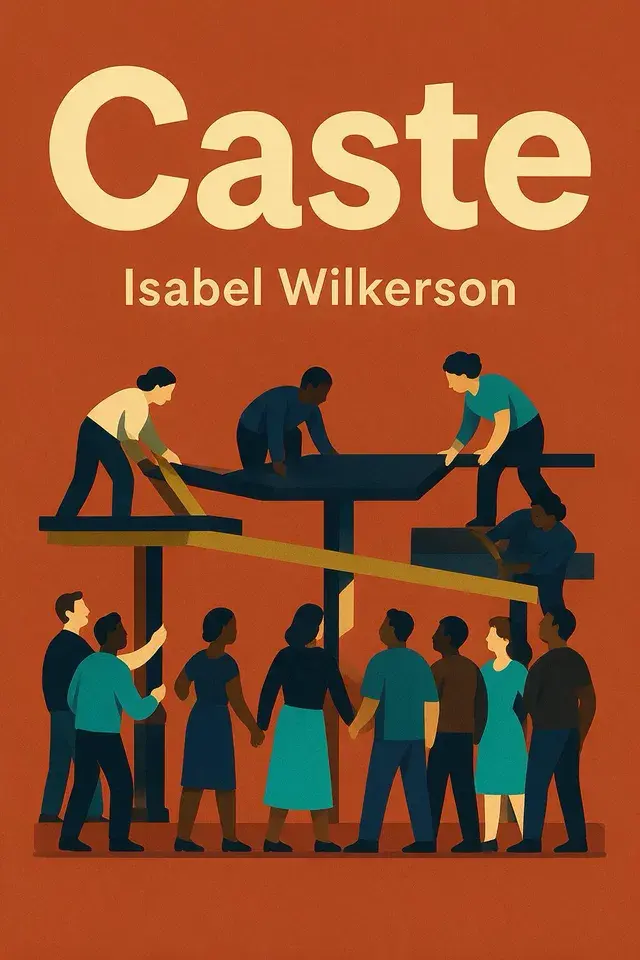
Key ideas from Caste
These ideas compress the book's argument without treating the author's view as settled fact. Use them as an orientation before reading the full work or listening in Wiseley.
Caste is hidden infrastructure: an artificial, inherited ranking that distributes power, safety, authority, resources, competence, and belonging unequally.
American caste emerged incrementally through conquest, labor extraction, colonial law, and the gradual conversion of Africans into a hereditary subordinate category.
Caste endures when sacred or natural explanations make arbitrary rank appear deserved and law converts that belief into enforceable categories.
Status threat makes another group’s advancement feel like demotion, allowing hierarchy to survive through insecurity rather than constant explicit hatred.
Misrecognition and surveillance impose a black tax of lost time, disrupted work, and constant proof of belonging.
Weathering links chronic discrimination and difficult conditions to cellular aging, while health disparities cannot be reduced to race alone.
A world without caste depends on repeated solidarity and institutional change that treats shared vulnerability as a common human responsibility.
How Caste builds its case
Follow how the book develops its argument. Each note is a brief orientation, not a replacement for the chapter.
Seeing the Hidden Structure
Caste is easiest to miss when we look only at the surface. In the United States, race is the visible signal: the shorthand that prompts assumptions about where someone belongs, what work they should do, whether they are believed, and how much safety or authority they deserve.
Building the American Caste Script
Martin Luther King Jr.’s 1959 visit to India gave Wilkerson a doorway into the American caste system. King expected to meet India’s Untouchables as an outsider sympathetic to them.
Law, Faith, and Bloodlines
A caste system becomes durable when a made hierarchy starts to look natural. Wilkerson identifies three supports: a sacred or natural explanation for rank, inheritance through birth, and endogamy, the restriction of marriage and sexual relations within caste lines.
Purity, Citizenship, and the Bottom Rung
Purity is the fourth pillar of caste. It turns rank into a physical code for contact, space, water, ancestry, citizenship, and public belonging.
The Mudsill and the Machinery of Dehumanization
Caste is not sustained by ideas alone. It needs people at the bottom to do work others avoid, and a story that makes their suffering acceptable.
Status Threat, Scapegoats, and Misfit Leaders
At a London conference, Wilkerson and Tushar recognize one another across caste lines. Tushar is assigned an upper warrior-soldier caste, yet works as a geologist.
The Everyday Labor of Belonging
Caste is enforced not only through law or spectacular violence, but through ordinary moments that decide who belongs, who may exercise authority, and whose mistakes are dangerous. For subordinate people, the cost is immediate: attention spent on vigilance, work interrupted to explain or defend their presence, and time lost proving what others may assume.
Talent Lost to the Script
Talent can be wasted even when a person is capable of excellence. Caste controls who may gather knowledge, whose account receives authority, and who gets to compete.
The Psychological World of Caste
One of the book’s most unsettling arguments is that caste can survive inside the mind before it appears as an explicit order. Wilkerson makes this visible through a silent museum film of Hitler’s return to Berlin in nineteen forty, after the fall of Paris.
When the Boundary Enters the Body
On an antebellum Southern steamboat, caste was announced by the dinner bell. White passengers ate first, white crewmen second, and Black crewmen last.
The Politics of Caste Resurgence
By 2016, the hidden hierarchy had become a political force that many observers could feel but not name. At a Washington gathering in late 2015, Isabel Wilkerson told journalist Gwen Ifill that the celebrity billionaire entering the Republican race could win the presidency.
The Price of Caste and the Work of Repair
Once caste is visible, the final question is not only how it harms those placed at the bottom. It is what the hierarchy costs everyone, and what repair demands.