What you'll learn
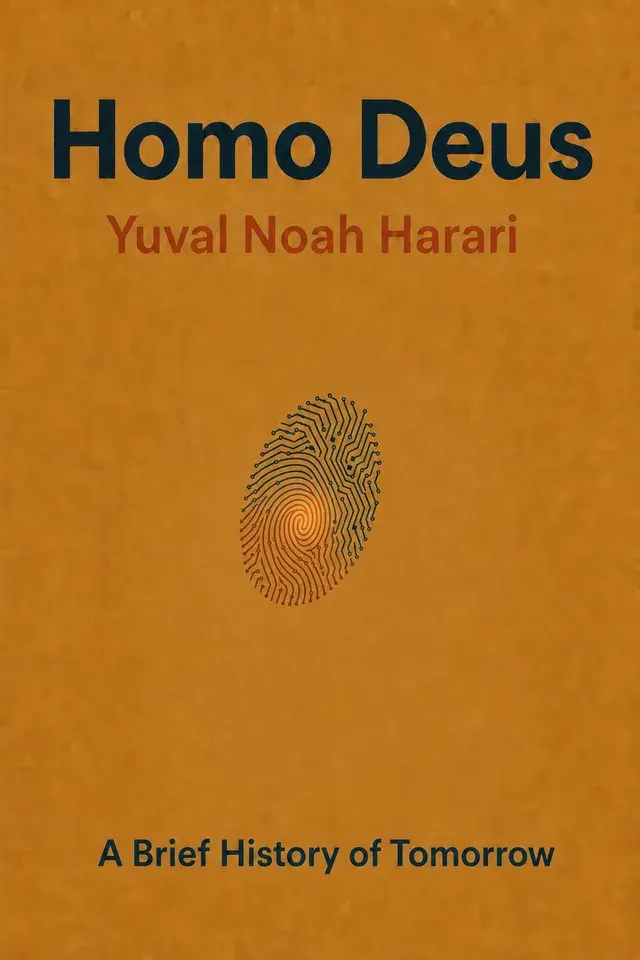
Key ideas from Homo Deus
These ideas compress the book's argument without treating the author's view as settled fact. Use them as an orientation before reading the full work or listening in Wiseley.
Earlier victories redirect the human agenda toward immortality, happiness, and upgrading, while the growth that enabled progress also destabilizes ecological systems.
Imagined orders create intersubjective realities such as money, nations, laws, religions, and corporations, coordinating strangers while remaining dependent on shared belief.
Capitalism makes reinvestment and endless expansion moral imperatives, so growth becomes a quasi-religious answer to social conflict.
Humanism relocates moral, political, and aesthetic authority from God and scripture to human experience, feeling, free choice, and judgment.
Liberalism’s free individual depends on choices being neither predetermined nor random, an assumption life science challenges.
A possible useless class would face not just unemployment, but the loss of economic, political, and artistic usefulness.
Enhancement may turn socioeconomic inequality into biological caste inequality if elites pursue upgraded abilities instead of shared health.
Dataism shifts authority from inner experience to external algorithms, raising unresolved questions about consciousness, human value, and the future.
How Homo Deus builds its case
Follow how the book develops its argument. Each note is a brief orientation, not a replacement for the chapter.
From Survival to Self-Transformation
For most of history, human beings faced three existential threats: famine, plague, and war. These were recurring forces, not exceptional emergencies.
Humanity’s Ecological Empire
The chapter asks whether Sapiens rules the world because it is superior or because it became a successful bully. Ecology offers the first answer.
The Mind Beyond the Soul
Human power and moral worth are not the same thing. Sapiens may dominate the planet, but that does not prove that human lives have greater intrinsic value than animals’ lives.
Stories That Make Strangers Cooperate
The question of human distinctiveness now shifts from what happens inside an individual mind to what millions can accomplish together. Sapiens did not dominate because each person possessed an eternal soul, the largest brain, or the finest tool.
When Science Meets Sacred Order
Modern science can look like the successor to religion. Stories about gods and nations organized projects, but did not control the Nile or cure infection.
The Growth-for-Power Covenant
Modernity can be understood as a covenant: people surrender the promise of a cosmic script in exchange for power. Premodern societies often imagined gods or eternal laws assigning human beings a role.
Humanism and the Inner Authority
Humanism begins with a problem created by modernity. Once people stop treating a cosmic plan as the final source of meaning, life can seem directionless.
The War Inside Humanism
Once humanism moved authority from God and inherited order to human experience, its internal disagreements became political. All three branches accepted that human experience gives meaning.
Free Will in the Laboratory
Liberalism’s package—individualism, human rights, democracy, and the free market—assumes each person is a free chooser. Voters and consumers are expected to make decisions that are neither predetermined nor random.
When Intelligence Leaves Us Behind
Earlier, the book questioned whether free will gives individuals a special status. This chapter follows the practical consequence.
The Datafied Self and Inequality
After examining algorithms that replace tasks, the argument asks what happens when they replace personal authority. Liberalism treats each person as uniquely valuable, free to choose, and best placed to know their desires.
The Ocean of Possible Minds
Techno-humanism begins with the possibility that Homo sapiens has reached the end of its historical role. New religions may come from laboratories and technology companies, promising earthly happiness, peace, prosperity, or eternal life through algorithms and genes.
Dataism and Human Obsolescence
Harari closes the book with a possible new religion: Dataism. It treats the universe as data flows and judges organisms, economies, politics, and history by how they contribute to information processing.